Thank you for visiting SNEWPapers!
Sign up free
Gazette Of The United States And Daily Evening Advertiser
Philadelphia, Philadelphia County, Pennsylvania
What is this article about?
Trial of Rev. Mr. Jackson for high treason in Dublin, April 4, 1794. Witness Mr. Cockayne testified to Jackson's treasonous schemes to invite French invasion via correspondence and envoys like Tone and Reynolds. Intercepted letters corroborated evidence, resulting in guilty verdict after 18-hour trial; jury recommended mercy.
Clipping
OCR Quality
Full Text
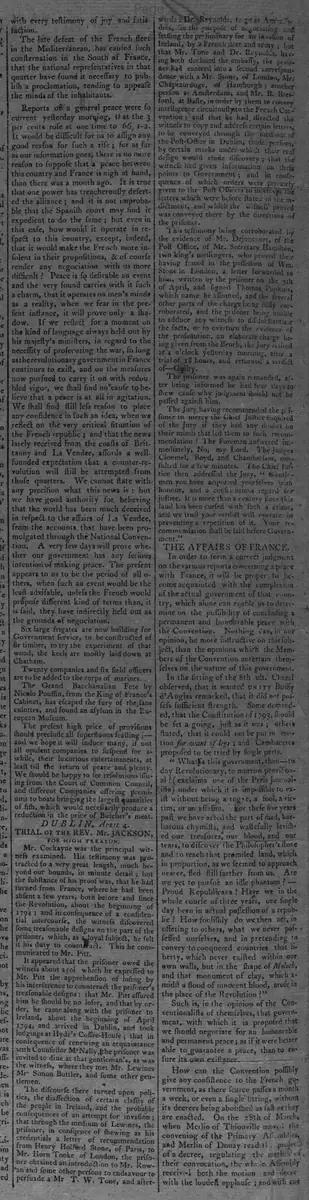
TRIAL OF THE REV. Mr. JACKSON,
FOR HIGH TREASON.
Mr. Cockayne was the principal witness examined. His testimony was protracted to a very great length, much beyond our bounds, in minute detail; but the substance of his proof was, that he had turned from France, where he had been absent a few years, both before and since the Revolution, about the beginning of 1794; and in consequence of a confidential intercourse, the witness discovered some treasonable designs on the part of the prisoner, which, as a loyal subject, he felt it his duty to counteract. This he communicated to Mr. Pitt.
It appeared that the prisoner owed the witness about 250l. which he expressed to Mr. Pitt the apprehension of losing by his interference to counteract the prisoner's treasonable designs: that Mr. Pitt assured him he should be no loser, and that by order, he came along with the prisoner to Ireland, about the beginning of April 1794, and arrived in Dublin, and took lodgings at Hyde's Coffee-House; that in consequence of renewing an acquaintance with Counsellor M'Nally, the prisoner was invited to dine at that gentleman's, as was the witness, where they met Mr. Lewins, Mr. Simon Butler, and some other gentlemen.
The discourse there turned upon politics, the disaffection of certain classes of the people in Ireland, and the probable consequences of an attempt for invasion; that through the medium of Lewins, the prisoner, in consequence of shewing as his credentials a letter of recommendation from Henry Holford Stone, of Paris, to Mr. Horne Tooke of London, the prisoner obtained an introduction to Mr. Rowan and some other persons to endeavour to persuade a Mr T. W. Tone, and afterwards a Dr. Reynolds, to go as Ambassadors, for the purpose of negotiating and settling the preliminary for an invasion of Ireland, by a French fleet and army; but that Mr. Tone and Dr. Reynolds, having both declined the embassy, the prisoner had entered into a second correspondence with a Mr. Stone, of London, Messrs Chapeaurouge, of Hamburgh; another person at Amsterdam, and Mr. B. Bresford, at Basle, in order by them to convey intelligence circuitously to the French Convention; and that he had directed the witness to copy and address certain letters, to be conveyed through the medium of the Post-Office in Dublin, those persons by certain marks under which their real design would elude discovery; that the witness had given information on these points to Government; and in consequence of which orders, were privately given to the Post Officers to intercept the letters which were before stated in the indictment, and which the witness proved was conveyed there by the directions of the prisoner.
This testimony being corroborated by the evidence of Mr. Dejoncourt, of the Post Office, of Mr. Secretary Hamilton, two king's messengers, who proved their having found in the possession of Wm. Stone in London, a letter forwarded to him, written by the prisoner on the 5th of April, and Signed Thomas Popkins, which name he assumed, and the several other parts of the charge being fully corroborated, and the prisoner being unable to adduce any witness to disprove or substantiate the facts, or to overturn the evidence of the prosecution, an elaborate charge being given from the Bench, the Jury retired at 4 o'clock yesterday morning, after a trial of 18 hours, and returned a verdict of Guilty.
The prisoner was again remanded, after being informed he had four days to shew cause why judgment should not be passed against him.
The Jury having recommended the prisoner to mercy the Chief Justice enquired of the Jury if they had any doubts on their minds that led them to such recommendation? The Foreman answered immediately, No, my Lord. The Judges Clonmel, Boyd, and Chamberlain, consulted for a few minutes. The Chief Justice then addressed the Jury, "Gentlemen you have acquitted yourselves with honour, and a conscientious regard for justice. It is more than a century since this land has been cursed with such a crime, and we trust your verdict will operate in preventing a repetition of it. Your recommendation shall be laid before Government."
What sub-type of article is it?
What themes does it cover?
What keywords are associated?
What entities or persons were involved?
Where did it happen?
Story Details
Key Persons
Location
Dublin, Ireland
Event Date
April 4, 1794
Story Details
Mr. Cockayne testified that Rev. Mr. Jackson plotted a French invasion of Ireland, attempting to recruit Tone and Reynolds as envoys and sending coded letters via intermediaries; letters intercepted on government orders, evidence corroborated, leading to guilty verdict after 18-hour trial with mercy recommendation.