Thank you for visiting SNEWPapers!
Sign up free
Editorial
March 23, 1803
The Recorder
Richmond, Virginia
What is this article about?
A Federalist editorial criticizes Congress's resolution supporting Albert Gallatin's sale of U.S. bank stock, claiming it was unauthorized, sold at a $120,000 loss, and hastily approved amid partisan delusion, questioning the fiscal wisdom and Gallatin's rapid report on the sinking fund.
Merged-components note: Continuation of the same editorial piece on Mr. Gallatin and bank stock across pages 1 and 2.
Clippings
1 of 2
OCR Quality
92%
Excellent
Full Text
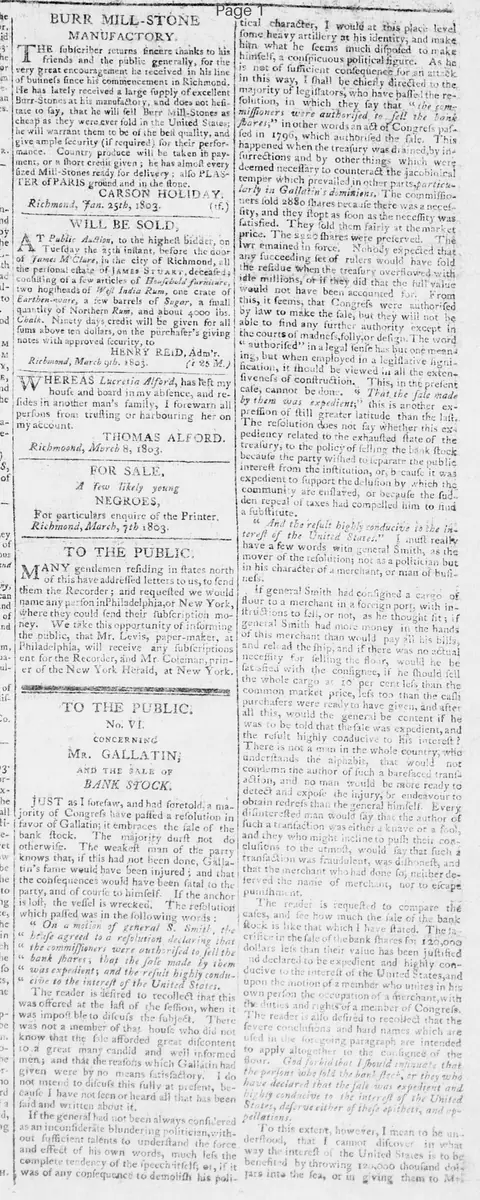
TO THE PUBLIC:
No. VI.
CONCERNING
MR. GALLATIN;
AND THE SALE OF
BANK STOCK.
JUST as I foresaw, and had foretold, a majority of Congress have passed a resolution in favor of Gallatin; it embraces the sale of the bank stock. The majority durst not do otherwise. The weakest man of the party knows that, if this had not been done, Gallatin's fame would have been injured; and that the consequences would have been fatal to the party, and of course to himself. If the anchor is lost, the vessel is wrecked. The resolution which passed was in the following words:
"On a motion of general S. Smith. the house agreed to a resolution declaring that
"the commissioners were authorised to sell the
"bank shares; that the sale made by them
"was expedient; and the result highly condu-
"cive to the interest of the United States."
The reader is desired to recollect that this was offered at the last of the session, when it was impossible to discuss the subject. There was not a member of that house who did not know that the sale afforded great discontent to a great many candid and well informed men; and that the reasons which Gallatin had given were by no means satisfactory. I do not intend to discuss this fully at present, because I have not seen or heard all that has been said and written about it.
If the general had not been always considered as an inconsiderate blundering politician, without sufficient talents to understand the force and effect of his own words, much less the complete tendency of the speech itself, or, if it was of any consequence to demolish his political character, I would at this place level some heavy artillery at his identity, and make him what he seems much disposed to make himself. a conspicuous political figure. As he is not of sufficient consequence for an attack in this way, I shall be chiefly directed to the majority of legislators. who have passed the resolution, in which they say that " the com-missioners were authorised to. sell the bank shares;" in other words an Act of Congress pas-sed in 1796, which authorised the sale. This happened when the treasury was drained, by in-surrections and by other things which were deemed necessary to counteract the jacobinical temper which prevailed in other parts, particularly in Gallatin's dominions. The commiio-ners sold 2880 shares because there was a neces-sity, and they stopt as soon as the necessity was satisfied. They sold them fairly at the market price. The 3920 shares were preserved. The law remained in force. Nobody expected that. any succeeding set. of rulers would have sold the residue when the treasury overflowed with idle millions, or if they did that the full value would not have been accounted for. From this, it seems, that Congress were authorised by law to make the sale, but they will not be able to find any further authority except in the courts of madness, folly, or design. The ward "authorised" in a legal sense has but one mean-ing, but when employed in a legislative signi-fication, it should be viewed in all the exten-siveness of construction. This, in the present case, cannot be done. That the sale made by them was expedient;" this is another ex-pression of still greater latitude than the last. The resolution does not say whether this ex-pediency related to the exhausted state of the treasury, to the policy of selling the bank stock because the party wished to separate the public interest from the institution, or, because it was expedient to support the delusion by which the community are enslaved, or because the sud-den repeal of taxes had compelled him to find a substitute.
"And the result highly conducive to the in-terest of the United States." I must really have a few words with general Smith, as the mover of the resolution: not as a politician but in his character of a merchant. or man of busi-ness.
If general Smith had consigned a cargo of flour to a merchant in a foreign port, with in-structions to sell, or not, as he thought fit; if general Smith had more money in the hands of this merchant than would pay all his bills, and retained the ship, and if there was no actual necessity for selling the flour. would he be satisfied with the consignee, if he should sell the whole cargo at 10 per cent less than the common market price, less too than the cash purchasers were ready to have given, and after all this, would the general be content if he was to be told that the sale was expedient, and the result highly conducive to his interest?
There is not a man in the whole country, who understands the alphabet, that would not condemn the author of such a barefaced trans-action, and no man would be more ready to detect and expose the injury, or endeavour to obtain redress than the general himself. Every disinterested man would say that the author of such a transaction was either a knave or a fool, and they who might incline to push their con-clusions to the utmost, would say that such a transaction was fraudulent, was dishonest, and that the merchant who had done so, neither de-served the name of merchant, nor to escape punishment.
The reader is requested to compare the cases, and see how much the sale of the bank stock is like that which I have stated. The sa-crific in the sale of the bank shares for 120,000 dollars less than their value has been justified and declared to be expedient and highly con-ducive to the interest of the United States, and upon the motion of a member who unites in his own person the occupation of a merchant, with the duties and rights of a member of Congress.
The reader is also desired to recollect that the severe conclusions and hard names which are used in the foregoing paragraph are intended to apply altogether to the consignee of the flour. God forbid that I should insinuate that the persons who sold the bank stock, or they who have declared that the sale was expedient and highly conducive to the interest of the United States, deserve either of these epithets, and ap-pellations.
To this extent, however, I mean to be un-derstood, that I cannot discover in what way the interest of the United States is to be benefit-ed by throwing 120,000 thousand doi-lars into the sea, or in giving them to M.
Faring in a contract, which, as respects the United States, comes to the same thing:
If this subject shall not be explained much better to my satisfaction than it has been yet; if the resolution has not more to support it than the vote of a majority given upon the last day of a session, when they were thinking of something else: I shall take the liberty of saying, in the very plainest words, that it involves the condemnation and reprobation of all the world.
It will be time enough after the wise ones on both sides have exhausted their accusations and excuses: it will then be time enough to give their aid to the illustration of truth which the public ought to have, and which, in these investigations, has been my constant design, and shall continue to be my polar star.
It appears, also, by the public prints, that Mr. Griswold, late in the session, offered a resolution for enquiring into the management of the sinking fund. This resolution was submitted to a committee, and the newspapers say that Mr. Gallatin used such talents, such industry, such promptitude, that he was ready in nine hours with thirty two pages of folio, all prepared, stated, and reported, and that Congress, in another hour, were ready to pass a vote of approbation, nay more, that in it was their confidence in the secretary, or their own revelation or intuition upon the subject, that they approved of the whole in this single hour.
Now, I beg leave to declare, in the most explicit manner, that Mr. Gallatin did not, and could not make up the report which is alluded to, in double, triple, or quadruple the time.
There is not a writer in any of the public offices, who does not find from 12 to 15 pages of common paper a good day's work. Thirty two pages of folio, are equal to forty-eight of common paper, which is good work for a good writer in four days. The necessary calculations, and examinations will take as much more time. Without saying any thing concerning the merit of the performance, I expect it cost from 8 to 10 days: Let the newspapers say what they will to the contrary, no reasonable man will believe them. So far as respects the secretary of the treasury I shall at this place say no more. A plump denial of the possibility, the reason for which every body at once perceives, requires no other proof or argument. But as respects the gentlemen who passed the resolution of applause, I shall take the liberty to say a little more.
The public have been already told that the democratic party have selected Gallatin as their Messiah, that they are governed by a blind and fatal faith which hurries them into difficulties and perplexities, which forethought to expose, reason is sure to condemn, and which justice ought to punish. What, let me ask, but a delusion of this sort, could induce a majority of Congress to declare that a sale of the bank stock, for one hundred and twenty thousand dollars less than the cash value in the market, was authorized, was expedient, and was conducive to the interest of the United States.
What, but this delusion, could induce them to say, that Gallatin deserved applause for executing a task in nine hours, which, if done well, would have employed as many days? If a slight-of-hand-man tell you, that he will swallow a razor, and delude you by his address, it will please, but cannot convince. So the majority may please, dazzle and delude the people by such a resolution, but they never can convince those who are writers and calculators, who will condescend to exercise any talent and reason on the subject, and who will open their eyes and ears to look, and to listen.
FEDERALIST.
To be continued.
No. VI.
CONCERNING
MR. GALLATIN;
AND THE SALE OF
BANK STOCK.
JUST as I foresaw, and had foretold, a majority of Congress have passed a resolution in favor of Gallatin; it embraces the sale of the bank stock. The majority durst not do otherwise. The weakest man of the party knows that, if this had not been done, Gallatin's fame would have been injured; and that the consequences would have been fatal to the party, and of course to himself. If the anchor is lost, the vessel is wrecked. The resolution which passed was in the following words:
"On a motion of general S. Smith. the house agreed to a resolution declaring that
"the commissioners were authorised to sell the
"bank shares; that the sale made by them
"was expedient; and the result highly condu-
"cive to the interest of the United States."
The reader is desired to recollect that this was offered at the last of the session, when it was impossible to discuss the subject. There was not a member of that house who did not know that the sale afforded great discontent to a great many candid and well informed men; and that the reasons which Gallatin had given were by no means satisfactory. I do not intend to discuss this fully at present, because I have not seen or heard all that has been said and written about it.
If the general had not been always considered as an inconsiderate blundering politician, without sufficient talents to understand the force and effect of his own words, much less the complete tendency of the speech itself, or, if it was of any consequence to demolish his political character, I would at this place level some heavy artillery at his identity, and make him what he seems much disposed to make himself. a conspicuous political figure. As he is not of sufficient consequence for an attack in this way, I shall be chiefly directed to the majority of legislators. who have passed the resolution, in which they say that " the com-missioners were authorised to. sell the bank shares;" in other words an Act of Congress pas-sed in 1796, which authorised the sale. This happened when the treasury was drained, by in-surrections and by other things which were deemed necessary to counteract the jacobinical temper which prevailed in other parts, particularly in Gallatin's dominions. The commiio-ners sold 2880 shares because there was a neces-sity, and they stopt as soon as the necessity was satisfied. They sold them fairly at the market price. The 3920 shares were preserved. The law remained in force. Nobody expected that. any succeeding set. of rulers would have sold the residue when the treasury overflowed with idle millions, or if they did that the full value would not have been accounted for. From this, it seems, that Congress were authorised by law to make the sale, but they will not be able to find any further authority except in the courts of madness, folly, or design. The ward "authorised" in a legal sense has but one mean-ing, but when employed in a legislative signi-fication, it should be viewed in all the exten-siveness of construction. This, in the present case, cannot be done. That the sale made by them was expedient;" this is another ex-pression of still greater latitude than the last. The resolution does not say whether this ex-pediency related to the exhausted state of the treasury, to the policy of selling the bank stock because the party wished to separate the public interest from the institution, or, because it was expedient to support the delusion by which the community are enslaved, or because the sud-den repeal of taxes had compelled him to find a substitute.
"And the result highly conducive to the in-terest of the United States." I must really have a few words with general Smith, as the mover of the resolution: not as a politician but in his character of a merchant. or man of busi-ness.
If general Smith had consigned a cargo of flour to a merchant in a foreign port, with in-structions to sell, or not, as he thought fit; if general Smith had more money in the hands of this merchant than would pay all his bills, and retained the ship, and if there was no actual necessity for selling the flour. would he be satisfied with the consignee, if he should sell the whole cargo at 10 per cent less than the common market price, less too than the cash purchasers were ready to have given, and after all this, would the general be content if he was to be told that the sale was expedient, and the result highly conducive to his interest?
There is not a man in the whole country, who understands the alphabet, that would not condemn the author of such a barefaced trans-action, and no man would be more ready to detect and expose the injury, or endeavour to obtain redress than the general himself. Every disinterested man would say that the author of such a transaction was either a knave or a fool, and they who might incline to push their con-clusions to the utmost, would say that such a transaction was fraudulent, was dishonest, and that the merchant who had done so, neither de-served the name of merchant, nor to escape punishment.
The reader is requested to compare the cases, and see how much the sale of the bank stock is like that which I have stated. The sa-crific in the sale of the bank shares for 120,000 dollars less than their value has been justified and declared to be expedient and highly con-ducive to the interest of the United States, and upon the motion of a member who unites in his own person the occupation of a merchant, with the duties and rights of a member of Congress.
The reader is also desired to recollect that the severe conclusions and hard names which are used in the foregoing paragraph are intended to apply altogether to the consignee of the flour. God forbid that I should insinuate that the persons who sold the bank stock, or they who have declared that the sale was expedient and highly conducive to the interest of the United States, deserve either of these epithets, and ap-pellations.
To this extent, however, I mean to be un-derstood, that I cannot discover in what way the interest of the United States is to be benefit-ed by throwing 120,000 thousand doi-lars into the sea, or in giving them to M.
Faring in a contract, which, as respects the United States, comes to the same thing:
If this subject shall not be explained much better to my satisfaction than it has been yet; if the resolution has not more to support it than the vote of a majority given upon the last day of a session, when they were thinking of something else: I shall take the liberty of saying, in the very plainest words, that it involves the condemnation and reprobation of all the world.
It will be time enough after the wise ones on both sides have exhausted their accusations and excuses: it will then be time enough to give their aid to the illustration of truth which the public ought to have, and which, in these investigations, has been my constant design, and shall continue to be my polar star.
It appears, also, by the public prints, that Mr. Griswold, late in the session, offered a resolution for enquiring into the management of the sinking fund. This resolution was submitted to a committee, and the newspapers say that Mr. Gallatin used such talents, such industry, such promptitude, that he was ready in nine hours with thirty two pages of folio, all prepared, stated, and reported, and that Congress, in another hour, were ready to pass a vote of approbation, nay more, that in it was their confidence in the secretary, or their own revelation or intuition upon the subject, that they approved of the whole in this single hour.
Now, I beg leave to declare, in the most explicit manner, that Mr. Gallatin did not, and could not make up the report which is alluded to, in double, triple, or quadruple the time.
There is not a writer in any of the public offices, who does not find from 12 to 15 pages of common paper a good day's work. Thirty two pages of folio, are equal to forty-eight of common paper, which is good work for a good writer in four days. The necessary calculations, and examinations will take as much more time. Without saying any thing concerning the merit of the performance, I expect it cost from 8 to 10 days: Let the newspapers say what they will to the contrary, no reasonable man will believe them. So far as respects the secretary of the treasury I shall at this place say no more. A plump denial of the possibility, the reason for which every body at once perceives, requires no other proof or argument. But as respects the gentlemen who passed the resolution of applause, I shall take the liberty to say a little more.
The public have been already told that the democratic party have selected Gallatin as their Messiah, that they are governed by a blind and fatal faith which hurries them into difficulties and perplexities, which forethought to expose, reason is sure to condemn, and which justice ought to punish. What, let me ask, but a delusion of this sort, could induce a majority of Congress to declare that a sale of the bank stock, for one hundred and twenty thousand dollars less than the cash value in the market, was authorized, was expedient, and was conducive to the interest of the United States.
What, but this delusion, could induce them to say, that Gallatin deserved applause for executing a task in nine hours, which, if done well, would have employed as many days? If a slight-of-hand-man tell you, that he will swallow a razor, and delude you by his address, it will please, but cannot convince. So the majority may please, dazzle and delude the people by such a resolution, but they never can convince those who are writers and calculators, who will condescend to exercise any talent and reason on the subject, and who will open their eyes and ears to look, and to listen.
FEDERALIST.
To be continued.
What sub-type of article is it?
Economic Policy
Partisan Politics
What keywords are associated?
Bank Stock Sale
Gallatin Criticism
Congress Resolution
Fiscal Loss
Democratic Delusion
Sinking Fund Report
What entities or persons were involved?
Mr. Gallatin
General S. Smith
Congress
Democratic Party
Mr. Griswold
Editorial Details
Primary Topic
Criticism Of Gallatin's Sale Of Bank Stock And Congress's Supportive Resolution
Stance / Tone
Strongly Critical And Accusatory Towards Gallatin And Democratic Majority
Key Figures
Mr. Gallatin
General S. Smith
Congress
Democratic Party
Mr. Griswold
Key Arguments
Congress's Resolution Authorizing And Approving The Bank Stock Sale Was Passed Hastily Without Discussion
The 1796 Act Authorized Initial Sales Due To Necessity, But Not The Later Sale When Treasury Was Full
Sale Resulted In $120,000 Loss Below Market Value, Akin To Fraudulent Merchant Transaction
Gallatin's Report On Sinking Fund Could Not Have Been Prepared In Nine Hours, Indicating Delusion
Democratic Party Exhibits Blind Faith In Gallatin, Leading To Irrational Approvals