Thank you for visiting SNEWPapers!
Sign up free
Clarksville Weekly Chronicle
Clarksville, Montgomery County, Tennessee
What is this article about?
In 1880, a Berlin correspondent critiques Germany's shift to protective tariffs under Bismarck, passed in July 1879. The policy aimed to aid iron and cotton industries amid crisis but has raised prices for laborers without improving wages or employment, increased government deficits, and failed to reduce taxes, exacerbating economic stagnation.
Merged-components note: The table of items and prices (e.g., 'Rye 2,000 82 16') is the computation of taxes on laborers referenced directly in the foreign news story text.
Clipping
OCR Quality
Full Text
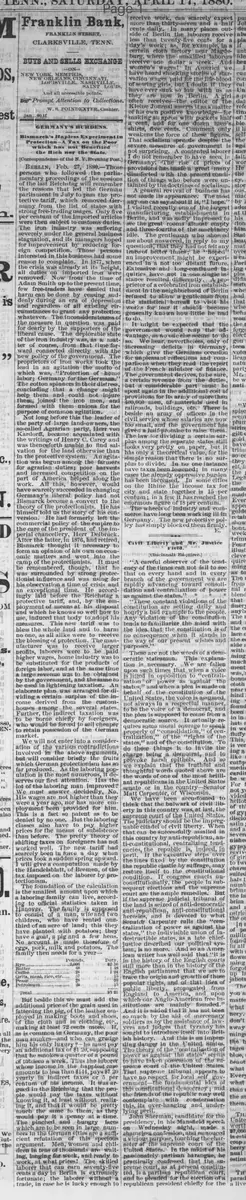
Bismarck's Hapless Experiment in Protection-A Tax on the Poor which has not Benefited the Rich nor the State.
[Correspondence of the N. Y. Evening Post.]
BERLIN, Feb. 27, 1880. Those persons who followed the parliamentary proceedings of the sessions of the last Reichstag will remember the reasons that led the German parliament in July to pass the protective tariff, which removed Germany from the list of states with strong free-trading usages. Only five per centum of the imported articles were then subject to customs duties. The iron industry was suffering severely under the general business stagnation, and its managers hoped for improvement by reducing foreign competition. Those persons interested in this business had some reason to complain. In 1877, when the crisis was already at its height, all duties on imported iron were removed. Now from the time of Adam Smith up to the present time, few free-traders have denied that harm can be done by ceasing suddenly during an era of depression and regardless of all existing circumstances to grant any protection whatever. The inconsiderateness of the measure in question was paid for dearly by the supporters of the liberal cause. The deplorable state of the iron industry was, as a matter of course, from that time forward connected directly with the new policy of the government. The proprietors of iron works took the lead in an agitation the motto of which was, "Protection of home labor; Germany for the Germans." The cotton spinners in their distress, concluding that a change might help them and could not injure them, joined the iron men, and formed with them unions for the purpose of common agitation. Not long before this the leader of the party of large land-owners, the so-called Agrarian party, Herr von Kardorff, became acquainted with the writings of Henry C. Carey and was thenceforth unable to find salvation for the land otherwise than in the protective system. An agitation was begun among the farmers for agrarian duties; poor harvests and increased competition on the part of America helped along the work. All this, however, would have scarcely succeeded in changing Germany's liberal policy had not Bismarck become a convert to the theory of the protectionists. He has himself told us the story of his conversion. He had formerly left the commercial policy of the empire to the care of the president of the imperial chancellery, Herr Delbruck. After the latter, in 1876, had retired, Bismarck thought it necessary to form an opinion of his own on economic matters and went into the camp of the protectionists. It must be remembered, though, that he was surrounded by strong protectionist influence and was using for his observation a time of crisis and an exceptional time. He accordingly laid before the Reichstag a protective tariff, and, by the employment of means at his disposal and which he knows so well how to use, induced that body to adopt his measures. This new tariff was to bless the whole land and to harm no one, as all alike were to receive the blessing of protection. The manufacturer was to receive larger profits, laborers were to be paid higher wages, home industry was to be substituted for the products of foreign labor, and at the same time a large revenue was to be obtained by the government, and the same to be used in lightening taxation. An elaborate plan was arranged for dividing a certain surplus of the income derived from the custom-houses among the several states. Further, the indirect taxation was to be borne chiefly by foreigners, who would be forced to sell cheaper to retain possession of the German market. We will not enter into a consideration of the various contradictions involved in the above arguments, but will consider briefly the fruits which German protectionism has so far produced. As the laboring population is the most numerous, it deserves our first attention. Has the lot of the laboring man improved? We must answer decidedly, No. His wages are not higher than they were a year ago, nor has more employment been provided for him. This is a fact so patent as to be denied by no one. But the laboring classes also have to pay higher prices for the means of subsistence than before. The pretty theory of shifting taxes on foreigners has not worked well. The new tariff had scarcely been in force a day when prices took a sudden spring upward. I will give a computation made by the Handelsblatt, of Bremen, of the tax imposed on the laborer by protectionism. The foundation of the calculation is the smallest amount upon which a laboring family can live, according to official statistics taken in Hanover. The family is supposed to consist of a man, wife and two children, who have rented one-third of an acre of land; this they have planted with potatoes; they have a goat, a pig and a few hens. No account is taken therefore of eggs, pork, milk and potatoes. The family then needs for a year— But beside this we must add the additional price of the grain used in fattening the pig, of the leather employed in making boots and shoes, of the cloth and in clothing, etc., making at least 72 cents more. If, as is common in Germany, the poor man smokes—and who can grudge him his only luxury?—he must pay an additional tax of $1 20, supposing that he smokes a quarter of a pound of tobacco a week. Thus the laborer whose income in the happiest case amounts to less than $144, pays $7 20 yearly in indirect taxes or 5 per centum of his income. It was argued in the Reichstag that the people would pay the taxes without knowing it, at least without realizing it, and that it would be pretty much the same to them, as they would pay it a penny at a time. The pinched and hungry faces which are to be seen in large numbers in the German cities are a sufficient refutation of this specious argument. Men, women and children in tens of thousands are waiting, longing for work, and ready to work, at what prices! The skilled laborer that can earn seventy-five cents a day in Berlin is extremely fortunate; the laborer without a trade, in case he is lucky enough to receive work, can scarcely expect more than thirty-seven and a half cents daily. In many places outside of Berlin the laborers receive less than twenty-five cents for a day's work; as, for example, in a certain cloth factory near Magdeburg, where the unskilled laborers receive one dollar a week. And women's wages! In America we have heard shocking stories of starvation wages paid for the life-blood of sewing girls, but I doubt if they have ever sunk so low with us as they are now in Berlin. A girl often receives—the editor of the Kleine Journal asserts it as a matter of his own positive knowledge—for making an apron with pockets half a cent, and for one dozen men's shirts, five cents. Comment only weakens the force of these figures. That socialism spreads despite the severe measures of government is not surprising. A contented laborer I do not remember to have seen in Germany! The "rise" of prices of provisions has made a great many disaffected with the present condition of things who before were untainted by the doctrines of socialism. A general revival of business has not made its appearance. The most anyone can say about it is, "I hope." I visited recently one of the largest manufacturing establishments in Berlin, and was sadly impressed to see the great rooms almost empty and three-fourths of the machinery idle. The gentleman who showed me about answered, in reply to my questions, that they had not felt any trace of better times. He "hoped" an improvement might be experienced in a not too distant future. Extensive and long-continued inquiries have not in one single instance resulted differently. A proprietor of a celebrated iron establishment in the neighborhood of Berlin refused to allow a gentleman from the statistical bureau to visit his works for fear it should become generally known how little he had to do. It might be expected that the government would "reap the advantage, as no one else seems to do so. We hear, nevertheless, only of increasing deficits in Germany, which give the Germans occasion for unpleasant reflections and comparisons when they read the report of the French minister of finance. The government derives, to be sure, a certain revenue from the duties, but a considerable part must be spent again in the additional cost of provisions for its army of more than 400,000 men, of materials used in railroads, buildings, etc. There is beside an army of officers in the civil service whose salaries are now too small, and the government has given a half-promise to raise them. The law for dividing a certain surplus among the separate states still looks very pretty on paper, but it has only a theoretical value, for the simple reason that there is no surplus to divide. In no one instance have taxes been lessened; in many cases the already oppressive burden has been increased. In some cities on the Rhine the income tax for city and state together is 15 per centum; in a few it has reached the enormous figure of 18 per centum. The wheels of industry and commerce have long been working ill in Germany. The new protective policy has simply blocked them firmly.
E.
| Rye | 2,000 | 82 16 |
| Butter | 68 | 1 48 |
| Coffee | 28 | 1 24 |
| Grits, meal, rice, etc. | 57 | 15 |
| Pense | 28 | 63 |
| Petroleum | 39 | 15 |
| Total | 85 21 |
What sub-type of article is it?
What keywords are associated?
What entities or persons were involved?
Where did it happen?
Foreign News Details
Primary Location
Germany
Event Date
Feb. 27, 1880
Key Persons
Outcome
no improvement in wages or employment for laborers; higher prices for subsistence; government deficits increasing; taxes not lessened and in some cases increased to 18%; economic stagnation persists.
Event Details
Germany adopted a protective tariff in July 1879 under Bismarck's influence, shifting from free trade to protectionism to aid iron, cotton, and agrarian sectors amid crisis. Promised benefits like higher profits, wages, and revenue failed; instead, prices rose immediately, burdening laborers with 5% indirect taxes on income, low wages (e.g., 37.5 cents/day unskilled in Berlin), and idle factories. Socialism spreads due to discontent.