Thank you for visiting SNEWPapers!
Sign up free
Miami Labor Citizen
Miami, Dade County, Florida
What is this article about?
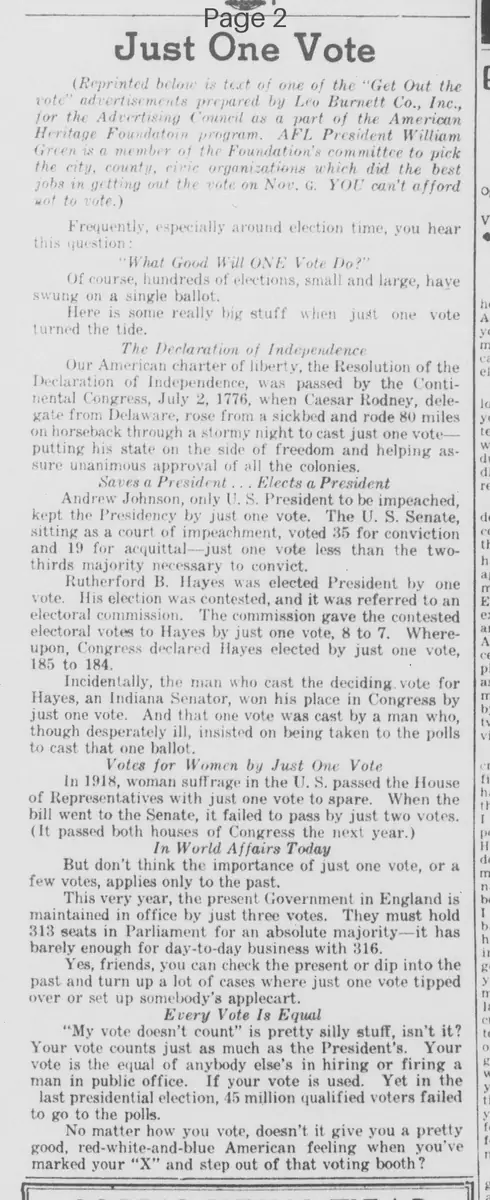
Advertisement promoting voting by citing historical U.S. examples where one vote influenced key events: Declaration of Independence (Caesar Rodney, 1776), Andrew Johnson's impeachment acquittal, Rutherford B. Hayes' election (1876), and women's suffrage (1918). Notes current English government's slim majority and 45 million U.S. non-voters in last election.
Clipping
OCR Quality
Full Text
(Reprinted below is text of one of the "Get Out the
Vote" advertisements prepared by Leo Burnett Co., Inc.
for the Advertising Council as a part of the American
Heritage Foundation program. AFL President William
Green is a member of the Foundation's committee to pick
the city, county, civic organizations which did the best
jobs in getting out the vote on Nov. 7. YOU can't afford
not to vote.)
Frequently, especially around election time, you hear
this question:
"What Good Will ONE Vote Do?"
Of course, hundreds of elections, small and large, have
swung on a single ballot.
Here is some really big stuff when just one vote
turned the tide.
The Declaration of Independence
Our American charter of liberty, the Resolution of the
Declaration of Independence, was passed by the Continen-
tal Congress, July 2, 1776, when Caesar Rodney, dele-
gate from Delaware, rose from a sickbed and rode 80 miles
on horseback through a stormy night to cast just one vote-
putting his state on the side of freedom and helping as-
sure unanimous approval of all the colonies.
Saves a President ... Elects a President
Andrew Johnson, only U. S. President to be impeached,
kept the Presidency by just one vote. The U. S. Senate,
sitting as a court of impeachment, voted 35 for conviction
and 19 for acquittal-just one vote less than the two-
thirds majority necessary to convict.
Rutherford B. Hayes was elected President by one
vote. His election was contested, and it was referred to an
electoral commission. The commission gave the contested
electoral votes to Hayes by just one vote, 8 to 7. Where-
upon, Congress declared Hayes elected by just one vote,
185 to 184.
Incidentally, the man who cast the deciding vote for
Hayes, an Indiana Senator, won his place in Congress by
just one vote. And that one vote was cast by a man who,
though desperately ill, insisted on being taken to the polls
to cast that one ballot.
Votes for Women by Just One Vote
In 1918, woman suffrage in the U. S. passed the House
of Representatives with just one vote to spare. When the
bill went to the Senate, it failed to pass by just two votes.
(It passed both houses of Congress the next year.)
In World Affairs Today
But don't think the importance of just one vote, or a
few votes, applies only to the past.
This very year, the present Government in England is
maintained in office by just three votes. They must hold
313 seats in Parliament for an absolute majority-it has
barely enough for day-to-day business with 316.
Yes, friends, you can check the present or dip into the
past and turn up a lot of cases where just one vote tipped
over or set up somebody's applecart.
Every Vote Is Equal
"My vote doesn't count" is pretty silly stuff, isn't it?
Your vote counts just as much as the President's. Your
vote is the equal of anybody else's in hiring or firing a
man in public office. If your vote is used. Yet in the
last presidential election, 45 million qualified voters failed
to go to the polls.
No matter how you vote, doesn't it give you a pretty
good, red-white-and-blue American feeling when you've
marked your "X" and step out of that voting booth?
What sub-type of article is it?
What themes does it cover?
What keywords are associated?
What entities or persons were involved?
Where did it happen?
Story Details
Key Persons
Location
United States, England
Event Date
July 2, 1776; 1868; 1876; 1918; 1944
Story Details
Advertisement illustrates the impact of single votes in historical U.S. events including the Declaration of Independence, Andrew Johnson's impeachment, Rutherford B. Hayes' election, and women's suffrage passage, plus a slim majority in contemporary English government, to encourage voter participation.