Thank you for visiting SNEWPapers!
Sign up free
Alexandria Daily Gazette, Commercial & Political
Alexandria, Virginia
What is this article about?
In 1812, E. Watson promotes Siberian Naked Wheat for cold northern U.S. regions, citing its hardiness, high yields, and quality from Varlo's 1795 account. Samples available via agricultural society members in Berkshire, MA.
Clipping
OCR Quality
Full Text
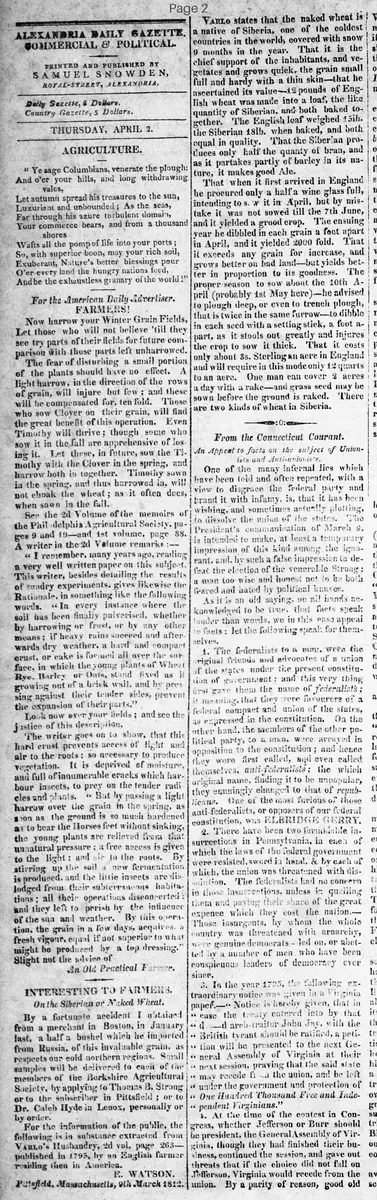
On the Siberian or Naked Wheat.
By a fortunate accident I obtained
from a merchant in Boston, in January
last, a half a bushel which he imported
from Russia, of this invaluable grain, as
respects our cold northern regions. Small
samples will be delivered to each of the
members of the Berkshire Agricultural
Society, by applying to Thomas B. Strong
or to the subscriber in Pittsfield; or to
Dr. Caleb Hyde in Lenox, personally or
by order.
For the information of the public, the
following is in substance extracted from
Varlo's Husbandry, 2d vol. page 263--
published in 1795, by an English farmer
residing then in America.
E. WATSON.
Pittsfield, Massachusetts, 9th March 1812.
Varlo states that the naked wheat is
a native of Siberia, one of the coldest
countries in the world covered with snow
9 months in the year, That it is the
chief support of the inhabitants, and ve-
getates and grows quick, the grain small
full and hardy with a thin skin--that he
ascertained its value--15 pounds of Eng-
lish wheat was made into a loaf. the like
quantity of Siberian, and both baked to-
gether. The English loaf weighed 15lb.
the Siberian 18lb. when baked, and both
equal in quality. That the Siberian pro-
duces only half the quantity of bran, and
as it partakes partly of barley in its na-
ture, it makes good Ale.
That when it first arrived in England
he procured only a half a wine glass full,
intending to sow it in April, but by mis-
take it was not sowed till the 7th June,
and it yielded a good crop. The ensuing
year he dibbled in each grain a foot apart
in April, and it yielded 2000 fold. That
it exceeds any grain for increase, and
grows better on bad land-but yields bet-
ter in proportion to its goodness. The
proper season to sow about the 10th A-
pril (probably 1st May here)-he advised
to plough deep, or even to trench plough,
that is twice in the same furrow--to dibble
in each seed with a setting stick, a foot a-
part, as it stools out greatly and injures
the crop to sow it thick. That it costs
only about 3s. Sterling an acre in England
and will require in this mode only 12 quarts
to an acre. One man can cover 2 acres
a day with a rake--and grass seed may be
sown before the ground is raked. There
are two kinds of wheat in Siberia.
What sub-type of article is it?
What themes does it cover?
What keywords are associated?
What entities or persons were involved?
Where did it happen?
Story Details
Key Persons
Location
Pittsfield, Massachusetts; Siberia; Boston; Berkshire
Event Date
9th March 1812
Story Details
E. Watson shares information on Siberian or Naked Wheat, obtained from Russia, suitable for cold regions. Excerpt from Varlo's Husbandry describes its origins, hardiness, superior baking qualities, low bran, ale-making potential, and high yields even when sown late or on poor land. Provides cultivation advice including sowing in April/May, deep plowing, dibbling seeds a foot apart, and low seed requirement.