Thank you for visiting SNEWPapers!
Sign up free
Story
January 12, 1949
Laurel Outlook
Laurel, Yellowstone County, Montana
What is this article about?
Cereal makers offer premiums like atomic bomb rings and jet models to boost child consumption and sales, estimated at $175 million annually. Premiums have evolved over 25 years, reflecting modern interests, with roots in ancient history like Pompeii medals.
Clipping
OCR Quality
98%
Excellent
Full Text
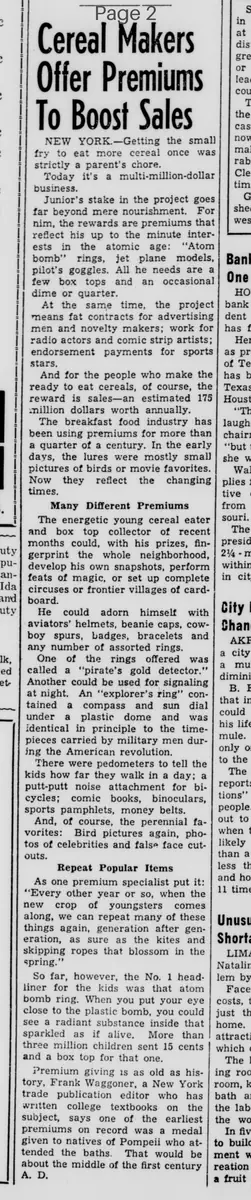
Cereal Makers
Offer Premiums
To Boost Sales
NEW YORK.-Getting the small fry to eat more cereal once was strictly a parent's chore.
Today it's a multi-million-dollar business.
Junior's stake in the project goes far beyond mere nourishment. For him, the rewards are premiums that reflect his up to the minute interests in the atomic age: "Atom bomb" rings, jet plane models, pilot's goggles. All he needs are a few box tops and an occasional dime or quarter.
At the same time, the project means fat contracts for advertising men and novelty makers; work for radio actors and comic strip artists; endorsement payments for sports stars.
And for the people who make the ready to eat cereals, of course, the reward is sales-an estimated 175 million dollars worth annually.
The breakfast food industry has been using premiums for more than a quarter of a century. In the early days, the lures were mostly small pictures of birds or movie favorites.
Now they reflect the changing times.
Many Different Premiums
The energetic young cereal eater and box top collector of recent months could, with his prizes, fingerprint the whole neighborhood, develop his own snapshots, perform feats of magic, or set up complete circuses or frontier villages of cardboard.
He could adorn himself with aviators' helmets, beanie caps, cowboy spurs, badges, bracelets and any number of assorted rings.
One of the rings offered was called a "pirate's gold detector."
Another could be used for signaling at night. An "explorer's ring" contained a compass and sun dial under a plastic dome and was identical in principle to the timepieces carried by military men during the American revolution.
There were pedometers to tell the kids how far they walk in a day: a putt-putt noise attachment for bicycles; comic books, binoculars, sports pamphlets, money belts.
And, of course, the perennial favorites: Bird pictures again, photos of celebrities and false face cutouts.
Repeat Popular Items
As one premium specialist put it: "Every other year or so, when the new crop of youngsters comes along, we can repeat many of these things again, generation after generation, as sure as the kites and skipping ropes that blossom in the spring."
So far, however, the No. 1 headliner for the kids was that atom bomb ring. When you put your eye close to the plastic bomb, you could see a radiant substance inside that sparkled as if alive. More than three million children sent 15 cents and a box top for that one.
Premium giving is as old as history, Frank Waggoner, a New York trade publication editor who has written college textbooks on the subject, says one of the earliest premiums on record was a medal given to natives of Pompeii who attended the baths. That would be about the middle of the first century A. D.
Offer Premiums
To Boost Sales
NEW YORK.-Getting the small fry to eat more cereal once was strictly a parent's chore.
Today it's a multi-million-dollar business.
Junior's stake in the project goes far beyond mere nourishment. For him, the rewards are premiums that reflect his up to the minute interests in the atomic age: "Atom bomb" rings, jet plane models, pilot's goggles. All he needs are a few box tops and an occasional dime or quarter.
At the same time, the project means fat contracts for advertising men and novelty makers; work for radio actors and comic strip artists; endorsement payments for sports stars.
And for the people who make the ready to eat cereals, of course, the reward is sales-an estimated 175 million dollars worth annually.
The breakfast food industry has been using premiums for more than a quarter of a century. In the early days, the lures were mostly small pictures of birds or movie favorites.
Now they reflect the changing times.
Many Different Premiums
The energetic young cereal eater and box top collector of recent months could, with his prizes, fingerprint the whole neighborhood, develop his own snapshots, perform feats of magic, or set up complete circuses or frontier villages of cardboard.
He could adorn himself with aviators' helmets, beanie caps, cowboy spurs, badges, bracelets and any number of assorted rings.
One of the rings offered was called a "pirate's gold detector."
Another could be used for signaling at night. An "explorer's ring" contained a compass and sun dial under a plastic dome and was identical in principle to the timepieces carried by military men during the American revolution.
There were pedometers to tell the kids how far they walk in a day: a putt-putt noise attachment for bicycles; comic books, binoculars, sports pamphlets, money belts.
And, of course, the perennial favorites: Bird pictures again, photos of celebrities and false face cutouts.
Repeat Popular Items
As one premium specialist put it: "Every other year or so, when the new crop of youngsters comes along, we can repeat many of these things again, generation after generation, as sure as the kites and skipping ropes that blossom in the spring."
So far, however, the No. 1 headliner for the kids was that atom bomb ring. When you put your eye close to the plastic bomb, you could see a radiant substance inside that sparkled as if alive. More than three million children sent 15 cents and a box top for that one.
Premium giving is as old as history, Frank Waggoner, a New York trade publication editor who has written college textbooks on the subject, says one of the earliest premiums on record was a medal given to natives of Pompeii who attended the baths. That would be about the middle of the first century A. D.
What sub-type of article is it?
Curiosity
Historical Event
What themes does it cover?
Triumph
Social Manners
What keywords are associated?
Cereal Premiums
Atomic Age Toys
Box Top Collections
Sales Boost
Marketing History
Children's Incentives
Novelty Items
What entities or persons were involved?
Frank Waggoner
Where did it happen?
New York
Story Details
Key Persons
Frank Waggoner
Location
New York
Story Details
Cereal industry uses premiums to increase sales by appealing to children's interests with items like atom bomb rings and explorer tools; premiums evolved from simple pictures to modern toys, generating $175 million annually, with historical precedent from ancient Pompeii.