Thank you for visiting SNEWPapers!
Sign up free
Story
July 7, 1841
The North Carolina Standard
Raleigh, Wake County, North Carolina
What is this article about?
Survivor John Messer recounts the shocking events in the lifeboat of the wrecked ship William Brown, where the crew threw 16 passengers overboard to lighten the boat in rough seas, despite protests; the perpetrators were later acquitted.
Clipping
OCR Quality
98%
Excellent
Full Text
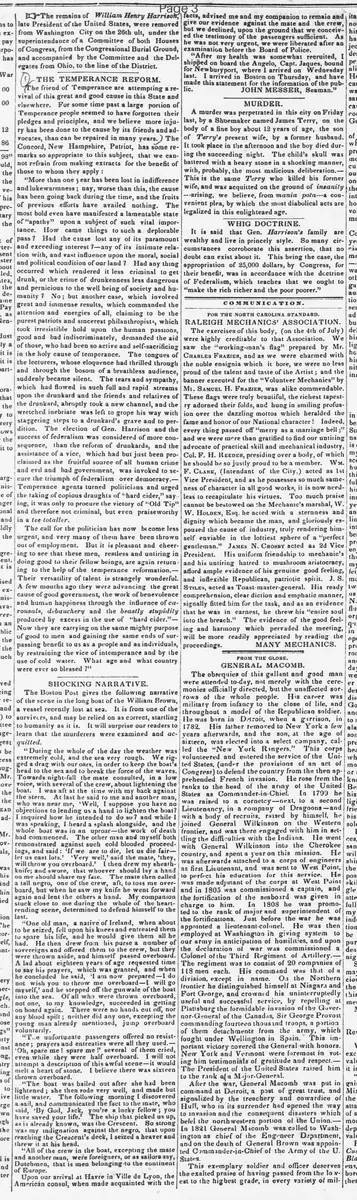
SHOCKING NARRATIVE.
The Boston Post gives the following narrative of the scene in the long boat of the William Brown, a vessel recently lost at sea. It is from one of the survivors, and may be relied on as correct, startling to humanity as it is. It will surprise our readers to learn that the murderers were examined and acquitted.
"During the whole of the day the weather was extremely cold, and the sea very rough. We rigged a drag with our oars, in order to keep the boat's head to the sea and to break the force of the waves. Towards night-fall the mate consulted, in a low voice, with several of the crew, about lightening the boat. I was aft at the time with my back against the stern. At last he said to me and another man, who was near me, 'Well, I suppose you have no objections to lending us a hand to lighten the boat?' I inquired how he intended to do so? and while I was speaking, I heard a splash alongside, and the whole boat was in an uproar—the work of death had commenced. The other man and myself both remonstrated against such cold blooded proceedings, and said: 'If we are to die, let us die fairly—let us cast lots.' 'Very well,' said the mate, 'they will throw you overboard.' I then drew my sheath-knife; and swore, that whoever should lay a hand on me should share my fate. The mate then called a tall negro, one of the crew, aft, to toss me overboard, but when he saw my knife he went forward again and lent the others a hand. My companion stuck close to me during the whole of the heart-rending scene, determined to defend himself to the last.
One old man, a native of Ireland, when about to be seized, fell upon his knees and entreated them to spare his life, and he would give them all he had. He then drew from his purse a number of sovereigns and offered them to the crew, but they were thrown aside, and himself passed overboard. A lad about eighteen years of age requested time to say his prayers, which was granted, and when he concluded he said, 'I am now prepared!—I do not wish you to throw me overboard—I will go myself,' and he stepped off the gunwale of the boat into the sea. Of all who were thrown overboard, not one, to my knowledge, succeeded in getting on board again. There were no hands cut off, nor any blood spilt; neither did any one, excepting the young man already mentioned, jump overboard voluntarily.
The unfortunate passengers offered no resistance; prayers and entreaties were all they used. 'Oh, spare me! spare me!' several of them cried, even while they were half overboard. I will not attempt a description of this awful scene—it would melt a heart of stone. I believe there was sixteen thrown overboard.
The boat was bailed out after she had been lightened; she then rode very well, and made but little water. The following morning I discovered a sail, and communicated the fact to the mate, who said, By God, Jack, you're a lucky fellow; you have saved your life.' The ship that picked us up, as is already known, was the Crescent. So strong was my indignation against the negro, that upon reaching the Crescent's deck, I seized a beaver and threw it at his head.
All of the crew in the boat, excepting the mate and another man, were foreigners, or as sailors say, Dutchmen, that is men belonging to the continent of Europe.
Upon our arrival at Havre in Ville de Lyon, the American consul, when made acquainted with the facts, advised me and my companion to remain and give our evidence against the mate and the crew. But we declined, upon the ground that we conceived the testimony of the passengers sufficient. As he was not very urgent, we were liberated after an examination before the Board of Police.
After my health was somewhat recruited, I shipped on board the Angelo, Capt. Jaques, bound for Newburyport, where I arrived on Wednesday last. I arrived in Boston on Thursday, and have made this statement for the information of the public.
JOHN MESSER, Seaman."
The Boston Post gives the following narrative of the scene in the long boat of the William Brown, a vessel recently lost at sea. It is from one of the survivors, and may be relied on as correct, startling to humanity as it is. It will surprise our readers to learn that the murderers were examined and acquitted.
"During the whole of the day the weather was extremely cold, and the sea very rough. We rigged a drag with our oars, in order to keep the boat's head to the sea and to break the force of the waves. Towards night-fall the mate consulted, in a low voice, with several of the crew, about lightening the boat. I was aft at the time with my back against the stern. At last he said to me and another man, who was near me, 'Well, I suppose you have no objections to lending us a hand to lighten the boat?' I inquired how he intended to do so? and while I was speaking, I heard a splash alongside, and the whole boat was in an uproar—the work of death had commenced. The other man and myself both remonstrated against such cold blooded proceedings, and said: 'If we are to die, let us die fairly—let us cast lots.' 'Very well,' said the mate, 'they will throw you overboard.' I then drew my sheath-knife; and swore, that whoever should lay a hand on me should share my fate. The mate then called a tall negro, one of the crew, aft, to toss me overboard, but when he saw my knife he went forward again and lent the others a hand. My companion stuck close to me during the whole of the heart-rending scene, determined to defend himself to the last.
One old man, a native of Ireland, when about to be seized, fell upon his knees and entreated them to spare his life, and he would give them all he had. He then drew from his purse a number of sovereigns and offered them to the crew, but they were thrown aside, and himself passed overboard. A lad about eighteen years of age requested time to say his prayers, which was granted, and when he concluded he said, 'I am now prepared!—I do not wish you to throw me overboard—I will go myself,' and he stepped off the gunwale of the boat into the sea. Of all who were thrown overboard, not one, to my knowledge, succeeded in getting on board again. There were no hands cut off, nor any blood spilt; neither did any one, excepting the young man already mentioned, jump overboard voluntarily.
The unfortunate passengers offered no resistance; prayers and entreaties were all they used. 'Oh, spare me! spare me!' several of them cried, even while they were half overboard. I will not attempt a description of this awful scene—it would melt a heart of stone. I believe there was sixteen thrown overboard.
The boat was bailed out after she had been lightened; she then rode very well, and made but little water. The following morning I discovered a sail, and communicated the fact to the mate, who said, By God, Jack, you're a lucky fellow; you have saved your life.' The ship that picked us up, as is already known, was the Crescent. So strong was my indignation against the negro, that upon reaching the Crescent's deck, I seized a beaver and threw it at his head.
All of the crew in the boat, excepting the mate and another man, were foreigners, or as sailors say, Dutchmen, that is men belonging to the continent of Europe.
Upon our arrival at Havre in Ville de Lyon, the American consul, when made acquainted with the facts, advised me and my companion to remain and give our evidence against the mate and the crew. But we declined, upon the ground that we conceived the testimony of the passengers sufficient. As he was not very urgent, we were liberated after an examination before the Board of Police.
After my health was somewhat recruited, I shipped on board the Angelo, Capt. Jaques, bound for Newburyport, where I arrived on Wednesday last. I arrived in Boston on Thursday, and have made this statement for the information of the public.
JOHN MESSER, Seaman."
What sub-type of article is it?
Disaster
Survival
Crime Story
What themes does it cover?
Catastrophe
Crime Punishment
Survival
What keywords are associated?
Shipwreck
Lifeboat
Passengers Thrown Overboard
Crew Murder
Acquittal
Survivor Account
What entities or persons were involved?
John Messer
The Mate
Tall Negro
Old Man From Ireland
Lad About Eighteen
Where did it happen?
Long Boat Of The William Brown At Sea
Story Details
Key Persons
John Messer
The Mate
Tall Negro
Old Man From Ireland
Lad About Eighteen
Location
Long Boat Of The William Brown At Sea
Story Details
After the ship William Brown is lost at sea, in the overcrowded lifeboat during rough weather, the mate and crew throw 16 passengers overboard to lighten the load despite protests and pleas; two survivors resist with threats; they are rescued by the Crescent and the crew is acquitted in Havre.