Thank you for visiting SNEWPapers!
Sign up free
Virginia Free Press
Charles Town, Jefferson County, West Virginia
What is this article about?
Henry Clay's 1838 Senate speech concludes his argument against the Sub-Treasury Bill, claiming it establishes an executive-controlled government bank on the ruins of existing banks, granting vast discretionary powers to the Treasury Secretary, undermining free institutions, and threatening liberty and prosperity through concentrated power.
Merged-components note: Continuation of Mr. Clay's speech on the Sub-Treasury Bill across pages, merged based on text content and sequential reading order.
Clippings
1 of 2
OCR Quality
Full Text
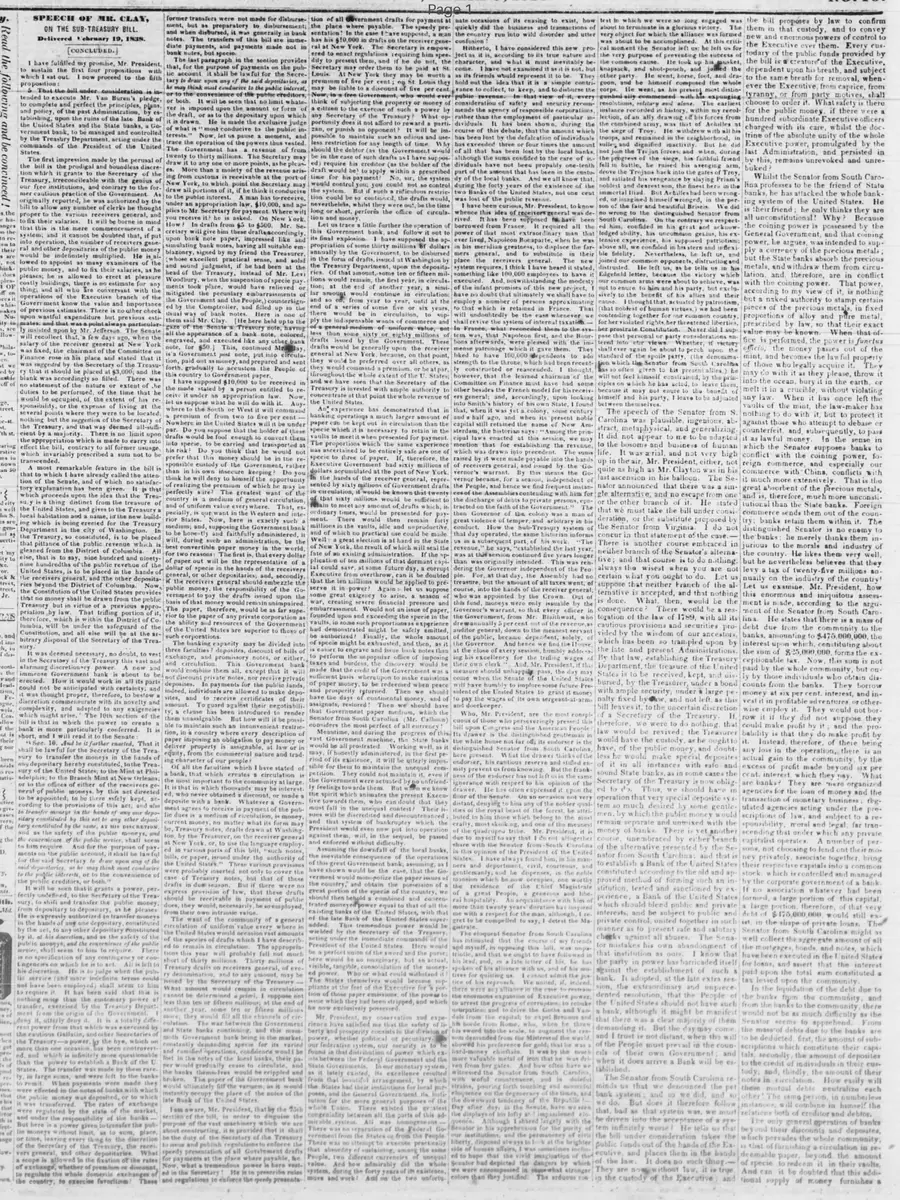
on The Sub-Treasury Bill,
Delivered January 29,
1838.
[CONCLUDED.]
I have fulfilled my promise, Mr. President, to sustain the first four propositions with which I set out. I now proceed to the fifth proposition:
5. That the bill under consideration is intended to execute Mr. Van Buren's pledge, to complete and perfect the principles, plans, and policy, of the past Administration, by establishing, upon the ruins of the late Bank of the United States and the State banks, a Government bank, to be managed and controlled by the Treasury Department, acting under the commands of the President of the United States.
The first impression made by the perusal of the bill is the prodigal and boundless discretion which it grants to the Secretary of the Treasury, irreconcilable with the genius of our free institutions, and contrary to the former cautious practice of the Government. As originally reported, he was authorized by the bill to allow any number of clerks he thought proper to the various receivers general, and to fix their salaries. It will be borne in mind that this is the mere commencement of a system, and it cannot be doubted that, if put into operation, the number of receivers general and other depositaries of the public money would be indefinitely multiplied. He is allowed to appoint as many examiners of the public money, and to fix their salaries, as he pleases; he is allowed to erect at pleasure costly buildings, there is no estimate for anything; and all who are conversant with the operations of the Executive branch of the Government know the value and importance of previous estimates. There is no other check upon wasteful expenditure but previous estimates, and that was a point always particularly insisted upon by Mr. Jefferson. The Senate will recollect that, a few days ago, when the salary of the receiver general at New York was fixed, the chairman of the Committee on Finance rose in his place and stated that it was suggested by the Secretary of the Treasury that it should be placed at $3,000; and the blank was accordingly so filled. There was no statement of the nature or extent of the duties to be performed, of the time that he would be occupied, of the extent of his responsibility, or the expense of living at the several points where they were to be located; nothing but the suggestion of the Secretary of the Treasury, and that was deemed all-sufficient by a majority. There is no limit upon the appropriation which is made to carry into effect the bill, contrary to all former usage, which invariably prescribed a sum not to be transcended.
A most remarkable feature in the bill is that to which I have already called the attention of the Senate, and of which no satisfactory explanation has been given. It is that which proceeds upon the idea that the Treasury is a thing distinct from the treasure of the United States, and gives to the Treasury a local habitation and a name, in the new building which is being erected for the Treasury Department in the city of Washington. In the Treasury, so constituted, is to be placed that pittance of the public revenue which is gleaned from the District of Columbia. All else, that is to say, nine hundred and ninety-nine hundredths of the public revenue of the United States, is to be placed in the hands of the receivers general, and the other depositaries beyond the District of Columbia. Now, the Constitution of the United States provides that no money shall be drawn from the public Treasury but in virtue of a previous appropriation by law. That trifling portion of it, therefore, which is within the District of Columbia, will be under the safeguard of the Constitution, and all else will be at the arbitrary disposal of the Secretary of the Treasury.
It was deemed necessary, no doubt, to vest in the Secretary of the Treasury this vast and alarming discretionary power. A new and immense Government bank is about to be erected. How it would work in all its parts could not be anticipated with certainty; and it was thought proper, therefore, to bestow a discretion commensurate with its novelty and complexity, and adapted to any exigencies which might arise. The 10th section of the bill is that in which the power to create a bank is more particularly conferred. It is short, and I will read it to the Senate:
Sec. 10. And be it further enacted, That it shall be lawful for the Secretary of the Treasury to transfer the moneys in the hands of any depositary hereby constituted, to the Treasury of the United States; to the Mint at Philadelphia; to the Branch Mint at New Orleans, or to the offices of either of the receivers general of public moneys, by this act directed to be appointed, to be there safely kept, according to the provisions of this act, and also to transfer moneys in the hands of any one depositary constituted by this act to any other depositary constituted by the same, AT HIS DISCRETION, and as the safety of the public moneys, and the convenience of the public service, shall seem to him to require. And for the purpose of payments on the public account, it shall be lawful for the said Secretary to draw upon any of the said depositaries, as he may think most conducive to the public interests, or to the convenience of the public creditors, or both.
It will be seen that it grants a power, perfectly undefined, to the Secretary of the Treasury, to shift and transfer the public money, from depositary to depositary, as he pleases. He is expressly authorized to transfer moneys in the hands of any one depositary, constituted by the act, to any other depositary constituted by it, at his discretion, and as the safety of the public moneys, and the convenience of the public service, shall seem to him to require. There is no specification of any contingency or contingencies on which he is to act. All is left to his discretion. He is to judge when the public service (and more indefinite terms could not have been employed) shall seem to him to require it. It has been said that this is nothing more than the customary power of transfer, exercised by the Treasury Department from the origin of the Government. I deny it, utterly deny it. It is a totally different power from that which was exercised by the cautious Gallatin, and other Secretaries of the Treasury—a power, by the bye, which on more than one occasion, has been controverted, and which is infinitely more questionable than the power to establish a Bank of the United States. The transfers were made by them rarely, in large sums, and were left to the banks to remit. When payments were made they were effected in the notes of banks with which the public money was deposited, or to which it was transferred. The rates of exchange were regulated by the state of the market, and under the responsibility of the banks.
But here is a power given to transfer the public money without limit, as to sum, place, or time, leaving everything to the discretion of the Secretary of the Treasury, the receivers general, and other depositaries. What a scope is allowed in the fixation of the rates of exchange, whether of premium or discount, to regulate the whole domestic exchanges of the country, to exercise favoritism! Those former transfers were not made for disbursement, but as preparatory to disbursement; and when disbursed, it was generally in bank notes. The transfers of this bill are immediate payments, and payments made not in bank notes, but specie.
The last paragraph in the section provides that, for the purpose of payments on the public account it shall be lawful for the Secretary to draw upon any of the said depositaries, as he may think most conducive to the public interest, or to the convenience of the public creditors, or both. It will be seen that no limit whatever is imposed upon the amount or form of the draft, or as to the depositary upon which it is drawn. He is made the exclusive judge of what is 'most conducive to the public interests.' Now, let us pause a moment, and trace the operation of the powers thus vested.
The Government has a revenue of from twenty to thirty millions. The Secretary may draw it to any one or more points, as he pleases. More than a moiety of the revenue arising from customs is receivable at the port of New York, to which point the Secretary may draw all portions of it, if he think it conducive to the public interest. A man has to receive, under an appropriation law, $10,000, and applies to Mr. Secretary for payment. Where will you receive it? he is asked. On New York. How? In drafts from $5 to $500. Mr. Secretary will give him these drafts accordingly, upon bank note paper, impressed like and simulating bank notes, having all suitable emblazonry, signed by my friend the Treasurer, (whose excellent practical sense, and solid and sound judgment, if he had been at the head of the Treasury, instead of Mr. Levi Woodbury, when the suspension of specie payments took place, would have relieved or mitigated the pecuniary embarrassments of the Government and the People,) countersigned by the Comptroller, and filled up in the usual way of bank notes. Here is one of them said Mr. Clay. [He here held up to the gaze of the Senate a Treasury note, having all the appearance of a bank note, colored, engraved, and executed like any other bank note, for $50.] This, continued Mr. Clay, is a Government post note, put into circulation, paid out as money, and prepared and sent forth, gradually to accustom the People of this country to Government paper.
I have supposed $10,000 to be received in the mode stated by a person entitled to receive it under an appropriation law. Now, let us suppose what he will do with it. Anywhere to the South or West it will command a premium of from two to five per cent. Nowhere in the United States will it be under par. Do you suppose that the holder of these drafts would be fool enough to convert them into specie, to be carried and transported at his risk? Do you think that he would not prefer that this money should be in the responsible custody of the Government, rather than in his own insecure keeping? Do you think he will deny to himself the opportunity of realizing the premium of which he may be perfectly sure? The greatest want of the country is a medium of general circulation, and of uniform value everywhere. That, especially, is our want in the Western and interior States. Now, here is exactly such a medium; and, supposing the Government bank to be honestly and faithfully administered, it will, during such an administration, be the best convertible paper money in the world, for two reasons: The first is, that every dollar of paper out will be the representative of a dollar of specie in the hands of the receivers general, or other depositaries; and, secondly, if the receivers general should embezzle the public money, the responsibility of the Government to pay the drafts issued upon the basis of that money would remain unimpaired. The paper, therefore, would be as far superior to the paper of any private corporation as the ability and resources of the Government of the United States are superior to those of such corporations.
The banking capacity may be divided into three faculties—deposites, discount of bills of exchange, and promissory notes, or either, and circulation. This Government bank would combine them all, except that it will not discount private notes, nor receive private deposite. In payments for the public lands, indeed, individuals are allowed to make deposite, and to receive certificates of their amount. To guard against their negotiability, a clause has been introduced to render them unassignable. But how will it be possible to maintain such an inconvenient restriction, in a country where every description of paper imposing an obligation to pay money or deliver property is assignable, at law or in equity, from the commercial nature and trading character of our people?
Of all the faculties which I have stated of a bank, that which creates a circulation is the most important to the community at large. It is that in which thousands may be interested, who never obtained discount, or made a deposite with a bank. Whatever a Government agrees to receive in payment of the public dues is a medium of circulation, is money, current money, no matter what its form may be—Treasury notes, drafts drawn at Washington by the Treasurer, on the receiver general at New York, or, to use the language employed in various parts of this bill, 'such notes, bills, or paper, issued under the authority of the United States.' These various provisions were probably inserted not only to cover the case of Treasury notes, but that of these drafts in due season. But if there were no express provision of law, that these drafts should be receivable in payment of public dues, they would, necessarily, be so employed, from their own intrinsic value.
The want of the community of a general circulation of uniform value everywhere in the United States would occasion vast amounts of the species of drafts which I have described to remain in circulation. The appropriations this year will probably fall not much short of thirty millions. Thirty millions of Treasury drafts on receivers general, of every denomination, and to any amount, may be issued by the Secretary of the Treasury—What amount would remain in circulation cannot be determined a priori. I suppose not less than ten or fifteen millions: at the end of another year, some ten or fifteen millions more, they would fill all the channels of circulation. The war between the Government and State banks continuing, and this mammoth Government bank being in the market, constantly demanding specie for its varied and ramified operations, confidence would be lost in the notes of the local banks, their paper would gradually cease to circulate, and the banks themselves would be crippled and broken. The paper of the Government bank would ultimately fill the vacuum, or it would instantly occupy the place of the notes of the late Bank of the United States.
I am aware, Mr. President, that by the 28th section of the bill, in order to disguise the purpose of the vast machinery which we are about constructing, it is provided that it shall be the duty of the Secretary of the Treasury to issue and publish regulations to enforce the speedy presentation of all Government drafts for payments at the place where payable, &c.
Now, what tremendous power is here vested in the Secretary! He is to prescribe rules and regulations to enforce the speedy presentation—In the case I have supposed, a man has his $10,000 in drafts on the receiver general at New York. The Secretary is empowered to enact regulations requiring him speedily to present them, and if he do not, the Secretary may order them to be paid at St. Louis. At New York they may be worth a premium of five per cent; at St. Louis they may be liable to a discount of five per cent. Now, in a free Government, who would ever think of subjecting the property or money of a citizen to the exercise of such a power by any Secretary of the Treasury? What opportunity does it not afford to reward a partisan, or punish an opponent? It will be impossible to maintain such an odious and useless restriction for any length of time. Why should the debtor (as the Government would be in the case of such drafts as I have supposed) require his creditor (as the holder of the draft would be) to apply within a prescribed time for his payment? No, sir, the system would control you; you could not so control the system. But if such a ridiculous restriction could be so continued, the drafts would, nevertheless, whilst they were out, be the time long or short, perform the office of circulation and money.
Let us trace a little further the operation of this Government bank, and follow it out to its final explosion. I have supposed the appropriation of some thirty millions of dollars annually by the Government, to be disbursed in the form of drafts, issued at Washington by the Treasury Department, upon the depositaries. Of that amount, some ten or fifteen millions would remain, the first year, in circulation; at the end of another year, a similar amount would continue in circulation; and so on, from year to year, until at the end of a series of some five or six years, there would be in circulation, to supply the indispensable wants of commerce and of a general medium of uniform value, not less than some sixty or eighty millions of drafts issued by the Government. These drafts would be generally upon the receiver general at New York, because, on that point, they would be preferred over all others, as they would command a premium, or be at par, throughout the whole extent of the U. States; and we have seen that the Secretary of the Treasury is invested with ample authority to concentrate at that point the whole revenue of the United States.
An experience has demonstrated that in banking operations a much larger amount of paper can be kept out in circulation than the specie which it is necessary to retain in the vaults to meet it when presented for payment. The proportions which the same experience has ascertained to be entirely safe are one of specie to three of paper. If, therefore, the Executive Government had sixty millions of dollars accumulated at the port of New York, in the hands of the receiver general, represented by sixty millions of Government drafts in circulation, it would be known that twenty of that sixty millions would be sufficient to sustain to meet any amount of drafts which, in ordinary times, would be presented for payment. There would then remain forty millions in the vaults, idle and unproductive, and of which no practical use could be made. Well: a great election is at hand in the State of New York, the result of which will seal the fate of an existing administration. If the application of ten millions of that dormant capital could save, at some future day, a corrupt Executive from overthrow, can it be doubted that the ten millions would be applied to preserve it in power? Again: let us suppose some great exigency to arise, a season of war, creating severe financial pressure and embarrassment. Would not an issue of paper, founded upon and exceeding the specie in the vaults, in some such proportions as experience had demonstrated might be safely emitted, be authorized? Finally, the whole amount of specie might be exhausted, and then, as it is easier to engrave and issue bank notes than to perform the unpopular office of imposing taxes and burdens, the discovery would be made that the credit of the Government was a sufficient basis whereupon to make emissions of paper money, to be redeemed when peace and prosperity returned. Then we should have the days of continental money, and of assignats, restored! Then we should have that Government paper medium, which the Senator from South Carolina (Mr. Calhoun) considers the most perfect of all currency.
Meantime, and during the progress of this vast Government machine, the State banks would be all prostrated. Working well, as it may, if honestly administered, in the first period of its existence, it will be utterly impossible for them to maintain the unequal competition. They could not maintain it, even if the Government were actuated by no unfriendly feelings towards them. But when we know the spirit which animates the present Executive towards them, who can doubt that they must fall in the unequal contest? Their issues will be discredited and discountenanced; and that system of bankruptcy which the President would even now put into operation against them, will, in the sequel, be passed and enforced without difficulty.
Assuming the downfall of the local banks, the inevitable consequence of the operations of this great Government bank, assuming, as I have shown would be the case, that the Government would monopolize the paper issues of the country, and obtain the possession of a great portion of the specie of the country, we should then behold a combined and concentrated moneyed power equal to that of all the existing banks of the United States, with that of the late Bank of the United States superadded. This tremendous power would be wielded by the Secretary of the Treasury, acting under the immediate commands of the President of the United States. There would be a perfect union of the sword and the purse; there would be no imaginary, but an actual, visible, tangible, consolidated moneyed power. Who or what could withstand it? The States themselves would become suppliant at the feet of the Executive for portions of those paper emissions, of the power to issue which they had been stripped, and which he now exclusively possessed.
Mr. President, my observation and experience have satisfied me that the safety of liberty and prosperity consists in the division of power, whether political or pecuniary. In our federal system, our security is to be found in that distribution of power which exists between the Federal Government and the State Governments. In our monetary system, as it lately existed, its excellence resulted from that beautiful arrangement, by which the States had their institutions for local purposes, and the General Government its institution for the more general purposes of the whole Union. There existed the greatest congeniality between all the parts of this admirable system. All was homogeneous—There was no separation of the Federal Government from the States or from the People. There was no attempt to execute practically that absurdity of sustaining, among the same People, two different currencies of unequal value. And how admirably did the whole system, during the forty years of its existence, move and work! And on the two unfortunate occasions of its ceasing to exist, how quickly did the business and transactions of the country run into wild disorder and utter confusion!
Hitherto, I have considered this new project as it is, according to its true nature and character, and what it must inevitably become. I have not examined it as it is not, but as its friends would represent it to be. They hold out the idea that it is a simple contrivance to collect, to keep, and to disburse the public revenue. In that view of it, every consideration of safety and security recommends the agency of responsible corporations, rather than the employment of particular individuals. It has been shown, during the course of this debate, that the amount which has been lost by the defalcation of individuals has exceeded three or four times the amount of all that has been lost by the local banks, although the sums confided to the care of individuals have not been probably one-tenth part of the amount that has been in the custody of the local banks. And we all know that, during the forty years of the existence of the two Banks of the United States, not one cent was lost of the public revenue.
I have been curious, Mr. President, to know whence this idea of receivers general was derived. It has been supposed to have been borrowed from France. It required all the power of that most extraordinary man that ever lived, Napoleon Bonaparte, when he was in his meridian greatness, to displace the farmers general, and to substitute in their place the receivers general.
The new system requires, I think I have heard it stated, something like 100,000 employees, to have it executed. And, notwithstanding the modesty of the infant promises of this new project, I have no doubt that ultimately we shall have to employ a number of persons approximating to that which is retained in France. That will undoubtedly be the case whenever we shall revive the system of internal taxation. In France, what reconciled them to the system was, that Napoleon first, and the Bourbons afterwards, were pleased with the immense patronage which it gave them. They liked to have 100,000 dependents to add strength to the throne, which had been recently constructed or reascended. I thought, however, that the learned chairman of the Committee on Finance must have had some other besides the French model for his receivers general; and, accordingly, upon looking into Smith's history of his own State, I found that, when it was yet a colony, some century and a half ago, and when its present noble capital still retained the name of New Amsterdam, the historian says: 'Among the principal laws enacted at this session, we may mention that for establishing the revenue, which was drawn into precedent. The sums raised by it were made payable into the hands of receivers general, and issued by the Governor's warrant. By this means the Governor became, for a season, independent of the People, and hence we find frequent instances of the Assemblies contending with him for the discharge of debts to private persons, contracted on the faith of the Government.' The then Governor of the colony was a man of great violence of temper, and arbitrary in his conduct. How the Sub-Treasury system of that day operated, the same historian informs us in a subsequent part of his work. 'The revenue,' he says, 'established the last year, was at this session continued five years longer than was originally intended. This was rendering the Governor independent of the People. For, at that day, the Assembly had no treasure, but the amount of all taxes went, of course, into the hands of the receiver general, who was appointed by the Crown. Out of this fund, moneys were only issuable by the Governor's warrant, so that every officer in the Government, from Mr. Blathwait, who drew annually 5 per cent out of the revenue, as auditor general, down to the meanest servant of the public, became dependent, solely, on the Governor. And hence we find the House, at the close of every session, humbly addressing his excellency for the trifling wages of their own clerk.' And, Mr. President, if this measure should unhappily pass, the day may come when the Senate of the United States will have humbly to implore some future President of the United States to grant it money to pay the wages of its own sergeant-at-arms and doorkeeper.
Who, Mr. President, are the most conspicuous of those who perseveringly press this bill upon Congress and the American People? Its drawer is the distinguished gentleman in the white house not far off; its endorser is the distinguished Senator from South Carolina here present. What the drawer thinks of the endorser, his cautious reserve and stifled enmity prevent us from knowing. But the frankness of the endorser has not left us in the same ignorance with respect to his opinion of the drawer. He has often expressed it upon the floor of the Senate. On an occasion not very distant, denying to him any of the nobler qualities of the royal beast of the forest, he attributed to him those which belong to the most crafty, most sneaking, and one of the meanest of the quadruped tribe. Mr. President, it is due to myself to say that I do not altogether share with the Senator from South Carolina in this opinion of the President of the United States. I have always found him, in his manners and deportment, civil, courteous, and gentlemanly, and he dispenses, in the noble mansion of which he now occupies, one worthy the residence of the Chief Magistrate of a great People, a generous and liberal hospitality. An acquaintance with him of more than twenty years duration has inspired me with a respect for the man, although, I regret to be compelled to say, I detest the Magistrate.
The eloquent Senator from South Carolina has intimated that the course of my friends and myself, in opposing this bill, was unpatriotic, and that we ought to have followed him in his lead, and, in a late letter of his he has spoken of his alliance with us, and of his motives for quitting us. I cannot admit the justice of his reproach. We united, it is true, there were our alliance in the cause to resist from the enormous expansion of Executive power to arrest the progress of corruption, to rebuke usurpation; and to drive the Goths and Vandals from the capitol, to expel Brennus and his horde from Rome, who, when he threw his sword into the scale, to augment the ransom demanded from the Mistress of the world, showed his preference for gold, that he was a hard-money chieftain. It was by the much more valuable metal of iron that he was driven from her gates. And how often have we witnessed the Senator from South Carolina, with woful countenance, and in doleful strains, pouring forth touching and mournful eloquence on the degeneracy of the times, and the downward tendency of the Republic.
Day after day, in the Senate, have we seen the displays of his lofty and impassioned eloquence. Although I shared largely with the Senator in his apprehensions for the purity of our institutions, and the permanency of civil liberty, disposed always to look at the brighter side of human affairs, I was sometimes inclined to hope that the vivid imagination of the Senator had depicted the dangers by which we were encompassed in somewhat stronger colors than they justified. The arduous contest in which we were engaged was about to terminate in a glorious victory. The very object for which the alliance was formed was about to be accomplished. At this critical moment the Senator left us: he left us for the very purpose of preventing the success of the common cause.
He took up his musket, knapsack, and shot-pouch, and joined the other party. He went, horse, foot, and dragoon, and he himself composed the whole corps. He went, as his present most distinguished ally commenced with his expunging resolutions, solitary and alone. The earliest instance recorded in history, within my recollection, of an ally drawing off his forces from the combined army, was that of Achilles at the siege of Troy. He withdrew with all his troops, and remained in the neighborhood, in sullen and dignified inactivity. But he did not join the Trojan forces, and when, during the progress of the siege, his faithful friend fell in battle, he raised his avenging arm, drove the Trojans back into the gates of Troy, and satiated his vengeance by slaying Priam's noblest and dearest son, the finest hero in the immortal Iliad. But Achilles had been wronged, or imagined himself wronged, in the person of the fair and beautiful Briseis. We did no wrong to the distinguished Senator from South Carolina. On the contrary we respected him, confided in his great and acknowledged ability, his uncommon genius, his extensive experience, his supposed patriotism; above all, we confided in his stern and inflexible fidelity. Nevertheless, he left us, and joined our common opponents, distrusting and distrusted. He left us, as he tells us in his Edgefield letter, because the victory which our common arms were about to achieve, was not to enure to him and his party, but exclusively to the benefit of his allies and their cause. I thought that, actuated by patriotism, (that noblest of human virtues,) we had been contending together for our common country, for her violated rights, her threatened liberties, her prostrate Constitution. Never did I suppose that personal or party considerations entered into our views. Whether, if victory shall ever again be about to perch upon the standard of the spoils party, (the denomination which the Senator from South Carolina has so often given to his present allies) he will not feel himself constrained, by the principles on which he has acted, to leave them, because it may not enure to the benefit of himself and his party. I leave to be adjusted between themselves.
The speech of the Senator from S. Carolina was plausible, ingenious, abstract, metaphysical, and generalizing. It did not appear to me to be adapted to the bosoms and business of human life. It was aerial, and not very high up in the air, Mr. President, either, not quite as high as Mr. Clayton was in his last ascension in his balloon. The Senator announced that there was a single alternative, and no escape from one or the other branch of it. He stated that we must take the bill under consideration, or the substitute proposed by the Senator from Virginia. I do not concur in that statement of the case. There is another course embraced in neither branch of the Senator's alternative: and that course is to do nothing, always the wisest when you are not certain what you ought to do. Let us suppose that neither branch of the alternative is accepted, and that nothing is done. What, then, would be the consequence? There would be a restoration of the law of 1789, with all its cautious provisions and securities provided by the wisdom of our ancestors, which has been so trampled upon by the late and present Administrations. By that law, establishing the Treasury Department, the treasure of the United States is to be received, kept, and disbursed, by the Treasurer, under a bond with ample security, under a large penalty fixed by law, and not left, as this bill leaves it, to the uncertain discretion of a Secretary of the Treasury. If, therefore, we were to do nothing, that law would be revived: the Treasurer would have the custody, as he ought to have, of the public money, and doubtless he would make special deposite of it in all instances with safe and sound State banks, as in some cases the Secretary of the Treasury is now obliged to do. Thus, we should have in operation that very special deposite system so much desired by some gentlemen, by which the public money would remain separate and unmixed with the money of banks. There is yet another course, unembraced by either branch of the alternative presented by the Senator from South Carolina, and that is to establish a Bank of the United States constituted according to the old and approved method of forming such an institution, tested and sanctioned by experience, a Bank of the United States which should blend public and private interests, and be subject to public and private control, united together in such manner as to present safe and salutary checks against all abuses. The Senator mistakes his own abandonment of that institution for ours. I know that the party in power has barricaded itself against the establishment of such a bank. It adopted, at the late extra session, the extraordinary and unprecedented resolution, that the People of the United States should not have such a bank, although it might be manifest that there was a clear majority of them demanding it. But the day may come, and I trust is not distant, when the will of the People must prevail in the councils of their own Government: and when it does arrive a Bank will be established.
The Senator from South Carolina reminds us that we denounced the pet bank system, and so we did, and so we do. But does it therefore follow that, bad as that system was, we must be driven into the acceptance of a system infinitely worse? He tells us that the bill under consideration takes the public funds out of the hands of the Executive, and places them in the hands of the law. It does no such thing. They are now without law, it is true, in the custody of the Executive: and the bill proposes by law to confirm them in that custody, and to convey new and enormous powers of control to the Executive over them. Every custodial of the public funds provided by the bill is a creature of the Executive, dependent upon his breath, and subject to the same breath for removal, whenever the Executive, from caprice, from tyranny, or from party motives, shall choose to order it. What safety is there for the public money, if there were a hundred subordinate Executive officers charged with its care, whilst the doctrine of the absolute unity of the whole Executive power, promulgated by the last Administration, and persisted in by this, remains unrevoked and unre buked?
Whilst the Senator from South Carolina professes to be the friend of State banks, he has attacked the whole banking system of the United States. He is their friend: he only thinks they are all unconstitutional! Why? Because the coining power is possessed by the General Government, and that coining power, he argues, was intended to supply a currency of the precious metals; but the State banks absorb the precious metals, and withdraw them from circulation, and, therefore, are in conflict with the coining power. That power, according to my view of it, is nothing but a naked authority to stamp certain pieces of the precious metals, in fixed proportions of alloy and pure metal, prescribed by law, so that their exact value may be known. When that office is performed, the power is functus officio, the money passes out of the mint, and becomes the lawful property of those who legally acquire it. They may do with it as they please, throw it into the ocean, bury it in the earth, or melt it in a crucible, without violating any law. When it has once left the vaults of the mint, the law-maker has nothing to do with it, but to protect it against those who attempt to debase or counterfeit, and, subsequently, to pass it as lawful money. In the sense in which the Senator supposes banks to conflict with the coining power, foreign commerce, and especially our commerce with China, conflicts with it much more extensively. That is the great absorbent of the precious metals, and is, therefore, much more unconstitutional than the State banks. Foreign commerce sends them out of the country; banks retain them within it. The distinguished Senator is no enemy to the banks: he merely thinks them injurious to the morals and industry of the country. He likes them very well, but he nevertheless believes that they levy a tax of twenty-five millions annually on the industry of the country.
Let us examine, Mr. President, how this enormous and iniquitous assessment is made, according to the argument of the Senator from South Carolina. He states that there is a mass of debt due from the community to the banks, amounting to $475,000,000, the interest upon which, constituting about the sum of $25,000,000, forms the exceptionable tax. Now, this sum is not paid by the whole community, but only by those individuals who obtain discounts from the banks. They borrow money at six per cent. interest, and invest it in profitable adventures, or otherwise employ it. They would not borrow it if they did not suppose they could make profit by it, and the probability is that they do make profit by it. Instead, therefore, of their being any loss in the operation, there is an actual gain to the community, by the excess of profit made beyond six per cent. interest, which they pay. What are banks? They are mere organized agencies for the loan of money and the transaction of monetary business, regulated agencies acting under the prescriptions of law, and subject to a responsibility, moral and legal, far transcending that under which any private capitalist operates. A number of persons, not choosing to lend out their money privately, associate together, bring their respective capitals into a common stock which is controlled and managed by the corporate government of a bank.
If no association whatever had been formed, a large portion of this capital, a large portion, therefore, of that very debt of $475,000,000 would still exist in the shape of private loans. The Senator from South Carolina might as well collect the aggregate amount of all the mortgages, bonds and notes, which have been executed in the United States for loans, and assert that the interest paid upon the total sum constituted a tax levied upon the community.
In the liquidation of the debt due to the banks from the community, and from the banks to the community, there would not be as much difficulty as the Senator seems to apprehend. From the mass of debts due to the banks are to be deducted, first, the amount of subscriptions which constitute their capital; secondly, the amount of deposits to the credit of individuals in their custody, and, thirdly, the amount of their notes in circulation. How easily will these mutual debts neutralize each other! The same person, in numberless instances, will combine in himself the relations both of creditor and debtor. The only general operation of banks beyond their discounts and deposits, which pervades the whole community, is that of furnishing a circulation in redeemable paper, beyond the amount of specie to redeem it in their vaults. And cannot be doubted that this additional supply of money furnishes
powerful stimulus to industry and production, fully compensating any casual inconveniences, which sometimes, though rarely occur? Banks reduce the rate of interest, and repress inordinate usury. The salutary influence of banking operations is demonstrated in countries and sections of country where they prevail, when contrasted with those in which they are not found. In the former, all is bustle, activity, general prosperity. The country is beautified and adorned by the noble works of internal improvements: the cities are filled with splendid edifices, and the wharves covered with the richest productions of our own or of foreign climes. In the latter, all is sluggishness, slothfulness, and inactivity. England in modern times, illustrates the great advantages of banks, of credit, and of stimulated industry. Contrast her with Spain, destitute of all those advantages. In ancient times, Athens would present an image of full and active employment of all the energies of man, carried to the highest point of civilization, whilst her neighbor, Sparta, with her iron money, affords another of the boasted benefits of metallic circulation. The Senator from South Carolina would do the banks no harm; but they are deemed by him highly injurious to the planting interest! According to him, they inflate prices, and the poor planter sells his productions for hard money, and has to purchase his supplies at the swollen prices produced by a paper medium. Now, I must dissent altogether from the Senator's statement of the case. England, the principal customer to the planter, is quite as much, if not more, a paper country than ours. And the paper-money prices of the one country are neutralized by the paper-money prices of the other country. If the argument were true, that a paper-money country trades disadvantageously with a hard-money country, we ought to continue to employ a paper medium, to counterbalance the paper medium of England. And if we were to banish our paper, and substitute altogether a metallic currency, we should be exposed to every inequality which has been insisted upon. But there is nothing in that view of the matter which is presented by the Senator from South Carolina. If, as he asserts, prices were always inflated in this country beyond their standard in England, the rate of exchange would be constantly against us. An examination, however, into the actual state of exchange between the two countries for a long series of years, evinces that it has generally been in our favor. In the direct trade between England and this country, I have no doubt, there is large annual balance against us; but that balance is adjusted and liquidated by balances in our favor in other branches of our foreign trade, which have wholly concentrated in England, as the great centre of the commercial world. Of all the interests and branches of industry in this country, none have profited more by the use and employment of credit and capital derived from banks and other sources, than the planting interest. It habitually employs credit in all countries where planting agriculture prevails. The States of Alabama, Mississippi, Arkansas, and Louisiana, have almost sprung into existence as it were by magic, or, at least, have been vastly improved and extended, under the influence of the credit system. Lands, slaves, utensils, beasts of burden, and other supplies, have been constantly bought, and still continue to be purchased, upon credit; and bank agency is all-essential to give the most beneficial operation to these credits. But the argument of the Senator from South Carolina, which I am combating, would not be correct, if it were true that we have inflated prices on this side of the Atlantic, without a corresponding inflation of price on the other side: because the planter generally selling at home, and buying at home, the proceeds of his sale, whatever that may be, constitute the means by which he effects his purchase and consequently neutralize each other. In what do we of the West receive payment for the immense quantity of live stock and other produce of our industry, which we annually sell to the South and Southwest, but that paper medium now so much decried and denounced: The Senator from South Carolina is very fond of the State banks: but he thinks there is no legitimate currency except that of the constitution. He contends that the power which the government possesses to impose taxes, restricts it in their payment, to the receipt of the precious metals. But the constitution does not say so. The power is given in broad and unrestricted terms; and the Government is left at liberty to collect the taxes in whatever medium or commodity, from the exigencies of the case, it can collect them. It is doubtless much the most convenient to collect them in money, because that represents, or can command, everything, the want of which is implied by the power of taxation. But suppose there was no money in the country, none whatever, to be extorted by the tax-gatherer from an impoverished people? Is the power of Government to cease, and the people to be thrown back into state of nature? The Senator asks if taxes could be levied and collected in tobacco, in cotton and other commodities? Undoubtedly they could, if the necessity existed for such an inconvenient imposition. Such a case of necessity did exist in the colony of Virginia, and other colonies, prior to the Revolution, and taxes were accordingly levied in tobacco or other commodities, as wolf scalps, even at this day, compose part of the revenue of more than one State. The argument, then, of the Senator against the right of the government to receive bank notes in payment of public dues, as a practice coeval with the existence of the Government, does not seem to me to be sound. It is not accurate, for another reason. Bank notes, when convertible at the will of the holder into specie, are as much counted as real specie, like the specie which counted and put into market here, depositing the receipts of their contents. Senator tells us that it has been only within a few days that he has discovered that it is illegal to receive bank notes in payment of public dues. Does he think that the usage of the Government, under successive administrations, and with every party in power, which has prevailed for nigh fifty years, ought to be set aside for a novel theory of his, just dreamed into existence, even if it possesses the merit of ingenuity? The bill under consideration, which has been eulogised by the Senator as perfect in its structure and details, contains a provision that bank notes shall be received in diminished proportions, during a term of six years. He himself introduced that identical principle. It was the only part of the bill that is emphatically his. How, then, can he contend that it is unconstitutional to receive bank notes in payment of public dues? I appeal from himself to himself. The Senator further contends, that general deposits cannot be made with banks, and be thus confounded with the general mass of the funds on which they transact business. The argument supposes that the money collected for taxes must be preserved in identity; but that is impossible often to do. May not the collector give the small change which he has received from one tax payer to another tax payer, to enable him to effect his payment? May he not change gold for silver, or vice versa, or both, if he be a distant collector, to obtain an undoubted remittance to the public Treasury? What, Mr. President, is the process of making deposits with banks? The deposit is made, and a credit is entered for its amount to the Government. That credit is supposed to be the exact equivalent of the amount deposited, ready and forthcoming to the Government whenever it was wanted for the purpose of disbursement. It is immaterial to the Government whether it receives back again the identical money put in, or other money of equal value. All that it wants is what it put in the bank, or its equivalent; and that, in ordinary times, with such prudent banks as alone ought to be selected, it is sure of getting. Again: the Treasury has frequently to make remittances to foreign countries, to meet the expenditure necessary there for our naval squadrons, and other purposes. They are made to the bankers, to the Barings or the Rothschilds, in the form of bills of exchange, purchased in the market by the agents of the Government here, with money drawn out of the Treasury. Here is one conversion of the money received from the tax gatherer into the Treasury. The bills are transmitted to the bankers, honored, paid and the amount credited by them to the United States. Are the bankers bound to retain the proceeds of the bills in identity? Are they bound to do more than credit the Government for an equal amount, for which they stand responsible whenever it is wanted? If they should happen to use any portion of those proceeds of bills remitted to them in their banking operations, would it be drawing the money from the Treasury, contrary to the provisions of the constitution? The Senator from South Carolina contends that there is no constitutional power to contract with the twenty-five selected banks, as proposed in the substitute; yet the deposit act of 1836, which obtained the hearty approbation of that Senator, contained similar provision; and the very bill under consideration, so warmly supported by him, provides, under certain contingencies, for contracts to be made with the State banks, to receive deposits of public money upon compensation. He objects to the substitute, that it converts twenty-five State banks into a system of federal institutions, but the employment of State institutions by the federal authority no more makes them federal, than the employment of federal institutions by the State converts them into State institutions. This mutual aid, and this reciprocal employment of the several institutions of the general and particular Government, is one of the results and beauties of our admirable though complex system of Government. The General Government has the use of the capitol, court houses, prisons and penitentiaries, in the several States. Do they, therefore, cease to appertain to the States? It is to be borne in mind that although the State banks may occasionally be used by the federal authority, their legal responsibility to the several States remains unimpaired. They continue to be accountable to them, and their existence can only be terminated or prolonged by the State authority. And being governed, as they are, by corporate authority emanating from and amenable to State jurisdiction, and not under the control of the Executive of the United States, constitutes at once a great security for the public money, and more safety to the public liberty. It has been argued that a separation of the Government from the banks, will diminish the Executive power. It must be admitted that the custody of the public money in various banks, subject to the control of State authority, furnishes some check upon the possible abuses of the Executive Government. But the argument maintains that the Executive has least power when it has most complete possession of the public Treasury! The Senator from South Carolina contends that the separation in question being once effected, the relation of Federal Government and the State Banks will be antagonistical. I believe no, Mr. President. That in the very thing I wish to prevent. I want them to live in peace, harmony and friendship. If they are antagonist, how is it possible that the State banks can maintain their existence against the tremendous influence of this Government? Especially, if this Government should be backed by such a vast Treasury bank as I verily believe this bill is intended to create! And what becomes of the argument urged by the Senator from South Carolina, and the abolition resolutions offered by him at an early period of the session, asserting that the General Government is bound to protect the domestic institutions of the several States? The substitute is not, I think, what the welfare of the country requires. It may serve the purpose of a good half-way house. Its accommodations appear fair, and with the feelings of a wearied traveller, one may be tempted to stop awhile and refresh himself there. I shall vote for it as an amendment to the bill because I believe it the least of two evils, if it should indeed inflict any evil: or rather, because I feel myself in the position of a patient to whom the physician presents in one hand a cup of arsenic, and in the other a cup of prussic acid. I reject the first, because of the instant death with which it is charged: I take the latter, as being the most harmless, and depend upon the sis medicalis nefure — It would have been a great improvement, in my opinion, if the mode of bringing about the resumption of specie payments, contained in the substitute, were reversed, provided that the notes of a certain number of safe, sound and unquestionable banks to be selected, should be forthwith received, by the General Government, in payment of all public dues, and that if the selected banks did not resume by a future designated day, their notes should cease to be taken. Several immediate effects would follow: 1st The Government would withdraw from the market as a competitor with the banks for specie, and they would be left undisturbed to strengthen themselves. And, 2dly, confidence would be restored by taking off the discredit and discouragement thrown upon all banks by the Government. And why should these notes not be so received? They are as good as Treasury notes, if not better. They answer all the purposes of the State Government and the people. They now would buy as much specie as could be commanded at the period of suspension. They could be disbursed by the government. And, lastly, the measure would be temporary. But the true and only efficacious and permanent remedy, I solemnly believe, is to be found in a Bank of the United States, properly organized and constituted. We are told that such a bank is fraught with indescribable danger, and that the Government must, in the sequel, gain possession of the bank, or the Bank of the Government. I oppose to these imaginary terrors the practical experience of forty years, I oppose to them the issue of the memorable contest, commenced by the late President against the Bank of the United States. The administration of that bank had been without serious fault. It had given no just offence to the Government, towards which it had faithfully performed every financial duty. Under its able and enlightened President, it had fulfilled every anticipation which had been formed by those who created it. President Jackson pronounced the edict that it must fall, and it did fall, against the wishes of an immense majority of the people of the United States, against the convictions of its utility entertained by a large majority of the States; and to the prejudice of the best interests of the whole country. If an innocent, unoffending, and highly beneficial institution could be thus easily destroyed by the power of one man, where would be the difficulty of crushing it, if it had given any real cause for just animadversion? Finally, I oppose to these imaginary terrors the example deducible from English history. There a bank has existed since the year 1694, and neither has the bank got possession of the Government, nor the Government of the bank. They have existed in harmony together, both conducting to the prosperity of that great country—and they have so existed, and so contributed, because each has avoided cherishing towards the other that wanton and unnecessary spirit of hostility which was unfortunately engendered in the bosom of the late President of the United States. I am admonished, sir, by my exhausted strength, and by, I fear, your more exhausted patience, to hasten to a close. Mr. President, a great, novel and untried measure, is pressingly urged upon the acceptance of Congress. That it is pregnant with tremendous consequences, for good or evil, is undeniable, and admitted by all. We firmly believe that it will be fatal to the best interests of this country, and ultimately subversive of its liberties. You, who have been greatly disappointed in other measures of equal promise, can only hope, in the doubtful and uncertain future, that its operation may prove salutary. Since it was first proposed at the extra session; the whole people have had an opportunity of passing in judgment upon it at their elections. As far as they have, they have expressed their unqualified disapprobation. From Maine to the State of Mississippi, its condemnation has been loudly thundered forth. In every intervening election, the administration has been defeated, or its former majorities neutralized. Maine has spoken; N. York, Pennsylvania, Maryland, Ohio, Rhode Island, Mississippi and Michigan, all these States, in tones and terms not to be misunderstood, have denounced the measure. The key-stone State (God bless her) has twice proclaimed her rejection of it; once at the polls, and once through her Legislature. Friends and foes of the administration have united in condemning it. And, at the very moment when I am addressing you, a large meeting of the late supporters of the administration, headed by the distinguished gentleman who presided in the electoral college which gave the vote of that patriotic State to President Van Buren, are assembled in Philadelphia, to protest solemnly against the passage of this bill. Is it right, that, under such circumstances, it should be forced upon a reluctant but free and intelligent people? Is it right that this Senate, constituted as it now is, should give sanction to this measure. I say it in no disrespectful or taunting sense, but we are entitled, according to the latest expression of the popular will, and in virtue of manifestations of opinion deliberately expressed by the State Legislatures, to a vote of 3s against the bill; and I am ready to enter, with any Senator friendly to the administration, into details to prove the assertion. Will the Senate, then, bring upon itself the odium of passing this bill? I implore it to forbear, forbear, forbear! I appeal to the instructed Senators. Is this Government made for us, or for the people and the States whose agents we are? Are we not bound so to administer it as to advance their welfare, promote their prosperity, and give general satisfaction? Will that sacred trust be fulfilled, if the known sentiments of large and respectable communities are despised and contemned by those whom they have sent here? I call upon the honorable Senator from Alabama (Mr. King), with whom I have so long stood in the public councils, shoulder to shoulder, bearing up the honor and glory of this great people; to come now to their rescue. I call upon all the Senators; let us bury deep and forever the character of the partisan, rise up patriots and statesmen, break the vile chains of party, throw the fragments to the winds, and feel the proud satisfaction that we have made but a small sacrifice to the paramount obligations which we owe our common country.
What sub-type of article is it?
What themes does it cover?
What keywords are associated?
What entities or persons were involved?
Where did it happen?
Story Details
Key Persons
Location
United States Senate, Washington
Event Date
January 29, 1838
Story Details
Henry Clay argues against the Sub-Treasury Bill, asserting it creates an executive-controlled government bank that grants excessive discretion to the Treasury Secretary, leads to wasteful spending, undermines constitutional safeguards, destroys state banks, concentrates power dangerously, and threatens liberty; he defends state banks, advocates for a national bank, and criticizes political alliances.