Thank you for visiting SNEWPapers!
Sign up free
Phenix Gazette
Alexandria, Virginia
What is this article about?
Senator Benton's letter defends John Randolph's duel with Henry Clay near Virginia's border, claiming it didn't violate anti-dueling laws since Randolph didn't fire. Critics ridicule the legal distinction, and Virginia Legislature tables Randolph's re-election motion 98-64.
Clipping
OCR Quality
Full Text
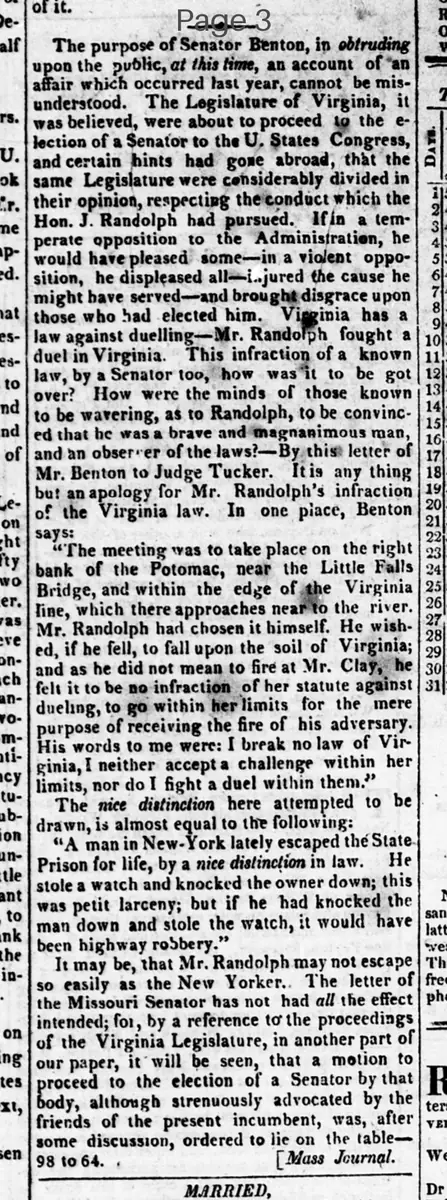
"The meeting was to take place on the right bank of the Potomac, near the Little Falls Bridge, and within the edge of the Virginia line, which there approaches near to the river. Mr. Randolph had chosen it himself. He wished, if he fell, to fall upon the soil of Virginia; and as he did not mean to fire at Mr. Clay, he felt it to be no infraction of her statute against dueling, to go within her limits for the mere purpose of receiving the fire of his adversary. His words to me were: I break no law of Virginia, I neither accept a challenge within her limits, nor do I fight a duel within them."
The nice distinction here attempted to be drawn, is almost equal to the following:
"A man in New-York lately escaped the State Prison for life, by a nice distinction in law. He stole a watch and knocked the owner down; this was petit larceny; but if he had knocked the man down and stole the watch, it would have been highway robbery."
It may be, that Mr. Randolph may not escape so easily as the New Yorker. The letter of the Missouri Senator has not had all the effect intended; for, by a reference to the proceedings of the Virginia Legislature, in another part of our paper, it will be seen, that a motion to proceed to the election of a Senator by that body, although strenuously advocated by the friends of the present incumbent, was, after some discussion, ordered to lie on the table-- 98 to 64.
[Mass. Journal.
What sub-type of article is it?
What themes does it cover?
What keywords are associated?
What entities or persons were involved?
Where did it happen?
Story Details
Key Persons
Location
Right Bank Of The Potomac, Near The Little Falls Bridge, Within The Edge Of The Virginia Line
Event Date
Last Year
Story Details
Senator Benton publishes a letter defending John Randolph's duel with Henry Clay on Virginia soil, arguing Randolph did not violate anti-dueling laws by not firing or accepting the challenge there. Critics compare the justification to a legal loophole in a New York theft case. The defense fails to sway the Virginia Legislature, which tables the motion for Randolph's re-election 98-64.