Thank you for visiting SNEWPapers!
Sign up free
Letter to Editor
August 14, 1829
Daily Richmond Whig
Richmond, Virginia
What is this article about?
A pseudonymous writer 'SCRIBLERUS' responds to 'Quintilian's' defense of General Jackson's writing style in the Whig newspaper, criticizing it as grammatically flawed and unclear, particularly a sentence about confidence in his administration principles, and proposes a corrected version amid political partisanship.
Clipping
OCR Quality
98%
Excellent
Full Text
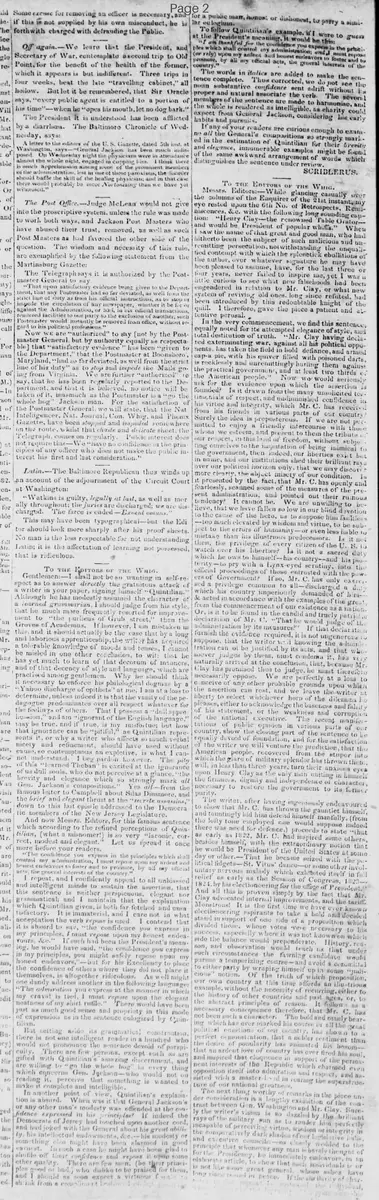
TO THE EDITORS OF THE WHIG.
Gentlemen:--I shall not be so wanting in self-respect as to answer directly the gratuitous attack of a writer in your paper, signing himself "Quintilian."
Although he has modestly assumed the character of a learned grammarian, I should judge from his style, that he much more frequently resorted for improvement to "the purlieus of Grub street," than the Groves of Academus. If however, I am mistaken in this, and it should actually be the case that by a long and laborious apprenticeship, the writer has acquired a tolerable knowledge of moods and tenses, I cannot be misled in one other conclusion, to wit: that he has yet much to learn of that decorum of manners, and of that decency of style and language, which are practised among gentlemen. Why he should think it necessary to enforce his philological dogmas by a Yahoo discharge of epithets at me, I am at a loss to determine, unless indeed it is that the vanity of the pedagogue predominates over all respect whatever for the feelings of others. That I possess a "dull apprehension," and am "ignorant of the English language," may be true, and if true, is my misfortune; but how that ignorance can be "pitiful," as Quintilian represents it, or why a writer who affects so much verbal nicety and refinement, should have used without cause, so contemptuous an expletive, is what I cannot understand. I beg pardon however. The pity of this "learned Theban" is excited at the ignorance of us dull souls, who do not perceive at a glance, "the brevity and elegance which so strongly mark all Gen. Jackson's compositions." Yes sir--from the famous letter to Campbell about Silas Dinsmore, and the brief and elegant thrust at the "secret assassins," down to this last epistle addressed to the Democratic members of the New Jersey Legislature.
And now Messrs. Editors, for this famous sentence which according to the refined perceptions of Quintilian, (what a misnomer!) is so very "laconic, correct, modest and elegant."
Let us spread it once more before your readers.
"The confidence you express in the principles which shall control my administration, I must repose upon my ardent and honest endeavors to foster and to promote, by all my official acts, the general interests of the country."
I repeat, and I confidently appeal to all unbiased and intelligent minds to sustain the assertion, that this sentence is neither perspicuous, elegant nor grammatical; and I maintain that the explanation which Quintilian gives, is both far fetched and unsatisfactory. It is immaterial, and I care not in what acceptation the verb repose is used I contend that it is absurd to say, "the confidence you express in my principles, I must repose upon my honest endeavors, &c." If such had been the President's meaning, he would have said, "the confidence you express in my principles, you might safely repose upon my honest endeavors,"--but for his Excellency to place the confidence of others where they did not place it themselves, is altogether ridiculous. As well might one dandy address another in the following language:
"The admiration you express at the manner in which my cravat is tied, I must repose upon the elegant neatness of my shirt ruffle." There would have been just as much good sense and propriety in this mode of expression as in the sentence eulogized by Quintilian.
But setting aside its grammatical construction, there is not one intelligent reader in a hundred who would not pronounce the sentence devoid of perspicuity. There are few persons, except such as are gifted with Quintilian's amazing discernment, and are willing to "go the whole hog" in every thing which concerns Gen. Jackson--who would not on reading it, perceive that something is wanted to make it complete and intelligible.
In another point of view, Quintilian's explanation is absurd. When was it that General Jackson's or any other man's modesty was offended at the confidence expressed in his principles? If indeed the Democrats of Jersey had touched upon another cord, and had joked with the General about his great ability, his intellectual endowments, &c.--his modesty or something else might have been alarmed in good earnest. In such a case he might have been glad to shuffle off their confidence and repose it upon some other quality. There are few men, (be their principles good or bad) who dislike to be praised for them, and I should as soon expect a virtuous woman to shrink from a compliment on her chastity, as a public man, honest or dishonest, to parry a similar eulogium.
To follow Quintilian's example. if I were to guess at the President's meaning. it would be this:
"I am thankful for the confidence you express in the principles which shall control my administration; and I must repose (or rely) upon my ardent and honest endeavors to foster and to promote, by all my official acts, the general interests of the country."
The words in italics are added to make the sentence complete. Thus corrected, we do not see the noun substantive confidence sent adrift "without its proper and natural associate the verb. The several members of the sentence are made to harmonize, and the whole is rendered as intelligible, as charity could expect from General Jackson, considering his early habits and pursuits.
If any of your readers are curious enough to examine all the General's compositions so strongly marked in the estimation of Quintilian for their brevity and elegance, innumerable examples might be found of the same awkward arrangement of words which distinguishes the sentence under review.
SCRIBLERUS.
Gentlemen:--I shall not be so wanting in self-respect as to answer directly the gratuitous attack of a writer in your paper, signing himself "Quintilian."
Although he has modestly assumed the character of a learned grammarian, I should judge from his style, that he much more frequently resorted for improvement to "the purlieus of Grub street," than the Groves of Academus. If however, I am mistaken in this, and it should actually be the case that by a long and laborious apprenticeship, the writer has acquired a tolerable knowledge of moods and tenses, I cannot be misled in one other conclusion, to wit: that he has yet much to learn of that decorum of manners, and of that decency of style and language, which are practised among gentlemen. Why he should think it necessary to enforce his philological dogmas by a Yahoo discharge of epithets at me, I am at a loss to determine, unless indeed it is that the vanity of the pedagogue predominates over all respect whatever for the feelings of others. That I possess a "dull apprehension," and am "ignorant of the English language," may be true, and if true, is my misfortune; but how that ignorance can be "pitiful," as Quintilian represents it, or why a writer who affects so much verbal nicety and refinement, should have used without cause, so contemptuous an expletive, is what I cannot understand. I beg pardon however. The pity of this "learned Theban" is excited at the ignorance of us dull souls, who do not perceive at a glance, "the brevity and elegance which so strongly mark all Gen. Jackson's compositions." Yes sir--from the famous letter to Campbell about Silas Dinsmore, and the brief and elegant thrust at the "secret assassins," down to this last epistle addressed to the Democratic members of the New Jersey Legislature.
And now Messrs. Editors, for this famous sentence which according to the refined perceptions of Quintilian, (what a misnomer!) is so very "laconic, correct, modest and elegant."
Let us spread it once more before your readers.
"The confidence you express in the principles which shall control my administration, I must repose upon my ardent and honest endeavors to foster and to promote, by all my official acts, the general interests of the country."
I repeat, and I confidently appeal to all unbiased and intelligent minds to sustain the assertion, that this sentence is neither perspicuous, elegant nor grammatical; and I maintain that the explanation which Quintilian gives, is both far fetched and unsatisfactory. It is immaterial, and I care not in what acceptation the verb repose is used I contend that it is absurd to say, "the confidence you express in my principles, I must repose upon my honest endeavors, &c." If such had been the President's meaning, he would have said, "the confidence you express in my principles, you might safely repose upon my honest endeavors,"--but for his Excellency to place the confidence of others where they did not place it themselves, is altogether ridiculous. As well might one dandy address another in the following language:
"The admiration you express at the manner in which my cravat is tied, I must repose upon the elegant neatness of my shirt ruffle." There would have been just as much good sense and propriety in this mode of expression as in the sentence eulogized by Quintilian.
But setting aside its grammatical construction, there is not one intelligent reader in a hundred who would not pronounce the sentence devoid of perspicuity. There are few persons, except such as are gifted with Quintilian's amazing discernment, and are willing to "go the whole hog" in every thing which concerns Gen. Jackson--who would not on reading it, perceive that something is wanted to make it complete and intelligible.
In another point of view, Quintilian's explanation is absurd. When was it that General Jackson's or any other man's modesty was offended at the confidence expressed in his principles? If indeed the Democrats of Jersey had touched upon another cord, and had joked with the General about his great ability, his intellectual endowments, &c.--his modesty or something else might have been alarmed in good earnest. In such a case he might have been glad to shuffle off their confidence and repose it upon some other quality. There are few men, (be their principles good or bad) who dislike to be praised for them, and I should as soon expect a virtuous woman to shrink from a compliment on her chastity, as a public man, honest or dishonest, to parry a similar eulogium.
To follow Quintilian's example. if I were to guess at the President's meaning. it would be this:
"I am thankful for the confidence you express in the principles which shall control my administration; and I must repose (or rely) upon my ardent and honest endeavors to foster and to promote, by all my official acts, the general interests of the country."
The words in italics are added to make the sentence complete. Thus corrected, we do not see the noun substantive confidence sent adrift "without its proper and natural associate the verb. The several members of the sentence are made to harmonize, and the whole is rendered as intelligible, as charity could expect from General Jackson, considering his early habits and pursuits.
If any of your readers are curious enough to examine all the General's compositions so strongly marked in the estimation of Quintilian for their brevity and elegance, innumerable examples might be found of the same awkward arrangement of words which distinguishes the sentence under review.
SCRIBLERUS.
What sub-type of article is it?
Persuasive
Satirical
Provocative
What themes does it cover?
Politics
What keywords are associated?
Andrew Jackson
Writing Style
Grammatical Critique
Quintilian
Presidential Sentence
Political Rhetoric
New Jersey Democrats
What entities or persons were involved?
Scriblerus
Editors Of The Whig
Letter to Editor Details
Author
Scriblerus
Recipient
Editors Of The Whig
Main Argument
the letter refutes 'quintilian's' praise of general jackson's writing as elegant and grammatical, arguing that a specific sentence about confidence in his principles is unclear, absurd, and poorly constructed, and proposes a corrected version to make it sensible.
Notable Details
Criticizes Quintilian's Style And Manners
References Jackson's Letter To Campbell About Silas Dinsmore
Mentions 'Secret Assassins' Thrust
New Jersey Legislature Epistle
Dandy Cravat Analogy For Absurdity
Suggested Correction With Added Words For Clarity