Thank you for visiting SNEWPapers!
Sign up free
The New Hampshire Gazette
Portsmouth, Rockingham County, New Hampshire
What is this article about?
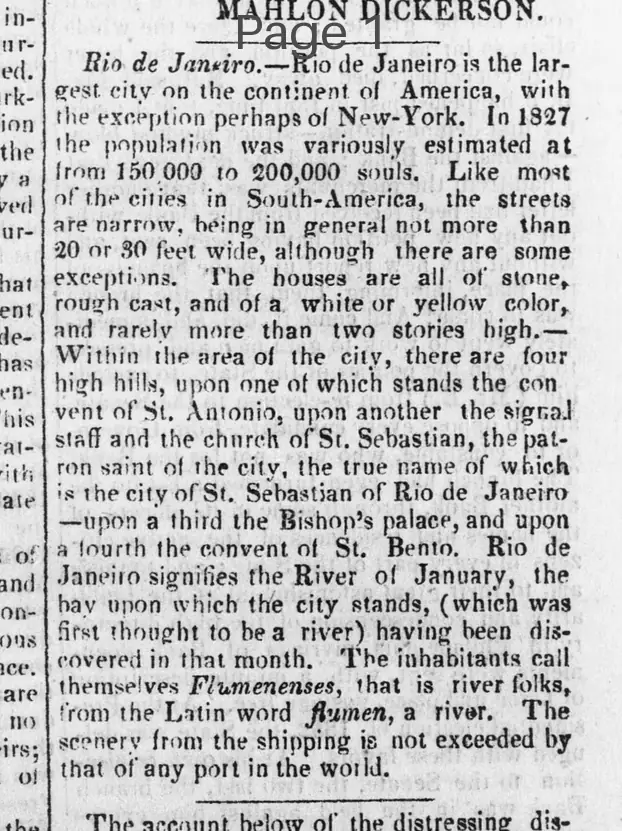
Description of Rio de Janeiro as South America's largest city (after New York), with 1827 population of 150,000-200,000. Details narrow streets, low stone houses, hills with convents and churches, etymology from January river discovery, and superior port scenery.
Clipping
OCR Quality
Full Text
Within the area of the city, there are four high hills, upon one of which stands the convent of St. Antonio, upon another the signal staff and the church of St. Sebastian, the patron saint of the city, the true name of which is the city of St. Sebastian of Rio de Janeiro -upon a third the Bishop's palace, and upon a fourth the convent of St. Bento. Rio de Janeiro signifies the River of January, the bay upon which the city stands, (which was first thought to be a river) having been discovered in that month. The inhabitants call themselves Fluminenses, that is river folks, from the Latin word flumen, a river. The scenery from the shipping is not exceeded by that of any port in the world.
What sub-type of article is it?
What keywords are associated?
Where did it happen?
Foreign News Details
Primary Location
Rio De Janeiro
Event Date
1827
Event Details
Rio de Janeiro is the largest city on the continent of America, with the exception perhaps of New-York. In 1827 the population was variously estimated at from 150,000 to 200,000 souls. Like most of the cities in South-America, the streets are narrow, being in general not more than 20 or 30 feet wide, although there are some exceptions. The houses are all of stone, rough cast, and of a white or yellow color, and rarely more than two stories high. Within the area of the city, there are four high hills, upon one of which stands the convent of St. Antonio, upon another the signal staff and the church of St. Sebastian, the patron saint of the city, the true name of which is the city of St. Sebastian of Rio de Janeiro; upon a third the Bishop's palace, and upon a fourth the convent of St. Bento. Rio de Janeiro signifies the River of January, the bay upon which the city stands, (which was first thought to be a river) having been discovered in that month. The inhabitants call themselves Fluminenses, that is river folks, from the Latin word flumen, a river. The scenery from the shipping is not exceeded by that of any port in the world.