Thank you for visiting SNEWPapers!
Sign up free
Virginia Argus
Richmond, Virginia
What is this article about?
Detailed account of the capture of the U.S. Frigate President by a British squadron off New York in January 1815, including battle circumstances, casualties, and Commodore Decatur's letter correcting British claims.
Merged-components note: These components form a single article on the capture of the U.S. Frigate President, including particulars from a Norwich paper, Commodore Decatur's official letter, and the related correction from the Royal Gazette. Sequential reading order and shared subject matter indicate they belong together.
Clipping
OCR Quality
Full Text
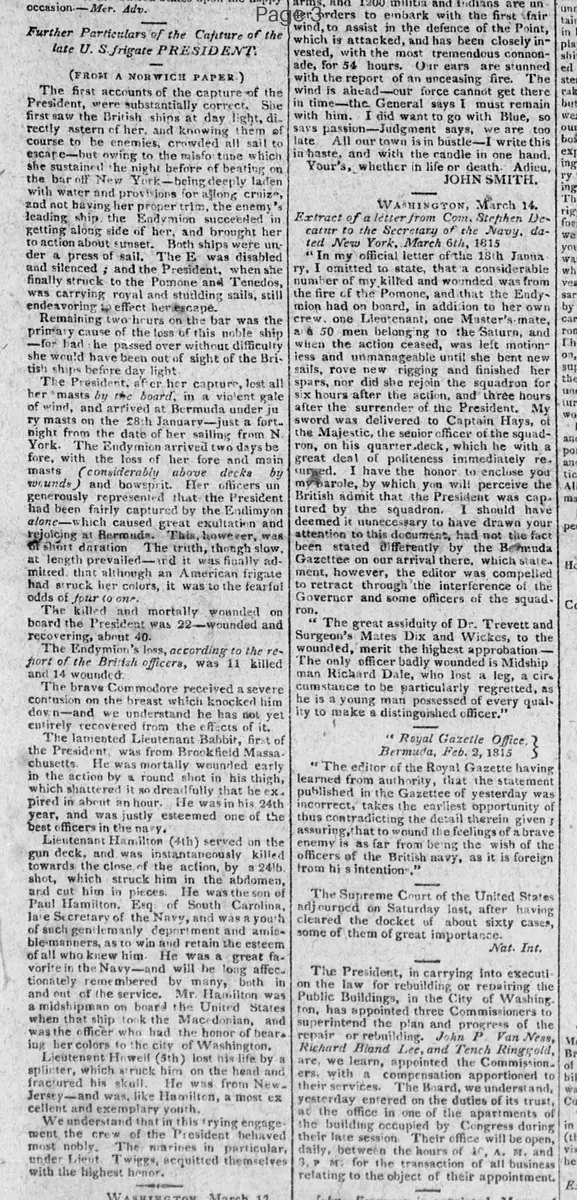
(FROM A NORWICH PAPER.)
The first accounts of the capture of the President, were substantially correct. She first saw the British ships at day light, directly astern of her, and knowing them of course to be enemies, crowded all sail to escape—but owing to the misfortune which she sustained the night before of beating on the bar off New York—being deeply laden with water and provisions for a long cruize, and not having her proper trim, the enemy's leading ship, the Endymion succeeded in getting along side of her, and brought her to action about sunset. Both ships were under a press of sail. The Endymion was disabled and silenced: and the President, when she finally struck to the Pomone and Tenedos, was carrying royal and studding sails, still endeavoring to effect her escape.
Remaining two hours on the bar was the primary cause of the loss of this noble ship—for had she passed over without difficulty she would have been out of sight of the British ships before day light.
The President, after her capture, lost all her masts by the board, in a violent gale of wind, and arrived at Bermuda under jury masts on the 28th January—just a fortnight from the date of her sailing from N. York. The Endymion arrived two days before, with the loss of her fore and main masts (considerably above decks by wounds) and bowsprit. Her officers ungenerously represented that the President had been fairly captured by the Endymion alone—which caused great exultation and rejoicing at Bermuda. This, however, was of short duration. The truth, though slow, at length prevailed—and it was finally admitted, that although an American frigate had struck her colors, it was to the fearful odds of four to one.
The killed and mortally wounded on board the President was 22—wounded and recovering, about 40.
The Endymion's loss, according to the report of the British officers, was 11 killed and 14 wounded.
The brave Commodore received a severe contusion on the breast which knocked him down—and we understand he has not yet entirely recovered from the effects of it.
The lamented Lieutenant Babbit, first of the President, was from Brookfield Massachusetts. He was mortally wounded early in the action by a round shot in his thigh, which shattered it so dreadfully that he expired in about an hour. He was in his 24th year, and was justly esteemed one of the best officers in the navy.
Lieutenant Hamilton (4th) served on the gun deck, and was instantaneously killed towards the close of the action, by a 24 lb. shot, which struck him in the abdomen, and cut him in pieces. He was the son of Paul Hamilton, Esq. of South Carolina, late Secretary of the Navy, and was a youth of such gentlemanly deportment and amiable manners, as to win and retain the esteem of all who knew him. He was a great favorite in the Navy—and will be long affectionately remembered by many, both in and out of the service. Mr. Hamilton was a midshipman on board the United States when that ship took the Macedonian, and was the officer who had the honor of bearing her colors to the city of Washington.
Lieutenant Howell (5th) lost his life by a splinter, which struck him on the head and fractured his skull. He was from New Jersey—and was, like Hamilton, a most excellent and exemplary youth.
We understand that in this trying engagement the crew of the President behaved most nobly. The marines in particular, under Lieut. Twiggs, acquitted themselves with the highest honor.
WASHINGTON, March 14.
Extract of a letter from Com. Stephen Decatur to the Secretary of the Navy, dated New York, March 6th, 1815
"In my official letter of the 18th January, I omitted to state, that a considerable number of my killed and wounded was from the fire of the Pomone, and that the Endymion had on board, in addition to her own crew, one Lieutenant, one Master's-mate, and 50 men belonging to the Saturn, and when the action ceased, was left motionless and unmanageable until she bent new sails, rove new rigging and finished her spars, nor did she rejoin the squadron for six hours after the action, and three hours after the surrender of the President. My sword was delivered to Captain Hays, of the Majestic, the senior officer of the squadron, on his quarter-deck, which he with a great deal of politeness immediately returned. I have the honor to enclose you my parole, by which you will perceive the British admit that the President was captured by the squadron. I should have deemed it unnecessary to have drawn your attention to this document, had not the fact been stated differently by the Bermuda Gazette on our arrival there, which statement, however, the editor was compelled to retract through the interference of the Governor and some officers of the squadron."
The great assiduity of Dr. Trevett and Surgeon's Mates Dix and Wickes, to the wounded, merit the highest approbation—The only officer badly wounded is Midshipman Richard Dale, who lost a leg, a circumstance to be particularly regretted, as he is a young man possessed of every quality to make a distinguished officer.
"Royal Gazette Office,
Bermuda, Feb. 2, 1815"
"The editor of the Royal Gazette having learned from authority, that the statement published in the Gazette of yesterday was incorrect, takes the earliest opportunity of thus contradicting the detail therein given, assuring, that to wound the feelings of a brave enemy is as far from being the wish of the officers of the British navy, as it is foreign from his intention."
What sub-type of article is it?
What keywords are associated?
What entities or persons were involved?
Where did it happen?
Domestic News Details
Primary Location
Off New York
Event Date
January 1815
Key Persons
Outcome
president: 22 killed and mortally wounded, about 40 wounded and recovering. endymion: 11 killed, 14 wounded. specific deaths: lieutenant babbit (mortally wounded), lieutenant hamilton (killed), lieutenant howell (killed). midshipman richard dale lost a leg. commodore decatur received a severe contusion. president captured by british squadron (endymion, pomone, tenedos), arrived bermuda on 28th january under jury masts.
Event Details
The U.S. Frigate President, after grounding on the bar off New York, was pursued and engaged by British ships starting at daylight. The Endymion came alongside at sunset, was disabled, but the President struck to the Pomone and Tenedos while still under sail. Post-capture, she lost masts in a gale. British initially claimed single-ship capture but later admitted squadron involvement. Decatur's letter details additional facts and parole.