Thank you for visiting SNEWPapers!
Sign up free
The National Intelligencer And Washington Advertiser
Washington, District Of Columbia
What is this article about?
Transcript of Jacob Dunbaugh's testimony in the 1807 U.S. Circuit Court trial of Aaron Burr, detailing his involvement in Burr's 1806-1807 Mississippi River expedition, interactions with Burr, military preparations, and suspicions of treasonous plans.
Merged-components note: Continuation of the court transcript from the Burr trial across pages 1 and 2, forming a single coherent story component.
Clippings
1 of 2
OCR Quality
Full Text
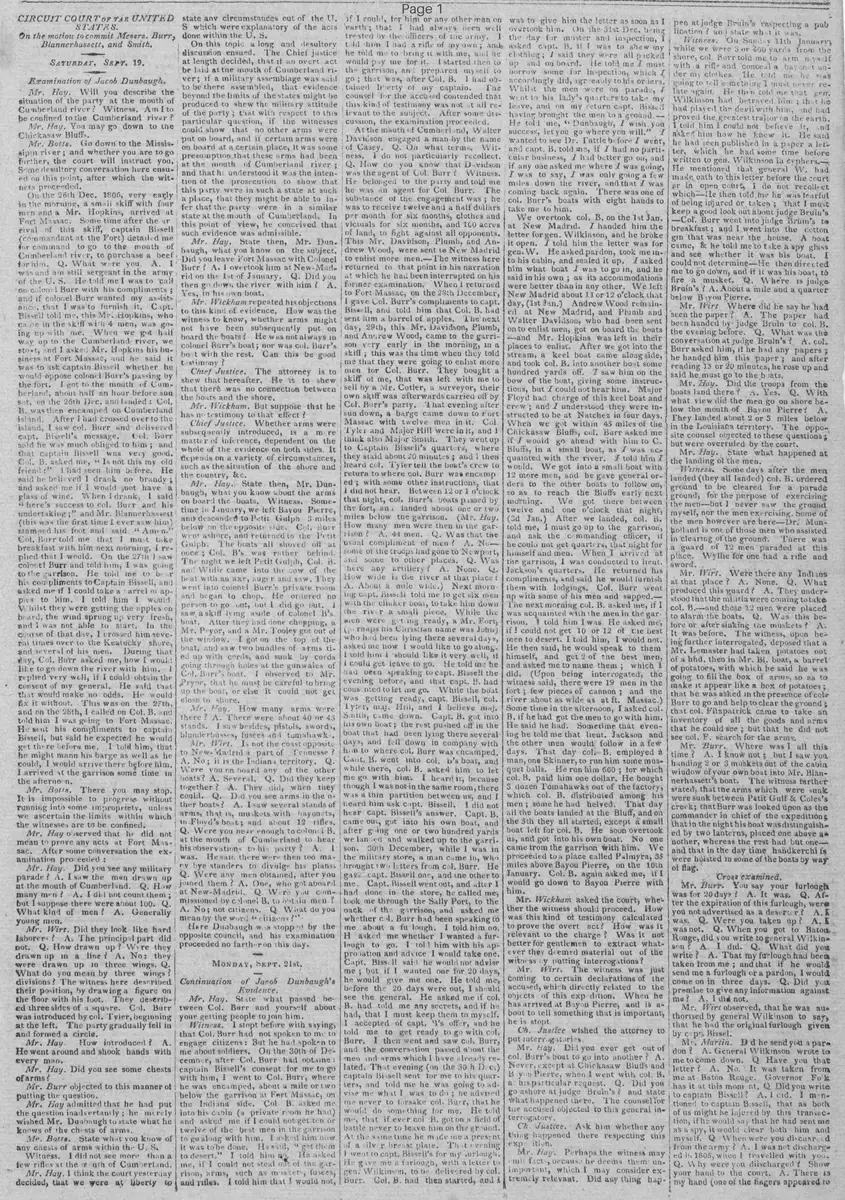
On the motion to commit Messrs. Burr, Blennerhassett, and Smith.
SATURDAY, SEPT. 19.
Examination of Jacob Dunbaugh.
Mr. Hay. Will you describe the situation of the party at the mouth of Cumberland river: Witness. Am I to be confined to the Cumberland river?
Mr. Hay. You may go down to the Chickasaw Bluffs.
Mr. Botts. (Go down to the Mississippi river; and whether you are to go further, the court will instruct you.)
Some desultory conversation here ensued on this point, after which the witness proceeded.
On the 26th Dec. 1806, very early in the morning, a small skiff with four men and a Mr. Hopkins, arrived at Fort Massac. Some time after the arrival of this skiff, captain Bissell (commandant at the Fort) detailed me or commanded me to go to the mouth of Cumberland river, to purchase a beef for him. Q. What were you. A. I was and am still sergeant in the army of the U. S. He told me I was to call on colonel Burr with his compliments; and if colonel Burr wanted my assistance, that I was to furnish it. Capt. Bissell told me, this Mr. Hopkins, who came in the skiff with 4 men, was going up with me. When we got half way up to the Cumberland river, we stopped, and I asked Mr. Hopkins his business at Fort Massac, and he said it was to ask captain Bissell whether he would oppose colonel Burr's passing by the fort. I got to the mouth of Cumberland, about half an hour before sun set, on the 26th Dec. and landed: Col. B. was then encamped on Cumberland island. After I had crossed over to the island, I saw col. Burr and delivered capt. Bissell's message. Col. Burr said he was much obliged to him; and that captain Bissell was very good. Col. B. asked me, "Is not this my old friend?" I had seen him before. He said he believed I drank no brandy; and asked me if I would not have a glass of wine. When I drank, I said "here's success to col. Burr and his undertaking;" and Mr. Blennerhassett (this was the first time I ever saw him) stamped his foot and said "Amen."
Col. Burr told me that I must take breakfast with him next morning, I replied that I would. On the 27th I saw colonel Burr and told him, I was going to the garrison. He told me to be ready with his compliments to Captain Bissell, and asked me if I could take a barrel of apples to him. I told him I would. Whilst they were getting the apples on board, the wind sprung up very fresh, and I was not able to start. In the course of that day, I crossed him several times over to the Kentucky shore, and several of his men. During that day, Col. Burr asked me, how I would like to go down the river with him. I replied very well, if I could obtain the consent of my general. He said that would make no odds. He would fix it without. This was on the 27th. and on the 28th, I called on Col. B. and told him I was going to Fort Massac. He sent his compliments to captain Bissell, but said he expected he would get there before me, I told him, that he might man his barge as well as he could, I would arrive there before him. I arrived at the garrison some time in the afternoon.
Mr. Botts. There you may stop.
It is impossible to progress without running into some impropriety, unless we ascertain the limits within which the witnesses are to be confined.
Mr. Hay observed that he did not mean to prove any acts at Fort Massac, After some conversation the examination proceeded:
Mr. Hay. Did you see any military parade? A. I saw the men drawn up at the mouth of Cumberland. Q. How many men? A. I did not count them; but I suppose there were about 100. Q. What kind of men? A. Generally young men.
Mr. Wirt. Did they look like hard laborers? A. The principal part did not. Q. How drawn up? Were they drawn up in a line? A. No: they were drawn up in three wings. Q. What do you mean by three wings? divisions? The witness here described their position, by drawing a figure on the floor with his foot. They described three sides of a square. Col. Burr was introduced by col. Tyler, beginning at the left. The party gradually fell in and formed a circle.
Mr. Hay. How introduced? A. He went around and shook hands with every man.
Mr. Hay. Did you see some chests of arms?
Mr. Burr objected to this manner of putting the question.
Mr. Hay admitted that he had put the question inadvertently; he merely wished Mr. Dunbaugh to state what he knows of the chests of arms.
Mr. Botts. State what you know of any chests of arms within the U. S.
Witness. I did not see more than a few rifles at the mouth of Cumberland.
Mr. Hay, I think the Court yesterday decided, that we were at liberty to state any circumstances out of the U. S. which were explanatory of the acts done within the U. S.
On this topic a long and desultory discussion ensued, The Chief justice at length decided, that if an overt act be laid at the mouth of Cumberland river; if a military assemblage was said to be there assembled, that evidence beyond the limits of the states might be produced to shew the military attitude of the party ; that with respect to this particular question, if the witnesses could show that no other arms were put on board, and if certain arms were on board at a certain place, it was some presumption that these arms had been at the mouth of Cumberland river : and that he understood it was the intention of the prosecution to show that this party were in such a state at such a place, that they might be able to infer that the party were in a similar state at the mouth of Cumberland. In this point of view, he conceived that such evidence was admissible.
Mr. Hay. State then, Mr. Dunbaugh, what you know on the subject. Did you leave Fort Massac with Colonel Burr? A. I overtook him at New-Madrid on the 1st of January. Q. Did you then go down the river with him? A. Yes, in his own boat.
Mr. Wickham repeated his objections to this kind of evidence. How was the witness to know, whether arms might not have been subsequently put on board the boats? He was not always in colonel Burr's boat; nor was col. Burr's boat with the rest. Can this be good testimony?
Chief Justice. The attorney is to shew that hereafter. He is to shew that there was no connection between the boats and the shore.
Mr. Wickham. But suppose that he has no testimony to that effect?
Chief Justice. Whether arms were subsequently introduced, is a mere matter of inference, dependent on the whole of the evidence on both sides. It depends on a variety of circumstances, such as the situation of the shore and the country, &c.
Mr. Hay. State then, Mr. Dunbaugh, what you know about the arms on board the boats. Witness, Sometime in January, we left Bayou Pierre, and descended to Petit Gulph 3 miles below on the opposite side. Col. Burr went ashore, and returned to the Petit Gulph. The boats all shoved off at once ; Col. B's. was rather behind. The night we left Petit Gulph, Col. B. and Willie came into the bow of the boat with an axe, auger and saw. They went into colonel Burr's private room and began to chop. He ordered no person to go out, but I did go out. I saw a skiff lying aside of colonel B's. boat. After they had done chopping, a Mr. Pryor, and a Mr. Tooley got out of the window. I got on the top of the boat, and saw two bundles of arms tied up with cords, and sunk by cords going through holes at the gunwales of Col. Burr's boat. I observed to Mr. Pryor, that he must be careful to bring up the boat, or else it could not get close to shore.
Mr. Hay. How many arms were there? A. There were about 40 or 43 stands. I saw besides, pistols, swords, blunderbusses, fusees and tomahawk.
Mr. Wirt. Is not the coast opposite to New-Madrid a part of Tennessee? A. No; it is the Indiana territory. Q. Were you on board any of the other boats? A. Several. Q. Did they keep together? A. They did, when they could. Q. Did you see arms in the other boats? A. I saw several stands of arms, that is, muskets with bayonets, in Floyd's boat: and about 12 rifles. Q. Were you near enough to colonel B. at the mouth of Cumberland to hear his observations to his party? A. I was. He said there were then too many by-standers to divulge his plans. Q. Were any men obtained, after you joined them? A. One, who got aboard at New-Madrid. Q. Were you commissioned by colonel B. to obtain men? A. No; not citizens. Q. What do you mean by the word "citizens?"
Here Dunbaugh was stopped by the opposite counsel, and his examination proceeded no farther on this day.
MONDAY, SEPT. 21st.
Continuation of Jacob Dunbaugh's Evidence.
Mr. Hay. State what passed between Col. Burr and yourself about your getting people to join him.
Witness. I stopped before with saying that Col. Burr had not spoken to me to engage citizens: But he had spoken to me about soldiers. On the 30th of December, after Col. Burr had obtained captain Bissell's consent for me to go with him, I went to Col. Burr, where he was encamped, about a mile or two below the garrison at Fort Massac, on the Indiana side. Col B. asked me into his cabin (a private room he had) and asked me if I could not get ten or twelve of the best men in the garrison to go along with him. I asked him how it was to be done. He said, "get them to desert." I told him no. He asked me, if I could not steal out of the garrison, arms, such as musket, fusees, and rifles. I told him that I would not, if I could, for him or any other man on earth: that I had always been well treated by the officers of the army. I told him I had a rifle of my own; and he told me to bring it with me, and he would pay me for it. I started then to the garrison, and prepared myself to go; that was, after Col. B. I had obtained liberty of my captain. The counsel for the accused contended that this kind of testimony was not at all relevant to the subject. After some discussion, the examination proceeded.
At the mouth of Cumberland, Walter Davidson engaged a man by the name of Casey. Q. On what terms? Witness. I do not particularly recollect. Q. How do you know that Davidson was the agent of Col. Burr? Witness. He belonged to the party and told me he was an agent for Col Burr. The substance of the engagement was; he was to receive twelve and a half dollars per month for six months, clothes and victuals for six months, and 100 acres of land, to fight against all opponents. This Mr. Davidson, Plumb, and Andrew Wood, were sent to New Madrid to enlist more men. The witness here returned to that point in his narration at which he had been interrupted on his former examination. When I returned to Fort Massac, on the 28th December, I gave Col. Burr's compliments to capt. Bissell, and told him that Col. B. had sent him a barrel of apples. The next day, 29th, this Mr. Davidson, Plumb, and Andrew Wood, came to the garrison very early in the morning, in a skiff ; this was the time when they told me that they were going to enlist more men for Col. Burr. They bought a skiff of me, that was left with me to sell by a Mr. Cutler, a surveyor, their own skiff was afterwards carried off by Col. Burr's party. That evening after sun down, a barge came down to Fort Massac with twelve men in it. Col Tyler and Major Hill were in it, and I think also Major Smith. They went up to Captain Bissell's quarters, where they staid about 20 minutes ; and I then heard col. Tyler tell the boat's crew to return to where col. Burr was encamped: with some other instructions, that I did not hear. Between 12 or 1 o'clock that night, col. Burr's boats passed by the fort, and landed about one or two miles below the garrison. (Mr. Hay. How many men were then in the garrison? A. 44 men. Q. Was that the usual complement of men? A. No-- some of the troops had gone to Newport, and some to other places. Q. Was there any artillery? A. None. Q. How wide is the river at that place? A. About a mile wide.) Next morning capt. Bissell told me to get six men to the clinker boat, to take him down the river a small piece. While the men were getting ready, a Mr. Forty (perhaps his Christian name was John) who had been lying there several days, asked me how I would like to go along. I told him I should like it very well, if I could get leave to go. He told me he had been speaking to capt. Bissell the evening before, and that capt. B. had consented to let me go. While the boat was getting ready, capt. Bissell, col. Tyler, maj. Hill, and I believe maj. Smith, came down. Capt. B. got into his own boat; the rest pushed off in the boat that had been lying there several days, and fell down in company with him to where col. Burr was encamped. Capt. B. went into col. B's boat, and while there, col. B. asked him to let me go with him. I heard it, because though I was not in the same room, there was a thin partition between us, and I heard him ask Capt. Bissell. I did not hear capt. Bissell's answer. Capt. B. came out, got into his own boat, and after going one or two hundred yards we landed and walked up to the garrison. 30th December, while I was in the military store, a man came in, who brought two letters from col. Burr, He gave capt. Bissell one, and the other to me. Capt. Bissell went out, and after I had done in the store, he called me, took me through the Sally Port, to the back of the garrison, and asked me whether col. Burr had been speaking to me about a furlough. I told him no. He asked me whether I wanted a furlough to go. I told him with his approbation and advice I would take one. Capt. Bissell said he would not advise me ; but if I wanted one for 20 days, he would give me one. He told me, before the 20 days were out, I should see the general. He asked me if col. B. had told me any secrets, and if he had, that I must keep them to myself. I accepted of capt. B's offer, and he told me to get ready to go with col. Burr. I then went and saw col Burr, and the conversation passed about the men and arms which I have already related. That evening (on the 30th Dec.) captain Bissell sent for me to his quarters, and told me he was going to advise me what I was to do; he advised me never to forsake col. Burr, that he would do something for me, He told me, that if ever col B. got on a field of battle never to leave him on the ground. At the same time he made me a present of a silver breast plate. That evening I went to capt, Bissell's for my furlough: He gave me a furlough, with a letter to gen. Wilkinson, to be delivered by col. Burr. Col. B. had then started. and I was to give him the letter as soon as I overtook him. On the 31st Dec. being the day for muster and inspection, I asked capt. B. if I was to shew my clothing; I said they were all picked up and on board. He told me I must borrow some for inspection, which I accordingly did, agreeably to his orders. While the men were on parade, I went to his lady's quarters to take my leave, and on my return capt. Bissell having brought the men to a ground.- He told me, "Dunbaugh, I wish you success, let you go where you will." I wanted to see Dr. Tuttle before I went, and capt. B. told me, if I had no particular business, I had better go off, and if any one asked me where I was going I was to say, I was only going a few miles down the river, and that I was coming back again. There was one of col. Burr's boats with eight hands to take me to him.
We overtook col. B, on the 1st Jan. at New Madrid. I handed him the letter for gen. Wilkinson, and he broke it open. I told him the letter was for gen. W. He asked pardon, took me into his cabin, and sealed it up. I asked him what boat I was to go in, and he said in his own : as its accommodations were better than in any other. We left New Madrid about 11 or 12 o'clock that day, (1st Jan.) Andrew Wood remained at New Madrid, and Plumb and Walter Davidson, who had been sent on to enlist men, got on board the boats -and Mr. Hopkins was left in their places to enlist. After we got into the stream, a keel boat came alongside, and took col. B. into another boat some hundred yards off. I saw him on the bow of the boat, giving some instructions, but I could not hear him. Major Floyd had charge of this keel boat and crew ; and I understood they were instructed to be at Natchez in four days. When we got within 45 miles of the Chickasaw Bluffs, col. Burr asked me if I would go ahead with him to C. Bluffs. in a small boat, as I was acquainted with the river. I told him I would. We got into a small boat with 12 more men, and he gave general orders to the other boats to follow on, so as to reach the Bluffs early next morning. We got there between twelve and one o'clock that night (3d Jan.) After we landed, col. B. told me, I must go up to the garrison, and ask the commanding officer, if he could not get quarters, that night for himself and men. When I arrived at the garrison, I was conducted to lieut. Jackson's quarters. He returned his compliments, and said he would furnish them with lodgings. Col. Burr went up with some of his men and supped.- The next morning col. B. asked me, if I was acquainted with the men in the garrison. I told him I was. He asked me, if I could not get 10 or 12 of the best men to desert. I told him, I would not. He then said, he would speak to them himself, and get 2 of the best men. and asked me to name them ; which I did. (Upon being interrogated, the witness said, there were 19 men in the fort ; few pieces of cannon ; and the river about as wide as at Ft. Massac.) Some time in the afternoon, I asked col. B. if he had got the men to go with him. He said he had. Sometime that evening he told me that lieut. Jackson and the other men would follow in a few days. That day col. B. employed a man, one Skinner, to run him some musquet balls. He run him 600 : for which col. B. paid him one dollar. He bought 3 dozen Tomahawks out of the factory. which col. B. distributed among his men; some he had helved. That day all the boats landed at the Bluff, and on the 5th they all started, except a small boat left for col, B. He soon overtook us, and got into his own boat. No one came from the garrison with him. We proceeded to a place called Palmyra, 35 miles above Bayou Pierre, on the 10th January. Col. B. again asked me, if I would go down to Bayou Pierre with him.
Mr. Wickham asked the court whether the witness should proceed. How was this kind of testimony calculated to prove the overt act? How was it relevant to the charge? Was it not better for gentlemen to extract whatever they deemed material out of the witness by putting interrogations?
Mr. Wirt. The witness was just coming to certain declarations of the accused, which directly related to the objects of this expedition. When he has arrived at Bayou Pierre, and is about to tell something that is important, he is stopped.
Ch. Justice wished the attorney to put interrogatories.
Mr. Hay. Did you ever get out of col. Burr's boat to go into another? A. Never, except at Chickasaw Bluffs and Bayou Pierre, when I went with col, B. at his particular request. Q. Did you go ashore at judge Bruin's? and state what happened there. The counsel for the accused objected to this general interrogatory.
Ch. Justice. Ask him whether any thing happened there respecting this expedition.
Mr. Hay. Perhaps the witness may omit facts, because he deems them unimportant, which I may consider extremely relevant. Did any thing happen at judge Bruin's respecting a publication? and state what it was.
Witness. On Sunday 11th January, while we were for 400 yards from the shore, col Burr told me to arm myself with a rifle and conceal a bayonet under my clothes. He told me he was going to tell something I must never relate again. He then told me that gen. Wilkinson had betrayed him ; that he had played the devil with him, and had proved the greatest traitor on the earth. I told him I could not believe it, and asked him how he knew it. He said he had seen published in a paper a letter, which he had some time before written to gen. Wilkinson in cyphers.- He mentioned that general W. had made oath to this letter before the court or in open court, I do not recollect which-He then told me he was fearful of being injured or taken ; that I must keep a good look out about judge Bruin's. Col. Burr went into judge Bruin's to breakfast; and I went into the cotton gin that was near the house. A boat came, & he told me to take a spy glass and see whether it was his boat. I could not determine-He then directed me to go down, and if it was his boat, to fire a musket. Q. Where is judge Bruin's? A. About a mile and a quarter below Bayou Pierre.
Mr. Wirt Where did he say he had seen the paper?. A. The paper had been handed by judge Bruin to col. B. the evening before. Q. What was the conversation at judge Bruin's? A. col. Burr asked him, if he had any papers ; he handed him this paper; and after reading 15 or 20 minutes, he rose up and said he must go to the boats.
Mr. Hay. Did the troops from the boats land there? A. Yes. Q. With what view did the men go on shore below the mouth of Bayou Pierre? A. They landed about 2 or 3 miles below in the Louisiana territory. The opposite counsel objected to these questions; but were overruled by the court.
Mr. Hay. State what happened at the landing of the men.
Witness. Some days after the men landed (they all landed) col. B. ordered ground to be cleared for a parade ground, for the purpose of exercising the men-but I never saw the ground myself, nor the men exercising. Some of the men however are here Dr. Munholland is one of those men who assisted in clearing of the ground. There was a guard of 12 men paraded at this place. Wylie for one had a rifle and sword.
Mr. Wirt. Were there any Indians at that place? A. None. Q. What produced this guard? A. They understood that the militia were coming to take col. B.-and those 12 men were placed to alarm the boats. Q. Was this before or after sinking the muskets? A. It was before. The witness, upon being further interrogated, deposed that a Mr. Lemaster had taken potatoes out of a hhd, then in Mr. Bl. boat, a barrel of potatoes, with which he said he was going to fill the box of arms, so as to make it appear like a box of potatoes; that he was asked in the presence of col. Burr to go and help to clear the ground; that col. Fitzpatrick came to take an inventory of all the goods and arms that he could see ;: but that he did not see col. F. search for the arms.
Mr. Burr. Where was I all this time? A. I know not ; but I saw you handing 2 or 3 muskets out of the cabin window of your own boat into Mr. Blannerhassett's boat. The witness further stated, that the arms which were sunk were sunk between Petit Gulf & Coles's creek; that Burr was looked upon as the commander in chief of the expedition; that in the night his boat was distinguished by two lanterns, placed one above another, whereas the rest had but one and that in the day time handkerchiefs were hoisted in some of the boats by way of flag.
Cross examined.
Mr. Burr. You say your furlough was for 20 days? A. It was. Q. After the expiration of this furlough, were you not advertised as a deserter? A. I was. Q. Were you taken up? A. I was not. Q. When you got to Baton Rouge, did you write to general Wilkinson? A. I did. Q. What did you write? A. That my furlough had been taken from me ; and that if he would send me a furlough or a pardon, I would come on in three days. Q. Did you promise to give any information against me? A. I did not.
Mr. Wirt observed, that he was authorised by general Wilkinson to say that he had the original furlough given by capt. Bissel.
Mr. Martin. Did he send you a pardon? A. General Wilkinson wrote to me to come down. Q Have you that letter? A. No. It was taken from me at Baton Rouge. Governor Folk has it at this moment, Q Did you write to captain Bissell? A. I did. I mentioned to captain Bissell, that as both of us might be injured by this transaction, if he would say that he had sent me as a spy, it would clear both him and myself. Q. When were you discharged from the army? A. I was not discharged in 1805, when I travelled with you. Q. Why were you discharged? Show your hand to the court. A. There is my hand (one of the fingers appeared to
have been injured. I can show my discharge. I procured a substitute, and many have liberty to procure them.
Mr. Hay. Hand me the discharge; the witness accordingly presented it. Q. Did you come round with general Wilkinson? A. I did. Q. Were you subpoenaed? A. I did not know I was. Q. Who requested you to come round from New Orleans? A. I came by request of general Wilkinson.
Q. Did he say for what? A. He said as a witness. Q. You gave a deposition in New Orleans? A. Yes. Q. At whose request? A. At general W's. Q. When I came down the Mississippi in 1805, by whose orders did I have the men?
A. I thought, by Gen. W's. Q. Had they arms? A. I think not. Q. Had they colours? A. They had, and they were flying every day. Q. Did you not tell me, you expected your discharge?
A. Yes. Q. Do you not know that the soldiers at Chickasaw Bluffs wanted to go with me; and I refused them. A. I recollect that you wanted me to get them to go, but I refused. Q. Did you not tell me that some of them wanted to go? A. I mentioned 1 or 2. Q. Did any go? A. No. Q. Why? A. You told me that the lieut. and all would follow in a few days.
Mr. Wirt. This previous voyage you took the year before—were they not troops of the U States? A. They were.
Q. These soldiers; were they going where their Company was? A. The whole company were going to New Orleans and this barge with ten men, was sent on ahead. Q. And this flag belonged to them? A. It did.
Mr. Wickham. Were they regimental colors? A. They were colors made for the barge.
Chief Justice. Did you tell captain Bissell, that col. Burr had applied to you to get the men to desert? A. I did not.
Mr. Wirt. Did you not reject the proposition? A. I did. At the request of the Chief Justice the witness here described the particular manner in which the arms were sunk. He said that they were so deep in the water, as to prevent the boat from going within so yards of the shore. He also related his visit to Judge Bruin's, where col. Burr got the newspaper. He also stated at the request of the court the contents of his letter to general Wilkinson: that if he would send him the furlough which lieut. Roney had taken from him or a pardon, that he would be there in three days. General Wilkinson informed him, that he had behaved very wrong in leaving the man he was going down with; but if he would come down he should not be molested.
Mr. Wirt. Where did the party break up? A. A few miles below Coles's creek. Q. How far is Coles's creek from Bayou Pierre? A. About 25 miles. Q. When was it that this parting speech was made at Coles's creek? A. About 6th, or 7th of February.
* The discharge states, that "having served three years and 6 months, and being permitted to procure a substitute in his place (J. D.) is hereby discharged."
What sub-type of article is it?
What themes does it cover?
What keywords are associated?
What entities or persons were involved?
Where did it happen?
Story Details
Key Persons
Location
Mississippi River, Mouth Of Cumberland River, Fort Massac, New Madrid, Chickasaw Bluffs, Bayou Pierre, Petit Gulph, Judge Bruin's, Louisiana Territory
Event Date
1806 12 26 To 1807 02 07; Trial 1807 09 19 To 1807 09 21
Story Details
Sergeant Jacob Dunbaugh testifies about joining Aaron Burr's expedition down the Mississippi River in late 1806, observing military preparations, arms, enlistments, and Burr's attempts to recruit soldiers and desertions; details interactions at forts, sinking of arms, and Burr's reaction to Wilkinson's betrayal via newspaper.