Thank you for visiting SNEWPapers!
Sign up free
Editorial
November 15, 1855
Southern Christian Advocate
Charleston, Charleston County, South Carolina
What is this article about?
Editorial in the Christian Advocate praises Methodism's spiritual earnestness as the source of its glory and revivals, urging members to avoid formal, worldly practices that could undermine its vitality and success. Dated Charleston, S.C., Nov. 15, 1855.
Clipping
OCR Quality
98%
Excellent
Full Text
CHRISTIAN ADVOCATE.
CHARLESTON, S. C., NOV. 15, 1855.
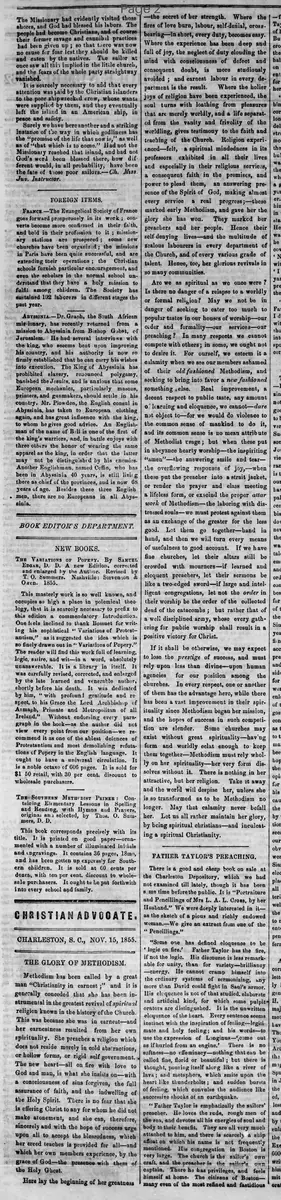
THE GLORY OF METHODISM.
Methodism has been called by a great man "Christianity in earnest;" and it is generally conceded that she has been instrumental in the greatest revival of spiritual religion known in the history of the Church.
This was because she was in earnest—and her earnestness resulted from her own spirituality. She preaches a religion which does not reside merely in cold abstractions, or hollow forms, or rigid self government.
The new heart—all on fire with love to God and man, is what she insists on with a consciousness of sins forgiven, the full assurance of faith, and the indwelling of the Holy Spirit. There is no fear that she is offering Christ to any for whom he did not make atonement, and she can, therefore, sincerely and with the hope of success urge upon all to accept the blessedness, which her creed teaches is provided for all—and which her own members experience, by the grace of God—the presence with them of the Holy Ghost.
Here lay the beginning of her greatness—the secret of her strength. Where the fires of love burn, labour, self-denial, cross-bearing—in short, every duty, becomes easy.
Where the experience has been deep and full of joy, the neglect of duty clouding the mind with consciousness of defect and consequent doubt, is more studiously avoided; and earnest labour in every department is the result. Where the holier joys of religion have been experienced, the soul turns with loathing from pleasures that are merely worldly, and a life separated from the vanity and frivolity of the worldling, gives testimony to the faith and teaching of the Church. Religion experienced—felt, a spiritual mindedness in its professors exhibited in all their lives and especially in their religious services, a consequent faith in the promises, and power to plead them, an answering presence of the Spirit of God, making almost every service a real progress;—these marked early Methodism, and gave her the glory she has won. They marked her preachers and her people. Hence their self-denying lives—and the multitude of zealous labourers in every department of the Church, and of every various grade of talent. Hence, too, her glorious revivals in so many communities.
Are we as spiritual as we once were? Is there no danger of a relapse to a worldly or formal religion? May we not be in danger of seeking to cater too much to popular tastes in our houses of worship—our order and formality—our services—our preaching? In many respects we cannot compete with others; in some, we ought not to desire it. For ourself, we esteem it a calamity when we see our members ashamed of their old fashioned Methodism, and seeking to bring into favor a new fashioned something else. Real improvement, a decent respect to public taste, any amount of learning and eloquence, we cannot—dare not object to—for we would do violence to the common sense of mankind to do it, and its common sense is no mean attribute of Methodist range; but when these put in abeyance hearty worship—the inspiriting "amen"—the answering smile and tear—the overflowing responses of joy,—when these put the preacher into a strait jacket, or render the prayer and class meeting a lifeless form, or exscind the proper altar work of Methodism—the laboring with distressed souls—we must protest against them as an exchange of the greater for the less good. Let them go together—hand in hand, and then we will turn every means of usefulness to good account. If we have fine churches, let their altars still be crowded with mourners—if learned and eloquent preachers, let their sermons be like a two-edged sword—if large and intelligent congregations, let not the order in their worship be the order of the collected dead of the catacombs; but rather that of a well disciplined army, whose every gathering for public worship shall result in a positive victory for Christ.
If it shall be otherwise, we may expect to lose the prestige of success, and must rely upon less than divine—upon human agencies for our position among the churches. In every respect, one or another of them has the advantage here, while there has been a vast improvement in their spirituality since Methodism began her mission, and the hopes of success in such competition are slender. Some churches may exist without great spirituality—having form and worldly eclat enough to keep them together—Methodism must rely wholly on her spirituality—her very form dissolves without it. There is nothing in her attractive, but her religion. Take it away and the world will despise her, unless she is so transformed as to be Methodism no longer. May that calamity never befall her. Let us all rather maintain her glory, by being spiritual Christians—and inculcating a spiritual Christianity.
CHARLESTON, S. C., NOV. 15, 1855.
THE GLORY OF METHODISM.
Methodism has been called by a great man "Christianity in earnest;" and it is generally conceded that she has been instrumental in the greatest revival of spiritual religion known in the history of the Church.
This was because she was in earnest—and her earnestness resulted from her own spirituality. She preaches a religion which does not reside merely in cold abstractions, or hollow forms, or rigid self government.
The new heart—all on fire with love to God and man, is what she insists on with a consciousness of sins forgiven, the full assurance of faith, and the indwelling of the Holy Spirit. There is no fear that she is offering Christ to any for whom he did not make atonement, and she can, therefore, sincerely and with the hope of success urge upon all to accept the blessedness, which her creed teaches is provided for all—and which her own members experience, by the grace of God—the presence with them of the Holy Ghost.
Here lay the beginning of her greatness—the secret of her strength. Where the fires of love burn, labour, self-denial, cross-bearing—in short, every duty, becomes easy.
Where the experience has been deep and full of joy, the neglect of duty clouding the mind with consciousness of defect and consequent doubt, is more studiously avoided; and earnest labour in every department is the result. Where the holier joys of religion have been experienced, the soul turns with loathing from pleasures that are merely worldly, and a life separated from the vanity and frivolity of the worldling, gives testimony to the faith and teaching of the Church. Religion experienced—felt, a spiritual mindedness in its professors exhibited in all their lives and especially in their religious services, a consequent faith in the promises, and power to plead them, an answering presence of the Spirit of God, making almost every service a real progress;—these marked early Methodism, and gave her the glory she has won. They marked her preachers and her people. Hence their self-denying lives—and the multitude of zealous labourers in every department of the Church, and of every various grade of talent. Hence, too, her glorious revivals in so many communities.
Are we as spiritual as we once were? Is there no danger of a relapse to a worldly or formal religion? May we not be in danger of seeking to cater too much to popular tastes in our houses of worship—our order and formality—our services—our preaching? In many respects we cannot compete with others; in some, we ought not to desire it. For ourself, we esteem it a calamity when we see our members ashamed of their old fashioned Methodism, and seeking to bring into favor a new fashioned something else. Real improvement, a decent respect to public taste, any amount of learning and eloquence, we cannot—dare not object to—for we would do violence to the common sense of mankind to do it, and its common sense is no mean attribute of Methodist range; but when these put in abeyance hearty worship—the inspiriting "amen"—the answering smile and tear—the overflowing responses of joy,—when these put the preacher into a strait jacket, or render the prayer and class meeting a lifeless form, or exscind the proper altar work of Methodism—the laboring with distressed souls—we must protest against them as an exchange of the greater for the less good. Let them go together—hand in hand, and then we will turn every means of usefulness to good account. If we have fine churches, let their altars still be crowded with mourners—if learned and eloquent preachers, let their sermons be like a two-edged sword—if large and intelligent congregations, let not the order in their worship be the order of the collected dead of the catacombs; but rather that of a well disciplined army, whose every gathering for public worship shall result in a positive victory for Christ.
If it shall be otherwise, we may expect to lose the prestige of success, and must rely upon less than divine—upon human agencies for our position among the churches. In every respect, one or another of them has the advantage here, while there has been a vast improvement in their spirituality since Methodism began her mission, and the hopes of success in such competition are slender. Some churches may exist without great spirituality—having form and worldly eclat enough to keep them together—Methodism must rely wholly on her spirituality—her very form dissolves without it. There is nothing in her attractive, but her religion. Take it away and the world will despise her, unless she is so transformed as to be Methodism no longer. May that calamity never befall her. Let us all rather maintain her glory, by being spiritual Christians—and inculcating a spiritual Christianity.
What sub-type of article is it?
Moral Or Religious
What keywords are associated?
Methodism
Spirituality
Religious Revival
Earnest Faith
Church Worship
Moral Exhortation
What entities or persons were involved?
Methodism
Holy Spirit
Christ
Editorial Details
Primary Topic
The Glory Of Methodism Through Spiritual Earnestness
Stance / Tone
Exhortation To Preserve Spiritual Vitality
Key Figures
Methodism
Holy Spirit
Christ
Key Arguments
Methodism's Greatness Stems From Earnest Spirituality And Revival Of Religion
Spirituality Results In Self Denial, Zealous Labor, And Separation From Worldly Pleasures
Warning Against Relapse To Formal Or Worldly Religion In Worship And Preaching
Protest Against Changes That Suppress Hearty Worship And Altar Work
Methodism Relies Wholly On Spirituality For Its Form And Success