Thank you for visiting SNEWPapers!
Sign up free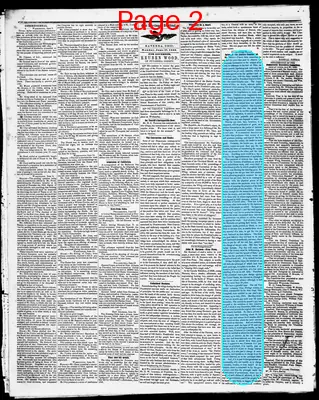
Letter to Editor
June 17, 1850
Portage Sentinel
Ravenna, Portage County, Ohio
What is this article about?
A letter critiques the justice of interest, arguing it benefits capitalists at labor's expense. It opposes Ohio's new 10% interest law for enforcing usury via state power and draws parallels to the Galphin claim and unpaid 1812 soldier pay from Portage County.
Clipping

OCR Quality
95%
Excellent
Full Text
For the Portage Sentinel.
Interest—Its Justice Considered.
Mr. Editor—I have been somewhat interested for some time past to observe the newspaper discussions on the subject of interest, in reference to the law of Ohio recently passed, legalizing and enforcing the payment of ten per cent. interest, where it has been agreed on by the parties—and as connected, also, with the claim recently allowed and paid by President Taylor's Cabinet—the noted Galphin case. The Legislature of Ohio, no doubt, mistook public sentiment when passing this law legalizing ten per cent. interest, and it is not strange nor unusual for Legislatures to make such mistakes. I believe every Legislature does so. Every Legislature passes laws destined soon to be repealed, as not the will of the people, and many unjust laws are submitted to quietly—not repealed—that in justice ought to be repealed—for the people best love quiet. They do not like opposition, excitement and agitation, to remove a trifling evil. It is only palpable and grievous wrongs that they are disposed to resist.
This ten per cent. law, however, it is supposed, will be productive of good, as it excites discussion on the justice of interest. It begins to be questioned whether interest is ever just. It is contended that it is only labor that produces—that money of itself produces nothing: and that if the borrower repays the money, the lender is made good. Certainly, the lender can, in strict justice, require no more than pay for his trouble, his labor of transferring the money from one person to the other, and the risk, if any. Anything more would be a tax on labor for the aggrandizement of capitalists.
This payment of interest has been the ruin of the fortunes of millions, as out of it grow exorbitant rents, and every kind of exorbitant profits by which property holders are ever fleecing the laboring poor. But the wrong in the ten per cent. law consists, not in allowing people to contract for and recover ten per cent., but in its arming the creditor with the physical power of the State to enforce the payment, even by the penalty of exposing the property of the debtor to forced sale, at any sacrifice. It is certainly enough for the money lords that they have the money, and can keep it, or can let it to those only on whose engagements they can depend to fulfil promises without the penalties of forced sales. That law is like too many other laws made by the representatives of the people, so called. Its apparent design is, 'to protect'—not 'the weak against the strong'—no! but to protect the strong against the weak—to protect those who need no protection—or, rather, to aid the strong to oppress the weak. And already, I learn, the Shylocks are getting their bonds, their judgment bonds, printed, in blank, to conform to the new law, to enable them on every renewal of a note, to get the ten per cent. fastened on their debtors. The debtors, poor fellows! they will hate to be sued and distressed immediately, and may, therefore, to put far off the evil day, submit to the charge of ten per cent. But they had better beware. Pay day will come, and with it the money must be forthcoming, or else—what?—not the pound of flesh,' perhaps, but the products of days, weeks and months of hard toil. It is, indeed, too bad.
Of that Galphin claim, for interest on an old debt, the principal of which had been paid years ago, it is plain to me that, if interest is just on a just debt, of a few years standing, it is on an old debt. Therefore, if the principal was a just charge against the United States, the interest is, (though I do not admit either,) although it had run for more than 70 years.
We have a parallel case. The old Volunteer company from Portage county, in 1812, commanded by the then Capt. John Campbell, were entitled to one year's pay at least, up to July, 1813. But they received but six months pay until near 20 years thereafter. The second six months' pay was not paid to the members of that company until, I think it was December, 1829, when, at 6 per cent interest, the original debt would have nearly doubled. So that a private of the company then receiving about 75 dollars as pay and rations for 6 months, should've received also about the same amount as interest on that sum. And not receiving that interest until the lapse of 16 and two thirds years, it would again double, so that at this time, if interest is a just charge, they would be entitled to about two hundred dollars each, as interest on the six months' pay that had been deferred, say 16½ years after the time it should have been paid.
Now, it appears to me, if interest is a just charge on principal, it is equally just on interest, and if it is just to charge interest annually, it is also just to charge it semi-annually, and equally so to charge it on the interest deferred, as on the principal deferred. And, if it is just to charge interest semi-annually, why not equally so to charge it monthly, weekly, or even daily? If the Galphin claim is submitted to by the government, and thus the principle made the settled policy of government, there are enough of such claims, if allowed, to bankrupt the government, and if the people sh'd be taxed to pay them, to beggar the people, the millionaires and government creditors only excepted, who only pay taxes, as now levied on imports, in proportion to the amount of imports they consume, not in proportion to their ability to pay. But I forbear to pursue this subject further at present. This is meant only as a suggestion to the minds of those readers who honestly believe that the products of labor should go to the laborer, and the products of idleness to the idler. The good sense and sense of justice of such readers will require no extended arguments on the subject. 'A word to the wise is sufficient.'
Interest—Its Justice Considered.
Mr. Editor—I have been somewhat interested for some time past to observe the newspaper discussions on the subject of interest, in reference to the law of Ohio recently passed, legalizing and enforcing the payment of ten per cent. interest, where it has been agreed on by the parties—and as connected, also, with the claim recently allowed and paid by President Taylor's Cabinet—the noted Galphin case. The Legislature of Ohio, no doubt, mistook public sentiment when passing this law legalizing ten per cent. interest, and it is not strange nor unusual for Legislatures to make such mistakes. I believe every Legislature does so. Every Legislature passes laws destined soon to be repealed, as not the will of the people, and many unjust laws are submitted to quietly—not repealed—that in justice ought to be repealed—for the people best love quiet. They do not like opposition, excitement and agitation, to remove a trifling evil. It is only palpable and grievous wrongs that they are disposed to resist.
This ten per cent. law, however, it is supposed, will be productive of good, as it excites discussion on the justice of interest. It begins to be questioned whether interest is ever just. It is contended that it is only labor that produces—that money of itself produces nothing: and that if the borrower repays the money, the lender is made good. Certainly, the lender can, in strict justice, require no more than pay for his trouble, his labor of transferring the money from one person to the other, and the risk, if any. Anything more would be a tax on labor for the aggrandizement of capitalists.
This payment of interest has been the ruin of the fortunes of millions, as out of it grow exorbitant rents, and every kind of exorbitant profits by which property holders are ever fleecing the laboring poor. But the wrong in the ten per cent. law consists, not in allowing people to contract for and recover ten per cent., but in its arming the creditor with the physical power of the State to enforce the payment, even by the penalty of exposing the property of the debtor to forced sale, at any sacrifice. It is certainly enough for the money lords that they have the money, and can keep it, or can let it to those only on whose engagements they can depend to fulfil promises without the penalties of forced sales. That law is like too many other laws made by the representatives of the people, so called. Its apparent design is, 'to protect'—not 'the weak against the strong'—no! but to protect the strong against the weak—to protect those who need no protection—or, rather, to aid the strong to oppress the weak. And already, I learn, the Shylocks are getting their bonds, their judgment bonds, printed, in blank, to conform to the new law, to enable them on every renewal of a note, to get the ten per cent. fastened on their debtors. The debtors, poor fellows! they will hate to be sued and distressed immediately, and may, therefore, to put far off the evil day, submit to the charge of ten per cent. But they had better beware. Pay day will come, and with it the money must be forthcoming, or else—what?—not the pound of flesh,' perhaps, but the products of days, weeks and months of hard toil. It is, indeed, too bad.
Of that Galphin claim, for interest on an old debt, the principal of which had been paid years ago, it is plain to me that, if interest is just on a just debt, of a few years standing, it is on an old debt. Therefore, if the principal was a just charge against the United States, the interest is, (though I do not admit either,) although it had run for more than 70 years.
We have a parallel case. The old Volunteer company from Portage county, in 1812, commanded by the then Capt. John Campbell, were entitled to one year's pay at least, up to July, 1813. But they received but six months pay until near 20 years thereafter. The second six months' pay was not paid to the members of that company until, I think it was December, 1829, when, at 6 per cent interest, the original debt would have nearly doubled. So that a private of the company then receiving about 75 dollars as pay and rations for 6 months, should've received also about the same amount as interest on that sum. And not receiving that interest until the lapse of 16 and two thirds years, it would again double, so that at this time, if interest is a just charge, they would be entitled to about two hundred dollars each, as interest on the six months' pay that had been deferred, say 16½ years after the time it should have been paid.
Now, it appears to me, if interest is a just charge on principal, it is equally just on interest, and if it is just to charge interest annually, it is also just to charge it semi-annually, and equally so to charge it on the interest deferred, as on the principal deferred. And, if it is just to charge interest semi-annually, why not equally so to charge it monthly, weekly, or even daily? If the Galphin claim is submitted to by the government, and thus the principle made the settled policy of government, there are enough of such claims, if allowed, to bankrupt the government, and if the people sh'd be taxed to pay them, to beggar the people, the millionaires and government creditors only excepted, who only pay taxes, as now levied on imports, in proportion to the amount of imports they consume, not in proportion to their ability to pay. But I forbear to pursue this subject further at present. This is meant only as a suggestion to the minds of those readers who honestly believe that the products of labor should go to the laborer, and the products of idleness to the idler. The good sense and sense of justice of such readers will require no extended arguments on the subject. 'A word to the wise is sufficient.'
What sub-type of article is it?
Persuasive
Philosophical
Ethical Moral
What themes does it cover?
Economic Policy
Morality
Politics
What keywords are associated?
Interest Justice
Ohio Interest Law
Ten Percent Interest
Galphin Claim
Usury Critique
Labor Exploitation
1812 Soldier Pay
What entities or persons were involved?
Mr. Editor
Letter to Editor Details
Recipient
Mr. Editor
Main Argument
interest is unjust as only labor produces value, and charging it taxes workers for capitalists' gain; ohio's 10% interest law wrongly empowers creditors to oppress debtors via state force, akin to the galphin claim's allowance of interest on an old debt.
Notable Details
References Shylocks Preparing Bonds Under New Law
Parallel To 1812 Portage County Volunteer Company Under Capt. John Campbell, Unpaid For 16.5 Years
Critique Of Galphin Claim Interest After 70 Years
Argument That Compound Interest Could Bankrupt Government