Thank you for visiting SNEWPapers!
Sign up free
Gadsden County Times
Quincy, Gadsden County, Florida
What is this article about?
Farmers and victory gardeners are planning fall and winter gardens, with advice on planting vegetables like cow peas, beans, and squash now, and onions later. Tips include fighting insects, soil considerations, proper seed spacing and depth. Pamphlets available from Miss Elise Laffitte.
Clipping
OCR Quality
Full Text
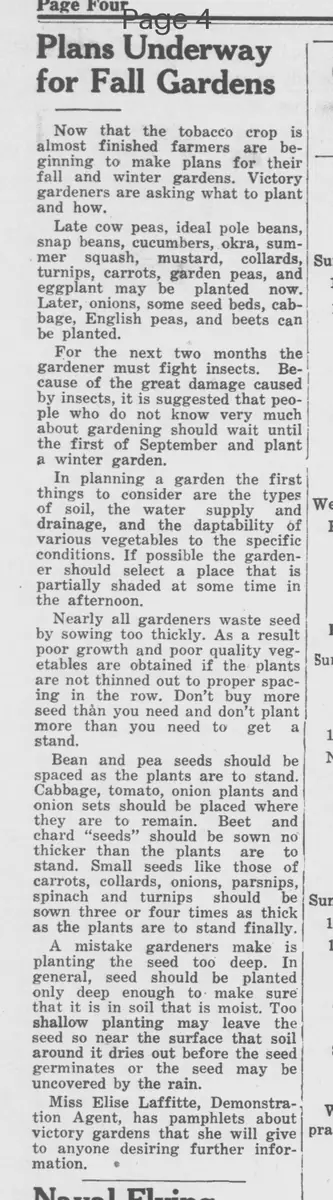
Now that the tobacco crop is almost finished farmers are beginning to make plans for their fall and winter gardens. Victory gardeners are asking what to plant and how.
Late cow peas, ideal pole beans, snap beans, cucumbers, okra, summer squash, mustard, collards, turnips, carrots, garden peas, and eggplant may be planted now.
Later, onions, some seed beds, cabbage, English peas, and beets can be planted.
For the next two months the gardener must fight insects. Because of the great damage caused by insects, it is suggested that people who do not know very much about gardening should wait until the first of September and plant a winter garden.
In planning a garden the first things to consider are the types of soil, the water supply and drainage, and the adaptability of various vegetables to the specific conditions. If possible the gardener should select a place that is partially shaded at some time in the afternoon.
Nearly all gardeners waste seed by sowing too thickly. As a result poor growth and poor quality vegetables are obtained if the plants are not thinned out to proper spacing in the row. Don't buy more seed than you need and don't plant more than you need to get a stand.
Bean and pea seeds should be spaced as the plants are to stand.
Cabbage, tomato, onion plants and onion sets should be placed where they are to remain. Beet and chard "seeds" should be sown no thicker than the plants are to stand. Small seeds like those of carrots, collards, onions, parsnips, spinach and turnips should be sown three or four times as thick as the plants are to stand finally.
A mistake gardeners make is planting the seed too deep. In general, seed should be planted only deep enough to make sure that it is in soil that is moist. Too shallow planting may leave the seed so near the surface that soil around it dries out before the seed germinates or the seed may be uncovered by the rain.
Miss Elise Laffitte, Demonstration Agent, has pamphlets about victory gardens that she will give to anyone desiring further information.
What sub-type of article is it?
What keywords are associated?
What entities or persons were involved?
Domestic News Details
Key Persons
Event Details
Farmers are planning fall and winter gardens after tobacco harvest. Victory gardeners seek planting advice: now plant late cow peas, pole beans, snap beans, cucumbers, okra, summer squash, mustard, collards, turnips, carrots, garden peas, eggplant. Later: onions, seed beds, cabbage, English peas, beets. Fight insects next two months; novices wait until September. Consider soil, water, drainage, vegetable adaptability; prefer partial afternoon shade. Avoid thick sowing; space seeds properly by type. Plant seeds at moist depth, not too deep or shallow. Pamphlets available from Demonstration Agent.