Thank you for visiting SNEWPapers!
Sign up free
The Alexandria Herald
Alexandria, Virginia
What is this article about?
On June 19, 1813, Rep. Felix Grundy delivers a speech in the U.S. House defending the administration against opposition claims that earlier disclosure of France's 1811 decree modifying Berlin and Milan decrees could have averted war with Britain, arguing Britain demanded total repeal for all neutrals.
Merged-components note: This is a single continuous speech by Mr. Grundy delivered in the House of Representatives, spanning pages 1 and 2 with sequential reading order and matching topic on the resolutions regarding French decrees and British orders in council.
Clippings
1 of 2
OCR Quality
Full Text
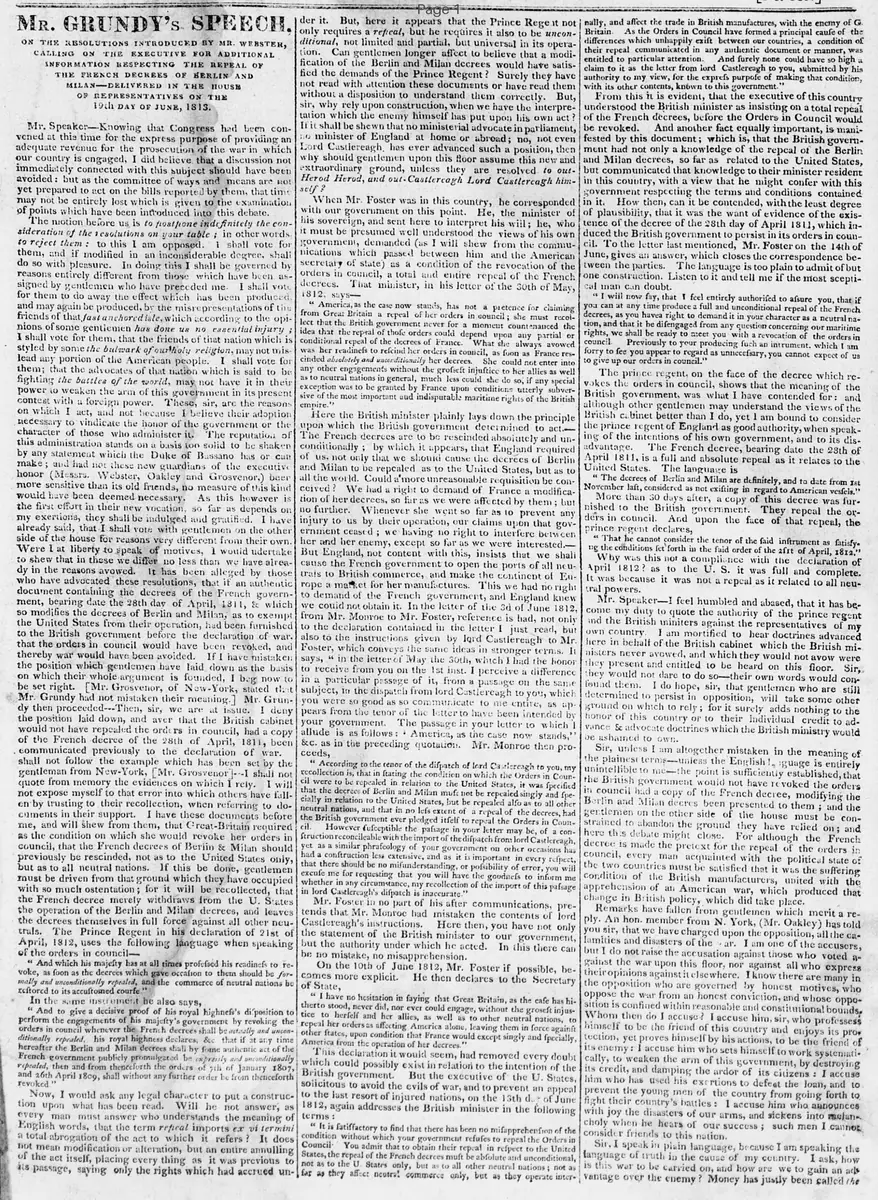
ON THE RESOLUTIONS INTRODUCED BY MR. WEBSTER,
CALLING ON THE EXECUTIVE FOR ADDITIONAL INFORMATION RESPECTING THE REPEAL OF THE FRENCH DECREES OF BERLIN AND MILAN—DELIVERED IN THE HOUSE OF REPRESENTATIVES ON THE 19th DAY OF JUNE, 1813.
Mr. Speaker—Knowing that Congress had been convened at this time for the express purpose of providing an adequate revenue for the prosecution of the war in which our country is engaged, I did believe that a discussion not immediately connected with this subject should have been avoided: but as the committee of ways and means are not yet prepared to act on the bills reported by them, that time may not be entirely lost which is given to the examination of points which have been introduced into this debate.
The motion before us is to postpone indefinitely the consideration of the resolutions on your table; in other words, to reject them: to this I am opposed. I shall vote for them, and if modified in an inconsiderable degree, shall do so with pleasure. In doing this I shall be governed by reasons entirely different from those which have been assigned by gentlemen who have preceded me. I shall vote for them to do away the effect which has been produced, and may again be produced, by the misrepresentations of the friends of that fast anchored isle which according to the opinions of some gentlemen has done us no essential injury;
I shall vote for them, that the friends of that nation which is styled by some the bulwark of our holy religion, may not mislead any portion of the American people. I shall vote for them; that the advocates of that nation which is said to be fighting the battles of the world, may not have it in their power to weaken the arm of this government in its present contest with a foreign power. These, sir, are the reasons on which I act, and not because I believe their adoption necessary to vindicate the honor of the government or the character of those who administer it. The reputation of this administration stands on a basis too solid to be shaken by any statement which the Duke of Bassano has or can make; and had not these new guardians of the executive honor (Messrs. Webster, Oakley and Grosvenor,) been more sensitive than its old friends, no measure of this kind would have been deemed necessary. As this however is the first effort in their new vocation, so far as depends on my exertions, they shall be indulged and gratified. I have already said, that I shall vote with gentlemen on the other side of the house for reasons very different from their own.
Were I at liberty to speak of motives, I would undertake to shew that in these we differ no less than we have already in the reasons avowed. It has been alleged by those who have advocated these resolutions, that if an authentic document containing the decrees of the French government, bearing date the 28th day of April, 1811, & which so modifies the decrees of Berlin and Milan, as to exempt the United States from their operation, had been furnished to the British government before the declaration of war, that the orders in council would have been revoked, and thereby war would have been avoided. If I have mistaken the position which gentlemen have laid down as the basis on which their whole argument is founded, I beg now to be set right. [Mr. Grosvenor, of New-York, stated that Mr. Grundy had not mistaken their meaning.] Mr. Grundy then proceeded—Then, sir, we are at issue. I deny the position laid down, and aver that the British cabinet would not have repealed the orders in council, had a copy of the French decree of the 28th of April, 1811, been communicated previously to the declaration of war.
I shall not follow the example which has been set by the gentleman from New-York, [Mr. Grosvenor]—I shall not quote from memory the evidences on which I rely. I will not expose myself to that error into which others have fallen by trusting to their recollection, when referring to documents in their support. I have these documents before me, and will shew from them, that Great-Britain required as the condition on which she would revoke her orders in council, that the French decrees of Berlin & Milan should previously be rescinded, not as to the United States only, but as to all neutral nations. If this be done, gentlemen must be driven from that ground which they have occupied with so much ostentation; for it will be recollected, that the French decree merely withdraws from the U. States the operation of the Berlin and Milan decrees, and leaves the decrees themselves in full force against all other neutrals. The Prince Regent in his declaration of 21st of April, 1812, uses the following language when speaking of the orders in council—
"And which his majesty has at all times professed his readiness to revoke, as soon as the decrees which gave occasion to them should be formally and unconditionally repealed, and the commerce of neutral nations be restored to its accustomed course."
In the same instrument he also says,
"And to give a decisive proof of his royal highness's disposition to perform the engagements of his majesty's government by revoking the orders in council whenever the French decrees shall be actually and unconditionally repealed, his royal highness declares, &c that if at any time hereafter the Berlin and Milan decrees shall by some authentic act of the French government publicly promulgated be expressly and unconditionally repealed, then and from thenceforth the orders of 7th of January 1807, and 26th April 1809, shall without any further order be from thenceforth revoked."
Now, I would ask any legal character to put a construction upon what has been read. Will he not answer, as every man must answer who understands the meaning of English words, that the term repeal imports ex vi termini a total abrogation of the act to which it refers? It does not mean modification or alteration, but an entire annulling of the act itself, placing every thing as it was previous to its passage, saving only the rights which had accrued under it. But, here it appears that the Prince Regent not only requires a repeal, but he requires it also to be unconditional, not limited and partial, but universal in its operation. Can gentlemen longer affect to believe that a modification of the Berlin and Milan decrees would have satisfied the demands of the Prince Regent? Surely they have not read with attention these documents or have read them without a disposition to understand them correctly. But, sir, why rely upon construction, when we have the interpretation which the enemy himself has put upon his own act?
If it shall be shewn that no ministerial advocate in parliament, no minister of England at home or abroad; no, not even Lord Castlereagh has ever advanced such a position, then why should gentlemen upon this floor assume this new and extraordinary ground, unless they are resolved to out-Herod Herod, and out-Castlereagh Lord Castlereagh himself?
When Mr. Foster was in this country, he corresponded with our government on this point. He, the minister of his sovereign, and sent here to interpret his will; he, who it must be presumed well understood the views of his own government, demanded (as I will shew from the communications which passed between him and the American secretary of state) as a condition of the revocation of the orders in council, a total and entire repeal of the French decrees. That minister, in his letter of the 30th of May, 1812, says—
"America, as the case now stands, has not a pretence for claiming from Great Britain a repeal of her orders in council; she must recollect that the British government never for a moment countenanced the idea that the repeal of those orders could depend upon any partial or conditional repeal of the decrees of France. What she always avowed was her readiness to rescind her orders in council, as soon as France rescinded absolutely and unconditionally her decrees. She could not enter into any other engagements without the grossest injustice to her allies as well as to neutral nations in general, much less could she do so, if any special exception was to be granted by France upon conditions utterly subversive of the most important and indisputable maritime rights of the British empire."
Here the British minister plainly lays down the principle upon which the British government determined to act.—The French decrees are to be rescinded absolutely and unconditionally; by which it appears, that England required of us, not only that we should cause the decrees of Berlin and Milan to be repealed as to the United States, but as to all the world. Could a more unreasonable requisition be conceived? We had a right to demand of France a modification of her decrees, so far as we were affected by them; but no further. Whenever she went so far as to prevent any injury to us by their operation, our claims upon that government ceased; we having no right to interfere between her and her enemy, except so far as we were interested.—But England, not content with this, insists that we shall cause the French government to open the ports of all neutrals to British commerce, and make the continent of Europe a market for her manufactures. This we had no right to demand of the French government, and England knew we could not obtain it. In the letter of the 3d of June 1812, from Mr. Monroe to Mr. Foster, reference is had, not only to the declaration contained in the letter I just read, but also to the instructions given by Lord Castlereagh to Mr. Foster, which conveys the same ideas in stronger terms. It says, "in the letter of May the 30th, which I had the honor to receive from you on the 1st inst. I perceive a difference in a particular passage of it, from a passage on the same subject, in the dispatch from lord Castlereagh to you, which you were so good as to communicate to me entire, as appears from the tenor of the letter to have been intended by your government. The passage in your letter to which I allude is as follows: 'America, as the case now stands,'" &c. as in the preceding quotation. Mr. Monroe then proceeds,
"According to the tenor of the dispatch of lord Castlereagh to you, my recollection is, that in stating the condition on which the Orders in Council were to be repealed in relation to the United States, it was specified that the decree of Berlin and Milan must not be repealed singly and specially in relation to the United States, but be repealed also as to all other neutral nations, and that in no less extent of a repeal of the decrees, had the British government ever pledged itself to repeal the Orders in Council. However susceptible the passage in your letter may be, of a construction reconcileable with the import of the dispatch from lord Castlereagh, yet as a similar phraseology of your government on other occasions has had a construction less extensive, and as it is important in every respect, that there should be no misunderstanding, or possibility of error, you will excuse me for requesting that you will have the goodness to inform me whether in any circumstance, my recollection of the import of this passage in lord Castlereagh's dispatch is inaccurate."
Mr. Foster in no part of his after communications, pretends that Mr. Monroe had mistaken the contents of lord Castlereagh's instructions. Here then, you have not only the statement of the British minister to our government, but the authority under which he acted. In this there can be no mistake, no misapprehension.
On the 10th of June 1812, Mr. Foster if possible, becomes more explicit. He then declares to the Secretary of State,
"I have no hesitation in saying that Great Britain, as the case has hitherto stood, never did, nor ever could engage, without the grossest injustice to herself and her allies, as well as to other neutral nations, to repeal her orders as affecting America alone, leaving them in force against other states, upon condition that France would except singly and specially America from the operation of her decrees."
This declaration it would seem, had removed every doubt which could possibly exist in relation to the intention of the British government. But the executive of the U. States, solicitous to avoid the evils of war, and to prevent an appeal to the last resort of injured nations, on the 13th day of June 1812, again addresses the British minister in the following terms:
"It is satisfactory to find that there has been no misapprehension of the condition without which your government refuses to repeal the Orders in Council. You admit that to obtain their repeal in respect to the United States, the repeal of the French decrees must be absolute and unconditional, not as to the U. States only, but as to all other neutral nations; not as far as they affect neutral commerce only, but as they operate internally, and affect the trade in British manufactures, with the enemy of G. Britain. As the Orders in Council have formed a principal cause of the differences which unhappily exist between our countries, a condition of their repeal communicated in any authentic document or manner, was entitled to particular attention. And surely none could have so high a claim to it as the letter from lord Castlereagh to you, submitted by his authority to my view, for the express purpose of making that condition, with its other contents, known to this government."
From this it is evident, that the executive of this country understood the British minister as insisting on a total repeal of the French decrees, before the Orders in Council would be revoked. And another fact equally important, is manifested by this document; which is, that the British government had not only a knowledge of the repeal of the Berlin and Milan decrees, so far as related to the United States, but communicated that knowledge to their minister resident in this country, with a view that he might confer with this government respecting the terms and conditions contained in it. How then, can it be contended, with the least degree of plausibility, that it was the want of evidence of the existence of the decree of the 28th day of April 1811, which induced the British government to persist in its orders in council. To the letter last mentioned, Mr. Foster on the 14th of June, gives an answer, which closes the correspondence between the parties. The language is too plain to admit of but one construction. Listen to it and tell me if the most sceptical man can doubt.
"I will now say, that I feel entirely authorised to assure you, that if you can at any time produce a full and unconditional repeal of the French decrees, as you have a right to demand it in your character as a neutral nation, and that it be disengaged from any question concerning our maritime rights, we shall be ready to meet you with a revocation of the orders in council. Previously to your producing such an instrument, which I am sorry to see you appear to regard as unnecessary, you cannot expect of us to give up our orders in council."
The prince regent, on the face of the decree which revokes the orders in council, shows that the meaning of the British government, was what I have contended for: and although other gentlemen may understand the views of the British cabinet better than I do, yet I am bound to consider the prince regent of England as good authority, when speaking of the intentions of his own government, and to its disadvantage. The French decree, bearing date the 28th of April 1811, is a full and absolute repeal as it relates to the United States. The language is
"The decrees of Berlin and Milan are definitely, and to date from 1st November last, considered as not existing in regard to American vessels."
More than 30 days after, a copy of this decree was furnished to the British government. They repeal the orders in council. And upon the face of that repeal, the prince regent declares,
"That he cannot consider the tenor of the said instrument as satisfying the conditions set forth in the said order of the 21st of April, 1812."
Why was this not a compliance with the declaration of April 1812? as to the U. S. it was full and complete. It was because it was not a repeal as it related to all neutral powers.
Mr. Speaker—I feel humbled and abased, that it has become my duty to quote the authority of the prince regent and the British ministers against the representatives of my own country. I am mortified to hear doctrines advanced here in behalf of the British cabinet which the British ministers never avowed, and which they would not avow were they present and entitled to be heard on this floor. Sir, they would not dare to do so—their own words would confound them. I do hope, sir, that gentlemen who are still determined to persist in opposition, will take some other ground on which to rely; for it surely adds nothing to the honor of this country or to their individual credit to advance & advocate doctrines which the British ministry would be ashamed to own.
Sir, unless I am altogether mistaken in the meaning of the plainest terms—unless the English language is entirely unintelligible to me—the point is sufficiently established, that the British government would not have revoked the orders in council had a copy of the French decree, modifying the Berlin and Milan decrees been presented to them; and the gentlemen on the other side of the house must be constrained to abandon the ground they have relied on; and here this debate might close. For although the French decree is made the pretext for the repeal of the orders in council, every man acquainted with the political state of the two countries must be satisfied that it was the suffering condition of the British manufacturers, united with the apprehension of an American war, which produced that change in British policy, which did take place.
Remarks have fallen from gentlemen which merit a reply. An hon. member from N. York, (Mr. Oakley) has told you sir, that we have charged upon the opposition, all the calamities and disasters of the war. I am one of the accusers, but I do not raise the accusation against those who voted against the war upon this floor, nor against all who express their opinions against it elsewhere. I know there are many in the opposition who are governed by honest motives, who oppose the war from an honest conviction, and whose opposition is confined within reasonable and constitutional bounds.
Whom then do I accuse? I accuse him, sir, who professes himself to be the friend of this country and enjoys its protection, yet proves himself by his actions, to be the friend of its enemy: I accuse him who sets himself to work systematically, to weaken the arm of this government, by destroying its credit, and damping the ardor of its citizens: I accuse him who has used his exertions to defeat the loan, and to prevent the young men of the country from going forth to fight their country's battles: I accuse him who announces with joy the disasters of our arms, and sickens into melancholy when he hears of our success; such men I cannot consider friends to this nation.
Sir, I speak in plain language, because I am speaking the language of truth in the cause of my country. I ask, how is this war to be carried on, and how are we to gain an advantage over the enemy? Money has justly been called the
sinew of war. Without money men cannot be raised, and without men battles cannot be gained: yet battles must be fought and gained before a peace, safe, honorable and durable, can be obtained for this nation. Is not that man then, subserving the interests of the enemy, who to the extent of his power, keeps money from our coffers, and men from our armies? And what, sir, is the greatest crime known to our constitution and laws? If a citizen goes over to the enemy and arms in his behalf, he is guilty of treason. The overt act is consummated, and the wickedness of his heart is demonstrated. Should the same citizen remain amongst us, and employ himself in aiding the enemy by paralyzing the national energies, is not the turpitude of his conduct, and his moral guilt equally great? Does he not serve the enemy as effectually? Nay, more, suppose he shall succeed in preventing ten men from joining the army, has he not rendered the enemy much more service than if he had actually joined the ranks of the enemy, and raised the sword in his favor? To my mind it is impossible to draw a line of distinction between adding to the strength of the enemy, and taking from the strength of his own country. In both cases he is working the ruin of his country, so far as that result depends on his exertions: and the only difference to himself is, that in one case he forfeits his life for his crime; in the other, he lives an object of public execration, and loaded with the abhorrence of all good men:
While upon the subject of the war, and the conduct of opposition, suffer me, Mr. Speaker, to devote another moment to the almost incomprehensible part which they are seen to act. They call themselves the friends of peace; yet what step do they take to procure it for their country? Now that the war rages upon the frontiers, peace can only be obtained by expelling the enemy from our borders, or by negotiating with him. Which method does the opposition prefer? It cannot be the former, because they withhold from the government, so far as they can do so, all the means of effecting it. Is it the latter? Then why not come out with a candid declaration in favor of the Russian mediation-- why not rejoice that an extraordinary mission is dispatched to St. Petersburgh? And yet upon this subject an impenetrable silence has been preserved, no sentence of approbation has escaped their lips: from the first we have not heard the emperor of Russia applauded for his friendly disposition manifested towards this country, by interposing his kind offices between the two nations.
Sir, an eternal cry of peace, peace! peace! is kept up, while at the same time, objection after objection, difficulty after difficulty, obstacle after obstacle, is thrown in the way of the government, in every attempt made to bring the war to a speedy termination. Every attempt to negotiate is treated with ridicule, and every means of carrying on the war successfully is withheld, so far as they can effect it-- and these are the friends of peace. Can gentlemen believe that the American people are to be deceived and imposed on by professions which are daily contradicted by actions? What does this extraordinary conduct mean? For something must be meant when even a system of contradiction is persisted in, with so much pertinacity and zeal.-- Will gentlemen compel me to say that self aggrandizement is the object and aim of many who practise this conduct? That war, protracted and disastrous, lingering and ruinous, is the secret wish of no small portion of the leaders of that party which cries so loudly for peace; war which shall involve in ruin, the administration that declared it, and which shall bring into power the men who were put down by the people twelve or thirteen years ago.
Sir, I felt some astonishment to hear the member from New York, (Mr. Grosvenor) who had no seat in this house when war was declared, who was not even in this city at that time, state with so much confidence, in what events the war would or would not have taken place. If the public documents are referred to, it will be seen that the impressment of our seamen was considered as a principal cause of the war. In the executive messages of that session, in the reports of the committee of foreign relations, it will be seen that the language of freemen was employed, the liberty of the citizen being deemed more valuable and precious than his property. I was one of those who voted for the war, and ought to be presumed to know something of the opinions and sentiments which prevailed at that time, and yet I feel no hesitation in saying, that no man can pronounce what would have been the course pursued, had the orders in council been revoked. I have heard many members say they would have voted for the war, had the orders in council been previously abandoned: I have heard others say they would not; and yet the gentleman from New York, (Mr. Grosvenor) affects to speak with great confidence and precision on this subject. There are two reasons why this honorable gentleman should have been less confident in his assertions. In the first place, he was not present when the war was declared; in the second, he belonged to the opposition, and would not on that account have been so freely communicated with by those who supported it.
Sir, I wish gentlemen clearly and distinctly to answer me this question-- Will they give up the principle of impressment? Will they suffer the petty officers of the British navy to seize at their pleasure American citizens, force them into a foreign service, and compel them with stripes to fight the battles of the enemy, even against that country which gave them birth? If so, let it be known to the people-- let it be proclaimed to this nation of freemen-- and let the line of distinction be drawn between those who will and will not submit to this tyranny of 'the mistress of the seas.' Gentlemen have indeed said that they will not fight for the question of impressment. But will they surrender it? Will they yield this point to the king of Great Britain? Will they say that the slaves of George the 3d, have a right to seize and drive into captivity the freemen of the American states? I demand an answer, yea or nay. There is no difficulty in understanding the question.
The gentleman from New-York, (Mr. Grosvenor) in adverting to the correspondence between Mr. Monroe and Mr. Foster, affects great difficulty in understanding its meaning. I cannot see wherein this difficulty lies; the language is plain, void of ambiguity, conveying distinct ideas, in clear and unequivocal expressions. The same gentleman has the modesty to tell you that Mr. Monroe and Mr. Foster did not understand the meaning of the words actually and unconditionally. What, sir, your Secretary of State, who has visited in the character of an American minister nearly half the courts of Europe; he whose literary acquirements have done honor to this nation, not understand the meaning of the common English words actually and unconditionally! Mr. Foster, too, the accredited minister of the 'fast-anchored isle,' sent by the British government upwards of three thousand miles to negotiate upon delicate and difficult points, is charged with the like ignorance. Sir, the gentleman who introduced these resolutions, (Mr. Webster) if he has ever read his name-sake's spelling-book, (and no doubt he has) can readily expound them. Even a school-boy can tell you their meaning.-- I feel no great solicitude or tenderness about the reputation of the late British minister, but surely he ought not to be subject to this imputation.
In one idea advanced by the opposition, I perfectly concur: if the executive had received a copy of the French decree previous to the declaration of war, and had withheld it from the British minister, I should say he deserved the execration of his country. The honorable gentleman who has manifested such critical skill in language might have drawn its character in terms of blackest import, and I would subscribe to it: but I know, with moral certainty, that the answer of the president will dissipate every idea of that kind-- it will shew, that in the whole of this transaction, he has conducted with fairness and uprightness, and from a desire to prevent a conflict between this and any other nation. Yes, sir, he has acted in obedience to honorable feelings, to which many who implicate him are entire strangers.
It is said, that formerly, when Mr. Jackson insulted this government, there was great solicitude manifested to resent it. Sir, who manifested on that occasion a disposition to maintain the honor and dignity of this nation? I answer, this side of the house. At the same time, who palliated-- who excused-- who apologised for that greatest of outrages? and who attempted, finally, to justify it? Why, sir, the political associates of these very men who have just taken the honor of this administration into their keeping.
The gentleman from New-York (Mr. Grosvenor) says, that a suspicion prevails among many of both parties in this country, that French influence has found its way into our councils. I do believe that among the prevailing party, the great majority of the nation, there are none who suspect it. In the opposition, I am satisfied there are a few who have been so far misled as to entertain such a suspicion: but many are they who speak of French influence, and do not believe it exists: they use it to alarm & deceive others. But is it not strange that the very party which has labored to excite this suspicion, should now become so clamorous to put it down?
Having answered all the observations of others which are deemed material, I will make a few enquiries of the hon. mover of those resolutions (Mr. Webster.) He certainly best knows the objects intended, and I pray him to answer for himself, and not by proxy. Is it his object to make it appear that the Duke of Bassano has been guilty of falsehood? If that shall turn out to be the case, what then? Will he make it a ground of going to war against France?
Great, indeed, are the insults and injuries which we have received from the French government, and much noise has the opposition made respecting them; but, sir, when my friend from Kentucky (Mr. M'Kee) offered a proposition to declare war against France, did the gentlemen on the other side of this house vote for it? To the best of my recollection, three of them only voted for the measure; a majority of the votes in favor of the proposition were given by this side of the house. He will not, I apprehend, say that he will go to war with France on this account. Is it intended to predicate any legislative act on the information which may be received from the executive? I can conceive of no legislative act which can grow out of it. What then, do gentlemen mean? What can be the object of these resolutions? To make it appear that France has acted with bad faith, and yet neither go to war nor pass any legislative act in consequence of it? I can see but one thing which gentlemen can promise themselves to follow from this course of proceeding.
They may hope by this to throw new difficulties in the way of the administration, to draw off the attention of the people from the prosecution of the war, paralyze the national energies, and multiply the chances of getting new men into power. If this be the object, the gentleman may please himself with the idea of having labored for the good of his country: but sure I am that the country can derive no benefit from such a course, however great his labors may be.
To show what has been done by an American Congress, how men have ceased their opposition, when the good of the country required it, I know full well, sir, would avail but little. But on this occasion, we may profit from the conduct of the enemy: he has set an example well worthy of imitation. Although in the British Parliament many were opposed to a war with America and all those measures which produced it, yet when war had broken out they threw no obstacle in the way of its success-- they voted the necessary supplies, they joined in the resolution to carry it on with vigor-- for they recollected that England was their country and America its enemy. If such has been the conduct of an English opposition, what ought to be the conduct of American representatives? If the slaves of a despot feel the impulse of patriotism, and act in obedience to its mandates, how much more should it be the case in this land of liberty, where the interest of each individual is intimately connected with the welfare of the government, and where every citizen is his own master!
What sub-type of article is it?
What themes does it cover?
What keywords are associated?
What entities or persons were involved?
Where did it happen?
Story Details
Key Persons
Location
House Of Representatives
Event Date
1813 06 19
Story Details
Rep. Grundy supports resolutions for executive information on French decrees' repeal to counter British sympathizers' misrepresentations, argues Britain required unconditional repeal for all neutrals not just U.S., defends administration's transparency and honor, criticizes opposition for undermining war effort.