Thank you for visiting SNEWPapers!
Sign up free
Literary
October 9, 1790
Gazette Of The United States
New York, New York County, New York
What is this article about?
In this concluding discourse on Davila, the Constable delays his journey to Paris amid suspicions, while the Princes of Navarre and Condé arrive at Orleans and face cold reception and arrest by the King, orchestrated by the court using the States General as a trap, leading to political intrigue and confinement.
Clipping
OCR Quality
98%
Excellent
Full Text
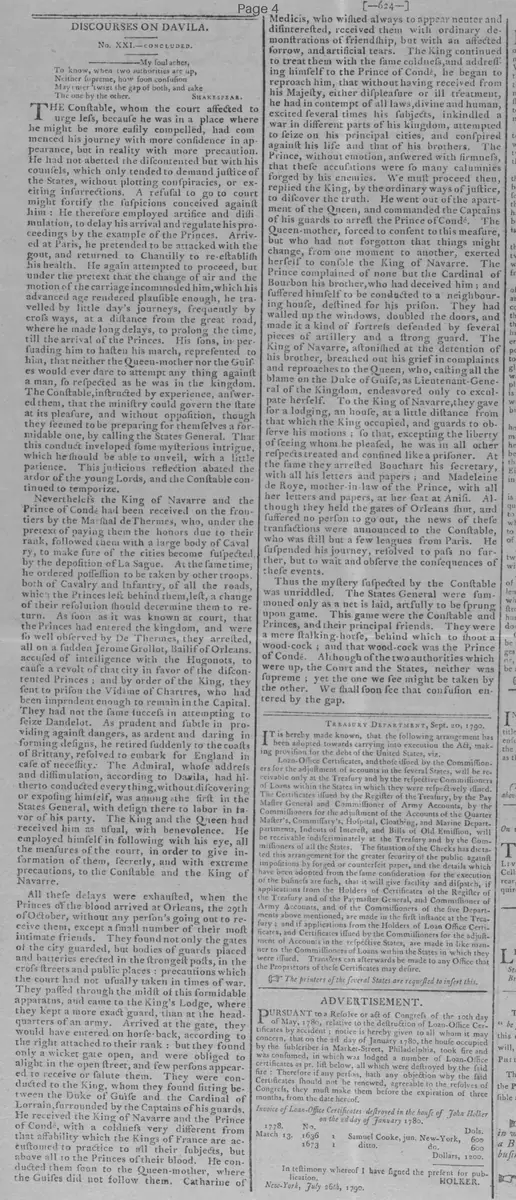
DISCOURSES ON DAVILA.
NO. XXI.-CONCLUDED.
-My soul aches,
To know, when two authorities are up,
Neither supreme, how soon confusion
May enter 'twixt the gap of both, and take
The one by the other.
SHAKESPEARE.
THE Constable, as he was, he might be more easily compelled, had commenced his journey with more confidence in appearance, but in reality with more precaution. He had not abetted the discontented but with his counsels, which only tended to demand justice of the States, without plotting conspiracies, or exciting insurrections. A refusal to go to court might fortify the suspicions conceived against him: He therefore employed artifice and dissimulation, to delay his arrival and regulate his proceedings by the example of the Princes. Arrived at Paris, he pretended to be attacked with the gout, and returned to Chantilly to re-establish his health. He again attempted to proceed, but under the pretext that the change of air and the motion of the carriage incommoded him, which his advanced age rendered plausible enough, he travelled by little day's journeys, frequently by cross ways, at a distance from the great road, where he made long delays, to prolong the time, till the arrival of the Princes. His sons, in persuading him to hasten his march, represented to him, that neither the Queen-mother nor the Guises would ever dare to attempt any thing against a man, so respected as he was in the kingdom. The Constable, instructed by experience, answered them, that the ministry could govern the state at its pleasure, and without opposition, though they seemed to be preparing for themselves a formidable one, by calling the States General. That this conduct enveloped some mysterious intrigue, which he should be able to unveil, with a little patience. This judicious reflection abated the ardor of the young Lords, and the Constable continued to temporize.
Nevertheless the King of Navarre and the Prince of Conde had been received on the frontiers by the Marshal de Thermes, who, under the pretext of paying them the honors due to their rank, followed them with a large body of Cavalry, to make sure of the cities become suspected by the deposition of La Sague. At the same time, he ordered possession to be taken by other troops, both of Cavalry and Infantry, of all the roads, which the Princes left behind them, lest a change of their resolution should determine them to return. As soon as it was known at court, that the Princes had entered the kingdom, and were so well observed by De Thermes, they arrested, all on a sudden Jerome Grollot, Bailiff of Orleans, accused of intelligence with the Hugonots, to cause a revolt of that city in favor of the discontented Princes; and by order of the King, they sent to prison the Vidaine of Chartres, who had been imprudent enough to remain in the Capital. They had not the same success in attempting to seize Dandelot. As prudent and subtle in providing against dangers, as ardent and daring in forming designs, he retired suddenly to the coasts of Brittany, resolved to embark for England in case of necessity. The Admiral, whose address and dissimulation, according to Davila, had hitherto conducted everything, without discovering or exposing himself, was among the first in the States General, with design there to labor in favor of his party. The King and the Queen had received him as usual, with benevolence. He employed himself in following with his eye, all the measures of the court, in order to give information of them, secretly, and with extreme precautions, to the Constable and the King of Navarre.
All these delays were exhausted, when the Princes of the blood arrived at Orleans, the 29th of October, without any person's going out to receive them, except a small number of their most intimate friends. They found not only the gates of the city guarded, but bodies of guards placed and batteries erected in the strongest posts, in the cross streets and public places: precautions which the court had not usually taken in times of war. They passed through the midst of this formidable apparatus, and came to the King's Lodge, where they kept a more exact guard, than at the headquarters of an army. Arrived at the gate, they would have entered on horse-back, according to the right attached to their rank: but they found only a wicket gate open, and were obliged to alight in the open street, and few persons appeared to receive or salute them. They were conducted to the King, whom they found sitting between the Duke of Guise and the Cardinal of Lorrain, surrounded by the Captains of his guards. He received the King of Navarre and the Prince of Condé, with a coldness very different from that affability which the Kings of France are accustomed to practice to all their subjects, but above all to the Princes of their blood. He conducted them soon to the Queen-mother, where the Guises did not follow them. Catharine of Medicis, who wished always to appear neuter and disinterested, received them with ordinary demonstrations of friendship, but with an affected sorrow, and artificial tears. The King continued to treat them with the same coldness, and addressing himself to the Prince of Condé, he began to reproach him, that without having received from his Majesty, either displeasure or ill treatment, he had in contempt of all laws, divine and human, excited several times his subjects, kindled a war in different parts of his kingdom, attempted to seize on his principal cities, and conspired against his life and that of his brothers. The Prince, without emotion, answered with firmness, that these accusations were so many calumnies forged by his enemies. We must proceed then, replied the King, by the ordinary ways of justice, to discover the truth. He went out of the apartment of the Queen, and commanded the Captains of his guards to arrest the Prince of Condé. The Queen-mother, forced to consent to this measure, but who had not forgotten that things might change, from one moment to another, exerted herself to console the King of Navarre. The Prince complained of none but the Cardinal of Bourbon his brother, who had deceived him; and suffered himself to be conducted to a neighboring house, destined for his prison. They had walled up the windows, doubled the doors, and made it a kind of fortress defended by several pieces of artillery and a strong guard. The King of Navarre, astonished at the detention of his brother, breathed out his grief in complaints and reproaches to the Queen, who, casting all the blame on the Duke of Guise, as Lieutenant-General of the Kingdom, endeavored only to exculpate herself. To the King of Navarre, they gave for a lodging, a house, at a little distance from that which the King occupied, and guards to observe his motions; so that, excepting the liberty of seeing whom he pleased, he was in all other respects treated and confined like a prisoner. At the same time they arrested Bouchart his secretary, with all his letters and papers; and Madeleine de Roye, mother-in-law of the Prince, with all her letters and papers, at her seat at Anet. Although they held the gates of Orleans shut, and suffered no person to go out, the news of these transactions were announced to the Constable, who was still but a few leagues from Paris. He suspended his journey, resolved to pass no further, but to wait and observe the consequences of these events.
Thus the mystery suspected by the Constable was unriddled. The States General were summoned only as a net is laid, artfully to be sprung upon game. This game were the Constable and Princes, and their principal friends. They were a mere stalking-horse, behind which to shoot a wood-cock; and that wood-cock was the Prince of Condé. Although of the two authorities which were up, the Court and the States, neither was supreme; yet the one we see might be taken by the other. We shall soon see that confusion entered by the gap.
NO. XXI.-CONCLUDED.
-My soul aches,
To know, when two authorities are up,
Neither supreme, how soon confusion
May enter 'twixt the gap of both, and take
The one by the other.
SHAKESPEARE.
THE Constable, as he was, he might be more easily compelled, had commenced his journey with more confidence in appearance, but in reality with more precaution. He had not abetted the discontented but with his counsels, which only tended to demand justice of the States, without plotting conspiracies, or exciting insurrections. A refusal to go to court might fortify the suspicions conceived against him: He therefore employed artifice and dissimulation, to delay his arrival and regulate his proceedings by the example of the Princes. Arrived at Paris, he pretended to be attacked with the gout, and returned to Chantilly to re-establish his health. He again attempted to proceed, but under the pretext that the change of air and the motion of the carriage incommoded him, which his advanced age rendered plausible enough, he travelled by little day's journeys, frequently by cross ways, at a distance from the great road, where he made long delays, to prolong the time, till the arrival of the Princes. His sons, in persuading him to hasten his march, represented to him, that neither the Queen-mother nor the Guises would ever dare to attempt any thing against a man, so respected as he was in the kingdom. The Constable, instructed by experience, answered them, that the ministry could govern the state at its pleasure, and without opposition, though they seemed to be preparing for themselves a formidable one, by calling the States General. That this conduct enveloped some mysterious intrigue, which he should be able to unveil, with a little patience. This judicious reflection abated the ardor of the young Lords, and the Constable continued to temporize.
Nevertheless the King of Navarre and the Prince of Conde had been received on the frontiers by the Marshal de Thermes, who, under the pretext of paying them the honors due to their rank, followed them with a large body of Cavalry, to make sure of the cities become suspected by the deposition of La Sague. At the same time, he ordered possession to be taken by other troops, both of Cavalry and Infantry, of all the roads, which the Princes left behind them, lest a change of their resolution should determine them to return. As soon as it was known at court, that the Princes had entered the kingdom, and were so well observed by De Thermes, they arrested, all on a sudden Jerome Grollot, Bailiff of Orleans, accused of intelligence with the Hugonots, to cause a revolt of that city in favor of the discontented Princes; and by order of the King, they sent to prison the Vidaine of Chartres, who had been imprudent enough to remain in the Capital. They had not the same success in attempting to seize Dandelot. As prudent and subtle in providing against dangers, as ardent and daring in forming designs, he retired suddenly to the coasts of Brittany, resolved to embark for England in case of necessity. The Admiral, whose address and dissimulation, according to Davila, had hitherto conducted everything, without discovering or exposing himself, was among the first in the States General, with design there to labor in favor of his party. The King and the Queen had received him as usual, with benevolence. He employed himself in following with his eye, all the measures of the court, in order to give information of them, secretly, and with extreme precautions, to the Constable and the King of Navarre.
All these delays were exhausted, when the Princes of the blood arrived at Orleans, the 29th of October, without any person's going out to receive them, except a small number of their most intimate friends. They found not only the gates of the city guarded, but bodies of guards placed and batteries erected in the strongest posts, in the cross streets and public places: precautions which the court had not usually taken in times of war. They passed through the midst of this formidable apparatus, and came to the King's Lodge, where they kept a more exact guard, than at the headquarters of an army. Arrived at the gate, they would have entered on horse-back, according to the right attached to their rank: but they found only a wicket gate open, and were obliged to alight in the open street, and few persons appeared to receive or salute them. They were conducted to the King, whom they found sitting between the Duke of Guise and the Cardinal of Lorrain, surrounded by the Captains of his guards. He received the King of Navarre and the Prince of Condé, with a coldness very different from that affability which the Kings of France are accustomed to practice to all their subjects, but above all to the Princes of their blood. He conducted them soon to the Queen-mother, where the Guises did not follow them. Catharine of Medicis, who wished always to appear neuter and disinterested, received them with ordinary demonstrations of friendship, but with an affected sorrow, and artificial tears. The King continued to treat them with the same coldness, and addressing himself to the Prince of Condé, he began to reproach him, that without having received from his Majesty, either displeasure or ill treatment, he had in contempt of all laws, divine and human, excited several times his subjects, kindled a war in different parts of his kingdom, attempted to seize on his principal cities, and conspired against his life and that of his brothers. The Prince, without emotion, answered with firmness, that these accusations were so many calumnies forged by his enemies. We must proceed then, replied the King, by the ordinary ways of justice, to discover the truth. He went out of the apartment of the Queen, and commanded the Captains of his guards to arrest the Prince of Condé. The Queen-mother, forced to consent to this measure, but who had not forgotten that things might change, from one moment to another, exerted herself to console the King of Navarre. The Prince complained of none but the Cardinal of Bourbon his brother, who had deceived him; and suffered himself to be conducted to a neighboring house, destined for his prison. They had walled up the windows, doubled the doors, and made it a kind of fortress defended by several pieces of artillery and a strong guard. The King of Navarre, astonished at the detention of his brother, breathed out his grief in complaints and reproaches to the Queen, who, casting all the blame on the Duke of Guise, as Lieutenant-General of the Kingdom, endeavored only to exculpate herself. To the King of Navarre, they gave for a lodging, a house, at a little distance from that which the King occupied, and guards to observe his motions; so that, excepting the liberty of seeing whom he pleased, he was in all other respects treated and confined like a prisoner. At the same time they arrested Bouchart his secretary, with all his letters and papers; and Madeleine de Roye, mother-in-law of the Prince, with all her letters and papers, at her seat at Anet. Although they held the gates of Orleans shut, and suffered no person to go out, the news of these transactions were announced to the Constable, who was still but a few leagues from Paris. He suspended his journey, resolved to pass no further, but to wait and observe the consequences of these events.
Thus the mystery suspected by the Constable was unriddled. The States General were summoned only as a net is laid, artfully to be sprung upon game. This game were the Constable and Princes, and their principal friends. They were a mere stalking-horse, behind which to shoot a wood-cock; and that wood-cock was the Prince of Condé. Although of the two authorities which were up, the Court and the States, neither was supreme; yet the one we see might be taken by the other. We shall soon see that confusion entered by the gap.
What sub-type of article is it?
Essay
What themes does it cover?
Political
Liberty Freedom
What keywords are associated?
Political Intrigue
French Court
Prince Of Conde
Constable
States General
Arrest
Queen Mother
Guises
Literary Details
Title
Discourses On Davila. No. Xxi. Concluded.
Form / Style
Historical Narrative In Prose
Key Lines
My Soul Aches,
To Know, When Two Authorities Are Up,
Neither Supreme, How Soon Confusion
May Enter 'Twixt The Gap Of Both, And Take
The One By The Other.
Shakespeare.
Thus The Mystery Suspected By The Constable Was Unriddled. The States General Were Summoned Only As A Net Is Laid, Artfully To Be Sprung Upon Game. This Game Were The Constable And Princes, And Their Principal Friends. They Were A Mere Stalking Horse, Behind Which To Shoot A Wood Cock; And That Wood Cock Was The Prince Of Condé. Although Of The Two Authorities Which Were Up, The Court And The States, Neither Was Supreme; Yet The One We See Might Be Taken By The Other. We Shall Soon See That Confusion Entered By The Gap.