Thank you for visiting SNEWPapers!
Sign up free
Story
May 19, 1883
Southern Standard
Mcminnville, Warren County, Tennessee
What is this article about?
Dr. E. L. Sturtevant shares observations on Hungarian grass, a warm-region drought plant with shallow roots, advising late June planting in warm, dry soil, surface fertilization, dense seeding, and early cutting for superior cattle feed compared to timothy hay.
Clipping
OCR Quality
98%
Excellent
Full Text
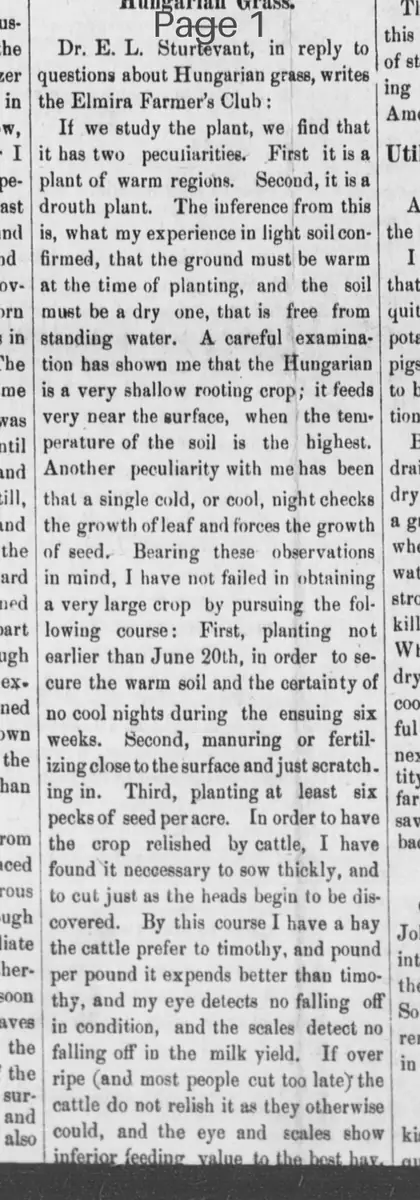
Dr. E. L. Sturtevant, in reply to questions about Hungarian grass, writes the Elmira Farmer's Club:
If we study the plant, we find that it has two peculiarities. First it is a plant of warm regions. Second, it is a drouth plant. The inference from this is, what my experience in light soil confirmed, that the ground must be warm at the time of planting, and the soil must be a dry one, that is free from standing water. A careful examination has shown me that the Hungarian is a very shallow rooting crop; it feeds very near the surface, when the temperature of the soil is the highest. Another peculiarity with me has been that a single cold, or cool, night checks the growth of leaf and forces the growth of seed. Bearing these observations in mind, I have not failed in obtaining a very large crop by pursuing the following course: First, planting not earlier than June 20th, in order to secure the warm soil and the certainty of no cool nights during the ensuing six weeks. Second, manuring or fertilizing close to the surface and just scratching in. Third, planting at least six pecks of seed per acre. In order to have the crop relished by cattle, I have found it necessary to sow thickly, and to cut just as the heads begin to be discovered. By this course I have a hay the cattle prefer to timothy, and pound per pound it expends better than timothy, and my eye detects no falling off in condition, and the scales detect no falling off in the milk yield. If over ripe (and most people cut too late) the cattle do not relish it as they otherwise could, and the eye and scales show inferior feeding value to the best hay.
If we study the plant, we find that it has two peculiarities. First it is a plant of warm regions. Second, it is a drouth plant. The inference from this is, what my experience in light soil confirmed, that the ground must be warm at the time of planting, and the soil must be a dry one, that is free from standing water. A careful examination has shown me that the Hungarian is a very shallow rooting crop; it feeds very near the surface, when the temperature of the soil is the highest. Another peculiarity with me has been that a single cold, or cool, night checks the growth of leaf and forces the growth of seed. Bearing these observations in mind, I have not failed in obtaining a very large crop by pursuing the following course: First, planting not earlier than June 20th, in order to secure the warm soil and the certainty of no cool nights during the ensuing six weeks. Second, manuring or fertilizing close to the surface and just scratching in. Third, planting at least six pecks of seed per acre. In order to have the crop relished by cattle, I have found it necessary to sow thickly, and to cut just as the heads begin to be discovered. By this course I have a hay the cattle prefer to timothy, and pound per pound it expends better than timothy, and my eye detects no falling off in condition, and the scales detect no falling off in the milk yield. If over ripe (and most people cut too late) the cattle do not relish it as they otherwise could, and the eye and scales show inferior feeding value to the best hay.
What sub-type of article is it?
Curiosity
Personal Triumph
What themes does it cover?
Nature
Triumph
What keywords are associated?
Hungarian Grass
Drought Plant
Crop Cultivation
Cattle Feed
Farming Advice
What entities or persons were involved?
Dr. E. L. Sturtevant
Where did it happen?
Elmira
Story Details
Key Persons
Dr. E. L. Sturtevant
Location
Elmira
Event Date
June 20th
Story Details
Dr. Sturtevant describes Hungarian grass peculiarities as a warm, drought-resistant, shallow-rooting plant sensitive to cool nights, and outlines successful cultivation method: late planting, surface fertilization, dense seeding, early cutting for preferred cattle hay outperforming timothy.