Thank you for visiting SNEWPapers!
Sign up free
Story
March 19, 1907
The Stark County Democrat
Canton, Stark County, Ohio
What is this article about?
S. Lewis Tillotson studies 463 global burial customs, revealing diverse rites from reverence and afterlife beliefs to cannibalism among tribes like Karens, Shans, Bantus, Niam-Niams, Shohos, Arabs, Fans, and Mumias, with most cultures showing respect except two.
Clipping
OCR Quality
95%
Excellent
Full Text
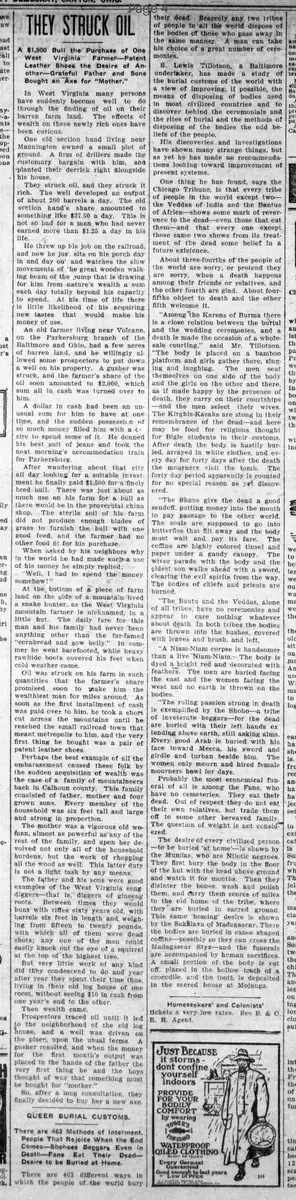
QUEER BURIAL CUSTOMS.
There are 463 Methods of Interment.
People That Rejoice When the End
Comes—Shohoes Beggars Even In
Death—Fans Eat Their Dead—
Desire to be Buried at Home.
There are 463 different ways in
which the people of the world bury
their dead. Scarcely any two tribes
of people in all the world dispose of
the bodies of those who pass away in
the same manner. A man can take
his choice of a great number of cere-
monies.
S. Lewis Tillotson, a Baltimore
undertaker, has made a study of
the burial customs of the world with
a view of improving, if possible, the
means of disposing of bodies used
in most civilized countries and to
discover behind the ceremonials and
the rites of burial and the methods of
disposing of the bodies the odd be-
liefs of the people.
His discoveries and investigations
have shown many strange things, but
as yet he has made no recommenda-
tions looking toward improvement of
present systems.
One thing he has found, says the
Chicago Tribune, is that every tribe
of people in the world except two
—the Veddas of India and the Bantus
of Africa—shows some mark of rever-
ence to the dead—even those that eat
them—and that every one except
those same two shows from its treat-
ment of the dead some belief in a
future existence.
About three-fourths of the people of
the world are sorry, or pretend they
are sorry, when a death happens
among their friends or relatives, and
the other fourth are glad. About four-
fifths object to death and the other
fifth welcome it.
"Among the Karens of Burma there
is a close relation between the burial
and the wedding ceremonies, and a
death is made the occasion of a whole-
sale courting," said Mr. Tillotson.
"The body is placed on a bamboo
platform and girls gather there, sing-
ing and laughing. The men seat
themselves on one side of the body
and the girls on the other and there,
as if made happy by the presence of
death, they carry on their courtships
—and the men select their wives.
The Kirghiz-Kazaks are strong in their
remembrance of the dead—and here
may be food for religious thought
for Bible students in their customs.
After death the body is hastily bur-
ied, arrayed in white clothes, and ev-
ery day for forty days after the death
the mourners visit the tomb. The
forty day period apparently is counted
for no special reason as yet discov-
ered.
"The Shans give the dead a good
sendoff, putting money into the mouth
to pay passage to the other world.
The souls are supposed to go into
butterflies that flit away and the body
must wait and pay its fare. The
coffins are highly colored tinsel and
paper under a gaudy canopy. The
wives parade with the body and the
eldest son walks ahead with a sword,
clearing the evil spirits from the way.
The bodies of chiefs and priests are
burned.
"The Bantu and the Veddas, alone
of all tribes, have no ceremonies and
appear to care nothing whatever
about death. In both tribes the bodies
are thrown into the bushes, covered
with leaves and brush, and left.
"A Niam-Niam corpse is handsomer
than a live Niam-Niam. The body is
dyed a bright red and decorated with
feathers. The men are buried facing
the east and the women facing the
west and no earth is thrown on the
bodies.
"The ruling passion strong in death
is exemplified by the Shoho—a tribe
of inveterate beggars—for the dead
are buried with their left hands ex-
tending above earth, still asking alms.
Every good Arab is buried with his
face toward Mecca, his sword and
girdle and turban beside him. The
women only mourn and hired female
mourners howl for days.
Probably the most economical fun-
eral of all is among the Fans, who
have no cemeteries. They eat their
dead. Out of respect they do not eat
their own relatives, but trade them
off to some other bereaved family.
The question of weight is not consid-
ered.
The desire of every civilized person
—to be buried 'at home' is shown by
the Mumias, who are Nilotic negroes.
They first bury the body in the floor
of the hut with the head above ground
and watch it for months. Then they
disinter the bones, wash and polish
them, and carry them scores of miles
to the old home of the tribe, where
they are buried in sacred ground.
This same 'homing' desire is shown
by the Sakalava of Madagascar. There
the bodies are buried in canoe shaped
coffins—possibly so they can cross the
Madagascar Styx—and the funerals
are accompanied by human sacrifices.
A small portion of the body is cut
off, placed in the hollow tooth of a
crocodile, and the tooth is deposited
in the sacred house at Mojanga.
There are 463 Methods of Interment.
People That Rejoice When the End
Comes—Shohoes Beggars Even In
Death—Fans Eat Their Dead—
Desire to be Buried at Home.
There are 463 different ways in
which the people of the world bury
their dead. Scarcely any two tribes
of people in all the world dispose of
the bodies of those who pass away in
the same manner. A man can take
his choice of a great number of cere-
monies.
S. Lewis Tillotson, a Baltimore
undertaker, has made a study of
the burial customs of the world with
a view of improving, if possible, the
means of disposing of bodies used
in most civilized countries and to
discover behind the ceremonials and
the rites of burial and the methods of
disposing of the bodies the odd be-
liefs of the people.
His discoveries and investigations
have shown many strange things, but
as yet he has made no recommenda-
tions looking toward improvement of
present systems.
One thing he has found, says the
Chicago Tribune, is that every tribe
of people in the world except two
—the Veddas of India and the Bantus
of Africa—shows some mark of rever-
ence to the dead—even those that eat
them—and that every one except
those same two shows from its treat-
ment of the dead some belief in a
future existence.
About three-fourths of the people of
the world are sorry, or pretend they
are sorry, when a death happens
among their friends or relatives, and
the other fourth are glad. About four-
fifths object to death and the other
fifth welcome it.
"Among the Karens of Burma there
is a close relation between the burial
and the wedding ceremonies, and a
death is made the occasion of a whole-
sale courting," said Mr. Tillotson.
"The body is placed on a bamboo
platform and girls gather there, sing-
ing and laughing. The men seat
themselves on one side of the body
and the girls on the other and there,
as if made happy by the presence of
death, they carry on their courtships
—and the men select their wives.
The Kirghiz-Kazaks are strong in their
remembrance of the dead—and here
may be food for religious thought
for Bible students in their customs.
After death the body is hastily bur-
ied, arrayed in white clothes, and ev-
ery day for forty days after the death
the mourners visit the tomb. The
forty day period apparently is counted
for no special reason as yet discov-
ered.
"The Shans give the dead a good
sendoff, putting money into the mouth
to pay passage to the other world.
The souls are supposed to go into
butterflies that flit away and the body
must wait and pay its fare. The
coffins are highly colored tinsel and
paper under a gaudy canopy. The
wives parade with the body and the
eldest son walks ahead with a sword,
clearing the evil spirits from the way.
The bodies of chiefs and priests are
burned.
"The Bantu and the Veddas, alone
of all tribes, have no ceremonies and
appear to care nothing whatever
about death. In both tribes the bodies
are thrown into the bushes, covered
with leaves and brush, and left.
"A Niam-Niam corpse is handsomer
than a live Niam-Niam. The body is
dyed a bright red and decorated with
feathers. The men are buried facing
the east and the women facing the
west and no earth is thrown on the
bodies.
"The ruling passion strong in death
is exemplified by the Shoho—a tribe
of inveterate beggars—for the dead
are buried with their left hands ex-
tending above earth, still asking alms.
Every good Arab is buried with his
face toward Mecca, his sword and
girdle and turban beside him. The
women only mourn and hired female
mourners howl for days.
Probably the most economical fun-
eral of all is among the Fans, who
have no cemeteries. They eat their
dead. Out of respect they do not eat
their own relatives, but trade them
off to some other bereaved family.
The question of weight is not consid-
ered.
The desire of every civilized person
—to be buried 'at home' is shown by
the Mumias, who are Nilotic negroes.
They first bury the body in the floor
of the hut with the head above ground
and watch it for months. Then they
disinter the bones, wash and polish
them, and carry them scores of miles
to the old home of the tribe, where
they are buried in sacred ground.
This same 'homing' desire is shown
by the Sakalava of Madagascar. There
the bodies are buried in canoe shaped
coffins—possibly so they can cross the
Madagascar Styx—and the funerals
are accompanied by human sacrifices.
A small portion of the body is cut
off, placed in the hollow tooth of a
crocodile, and the tooth is deposited
in the sacred house at Mojanga.
What sub-type of article is it?
Curiosity
Extraordinary Event
What themes does it cover?
Fate Providence
Social Manners
What keywords are associated?
Burial Customs
Death Rites
Tribal Ceremonies
Afterlife Beliefs
Cannibalism
Reverence For Dead
What entities or persons were involved?
S. Lewis Tillotson
Where did it happen?
Worldwide
Story Details
Key Persons
S. Lewis Tillotson
Location
Worldwide
Story Details
Baltimore undertaker S. Lewis Tillotson studies 463 global burial customs, finding most tribes show reverence and belief in afterlife except Veddas and Bantus; examples include Karens' courting at funerals, Shans' coin payments for souls, Niam-Niams' decorated bodies, Shohos' begging hands, Fans' cannibalism trades, and Mumias' bone transport home.