Thank you for visiting SNEWPapers!
Sign up free
Story
November 5, 1894
The Morning News
Savannah, Chatham County, Georgia
What is this article about?
Debate on viability of cotton planting in North Carolina and Virginia: Justice Clark urges switching to peas and hay due to global competition; opponents highlight seed profits and better American fiber quality.
Clipping
OCR Quality
98%
Excellent
Full Text
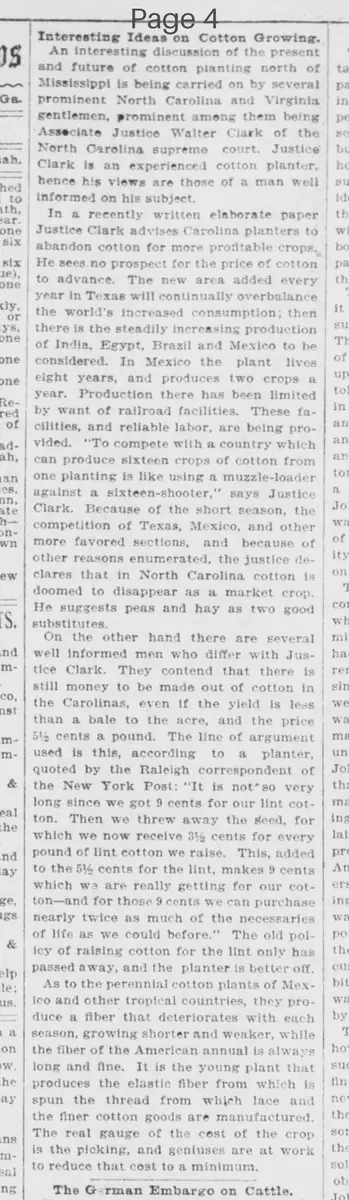
Interesting Ideas on Cotton Growing.
An interesting discussion of the present and future of cotton planting north of Mississippi is being carried on by several prominent North Carolina and Virginia gentlemen, prominent among them being Associate Justice Walter Clark of the North Carolina supreme court. Justice Clark is an experienced cotton planter, hence his views are those of a man well informed on his subject.
In a recently written elaborate paper Justice Clark advises Carolina planters to abandon cotton for more profitable crops. He sees no prospect for the price of cotton to advance. The new area added every year in Texas will continually overbalance the world's increased consumption, then there is the steadily increasing production of India, Egypt, Brazil and Mexico to be considered. In Mexico the plant lives eight years, and produces two crops a year. Production there has been limited by want of railroad facilities. These facilities, and reliable labor, are being provided. "To compete with a country which can produce sixteen crops of cotton from one planting is like using a muzzle-loader against a sixteen-shooter," says Justice Clark. Because of the short season, the competition of Texas, Mexico, and other more favored sections, and because of other reasons enumerated, the justice declares that in North Carolina cotton is doomed to disappear as a market crop. He suggests peas and hay as two good substitutes.
On the other hand there are several well informed men who differ with Justice Clark. They contend that there is still money to be made out of cotton in the Carolinas, even if the yield is less than a bale to the acre, and the price 5⅛ cents a pound. The line of argument used is this, according to a planter, quoted by the Raleigh correspondent of the New York Post: "It is not so very long since we got 9 cents for our lint cotton. Then we threw away the seed, for which we now receive 3⅛ cents for every pound of lint cotton we raise. This, added to the 5⅛ cents for the lint, makes 9 cents which we are really getting for our cotton—and for those 9 cents we can purchase nearly twice as much of the necessaries of life as we could before." The old policy of raising cotton for the lint only has passed away, and the planter is better off.
As to the perennial cotton plants of Mexico and other tropical countries, they produce a fiber that deteriorates with each season, growing shorter and weaker, while the fiber of the American annual is always long and fine. It is the young plant that produces the elastic fiber from which is spun the thread from which lace and the finer cotton goods are manufactured. The real gauge of the cost of the crop is the picking, and geniuses are at work to reduce that cost to a minimum.
An interesting discussion of the present and future of cotton planting north of Mississippi is being carried on by several prominent North Carolina and Virginia gentlemen, prominent among them being Associate Justice Walter Clark of the North Carolina supreme court. Justice Clark is an experienced cotton planter, hence his views are those of a man well informed on his subject.
In a recently written elaborate paper Justice Clark advises Carolina planters to abandon cotton for more profitable crops. He sees no prospect for the price of cotton to advance. The new area added every year in Texas will continually overbalance the world's increased consumption, then there is the steadily increasing production of India, Egypt, Brazil and Mexico to be considered. In Mexico the plant lives eight years, and produces two crops a year. Production there has been limited by want of railroad facilities. These facilities, and reliable labor, are being provided. "To compete with a country which can produce sixteen crops of cotton from one planting is like using a muzzle-loader against a sixteen-shooter," says Justice Clark. Because of the short season, the competition of Texas, Mexico, and other more favored sections, and because of other reasons enumerated, the justice declares that in North Carolina cotton is doomed to disappear as a market crop. He suggests peas and hay as two good substitutes.
On the other hand there are several well informed men who differ with Justice Clark. They contend that there is still money to be made out of cotton in the Carolinas, even if the yield is less than a bale to the acre, and the price 5⅛ cents a pound. The line of argument used is this, according to a planter, quoted by the Raleigh correspondent of the New York Post: "It is not so very long since we got 9 cents for our lint cotton. Then we threw away the seed, for which we now receive 3⅛ cents for every pound of lint cotton we raise. This, added to the 5⅛ cents for the lint, makes 9 cents which we are really getting for our cotton—and for those 9 cents we can purchase nearly twice as much of the necessaries of life as we could before." The old policy of raising cotton for the lint only has passed away, and the planter is better off.
As to the perennial cotton plants of Mexico and other tropical countries, they produce a fiber that deteriorates with each season, growing shorter and weaker, while the fiber of the American annual is always long and fine. It is the young plant that produces the elastic fiber from which is spun the thread from which lace and the finer cotton goods are manufactured. The real gauge of the cost of the crop is the picking, and geniuses are at work to reduce that cost to a minimum.
What sub-type of article is it?
Agricultural Debate
Economic Discussion
What keywords are associated?
Cotton Growing
North Carolina
Justice Clark
Agricultural Debate
Cotton Competition
Fiber Quality
What entities or persons were involved?
Walter Clark
Where did it happen?
North Carolina, Virginia, Texas, India, Egypt, Brazil, Mexico
Story Details
Key Persons
Walter Clark
Location
North Carolina, Virginia, Texas, India, Egypt, Brazil, Mexico
Story Details
Justice Walter Clark advises North Carolina planters to abandon cotton due to competition from Texas and tropical countries like Mexico, suggesting peas and hay instead. Others argue cotton remains profitable considering seed value and superior fiber quality, with innovations reducing picking costs.