Thank you for visiting SNEWPapers!
Sign up free
Norfolk Gazette And Publick Ledger
Norfolk, Virginia
What is this article about?
New York Evening Post commentary on Robert Fulton's torpedo inventions, British government payments of £3187 in 1806 for experiments, successful trials off Walmer Castle and partial at Calais, and revelation that the idea originated with David Bushnell in 1770s. Contrasts with U.S. congressional grant and critiques political insinuations.
Merged-components note: The text content is a continuous article about Robert Fulton and torpedoes, spanning adjacent columns on page 1 with sequential reading orders.
Clipping
OCR Quality
Full Text
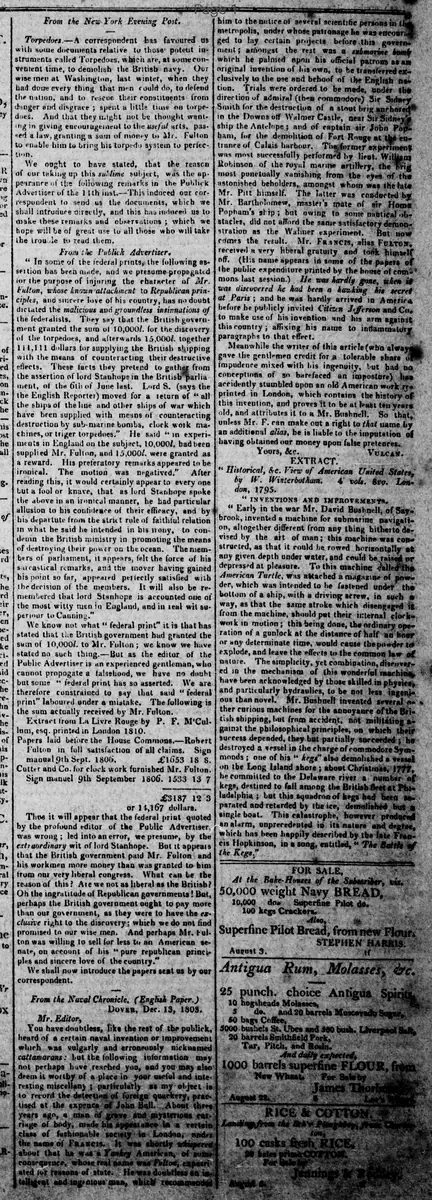
Torpedoes.—A correspondent has favoured us with some documents relative to those potent instruments called Torpedoes, which are, at some convenient time, to demolish the British navy. Our wise men at Washington, last winter, when they had done every thing that men could do, to defend the nation, and to rescue their constituents from danger and disgrace; spent a little time on torpedoes. And that they might not be thought wanting in giving encouragement to the useful arts, passed a law, granting a sum of money to Mr. Fulton to enable him to bring his torpedo system to perfection.
We ought to have stated, that the reason of our taking up this sublime subject, was the appearance of the following remarks in the Publick Advertiser of the 11th inst.—This induced our correspondent to send us the documents, which we shall introduce directly. And this has induced us to make these remarks and observations; which we hope will be of great use to all those who will take the trouble to read them.
From the Publick Advertiser.
"In some of the federal prints, the following assertion has been made, and we presume—propagated for the purpose of injuring the character of Mr. Fulton, whose known attachment to Republican principles, and sincere love of his country, has no doubt dictated the malicious and groundless insinuations of the federalists. They say that the British government granted the sum of £10,000 for the discovery of the torpedoes, and afterwards £15,000 together 25,000 pounds or 111,111 dollars for supplying the British shipping with the means of counteracting their destructive effects. These facts they pretend to gather from the assertion of lord Stanhope in the British parliament, of the 6th of June last. Lord S. (says the English Reporter) moved for a return of "all the ships of the line and other ships of war which have been supplied with means of counteracting destruction by sub-marine bombs, clock work machines, or trigger torpedoes." He said "in experiments in England on the subject, £10,000 had been supplied Mr. Fulton, and £15,000 were granted as a reward. His prefatory remarks appeared to be ironical. The motion was negatived." After reading this, it would certainly appear to every one but a fool or knave, that as lord Stanhope spoke the above in an ironical manner, he had particular allusion to his confidence of their efficacy, and by his departure from the strict rule of faithful relation in what he said he intended in his way, to condemn the British ministry in promoting the means of destroying their power on the ocean. The members of parliament, it appears, felt the force of his sarcastical remarks, and the mover having gained his point so far, appeared perfectly satisfied with the decision of the members. It will also be remembered that lord Stanhope is accounted one of the most witty men in England, and in real wit superior to Canning."
We know not what "federal print" it is that has stated that the British government had granted the sum of £10,000 to Mr. Fulton; we know we have stated no such thing.—But as the editor of the Public Advertiser is an experienced gentleman, who cannot propagate a falsehood, we have no doubt but some "federal print" has so asserted. We are therefore constrained to say that said "federal print" laboured under a mistake. The following is the sum actually received by Mr. Fulton.
Extract from La Livre Rouge by P. F. M'Cullum, esq. printed in London 1810.
Papers laid before the House Commons.—Robert Fulton in full satisfaction of all claims. Sign manual 9th Sept. 1806 £1653 18 s.
Cutter and Co. for clock work furnished Mr. Fulton. Sign manual 9th September 1806. 1533 13 7
£3187 12 3 or 14,167 dollars.
Thus it will appear that the federal print quoted by the profound editor of the Public Advertiser, was wrong; led into an error, we presume, by the extraordinary wit of lord Stanhope. But it appears that the British government paid Mr. Fulton and his workmen more money than was granted to him from our very liberal congress. What can be the reason of this? Are we not as liberal as the British? Oh the ingratitude of Republican governments! But, perhaps the British government ought to pay more than our government, as they were to have the exclusive right to the discovery; which we do not find promised to our wise men. And perhaps Mr. Fulton was willing to sell for less to an American senate, on account of his "pure republican principles and sincere love of the country"
We shall now introduce the papers sent us by our correspondent.
From the Naval Chronicle, (English Paper.)
Dover, Dec. 13, 1808.
Mr. Editor,
You have doubtless, like the rest of the publick, heard of a certain naval invention or improvement which was vulgarly and erroneously nicknamed catamarans: but the following information may not perhaps have reached you, and you may also deem it worthy of a place in your useful and interesting miscellany; particularly. as my object is to record the detection of foreign quackery practised at the expence of John Bull. About three years ago, a man of grave. and mysterious carriage of body, made his appearance in a certain class of fashionable-society in London, under the name of Francis. It was shortly whispered about that he was a Yankee American of some consequence whose real name was Fulton.experienced for reasons of state. : He was doubtless an intelligent and ingenious man, which recommended
him to the notice of several scientific persons in the metropolis, under whose patronage he was encouraged to lay certain projects before this government; amongst the rest was a submarine bomb which he palmed upon his official patrons as an original invention of his own, to be transferred exclusively to the use and behoof of the English nation. Trials were ordered to be made, under the direction of admiral (then commodore) Sir Sidney Smith for the destruction of a stout brig anchored in the Downs off Walmer Castle, near Sir Sidney's ship the Antelope; and of captain sir John Popham, for the demolition of Fort Rouge at the entrance of Calais harbour. The former experiment was most successfully performed by lieut. William Robinson. of the royal marine artillery, the brig most punctually vanishing from the eyes of the astonished beholders, amongst whom was the late Mr. Pitt himself. The latter was conducted by Mr. Bartholoinew, master's mate of sir Home Popham's ship; but owing to some nautical obstacles, did not afford the same satisfactory demonstration as the Walmer experiment. But now comes the result. Mr. Francis, alias Fulton—received a very liberal gratuity and took himself off. (His name appears in some of the papers of the public expenditure printed by the house of commons last session.). He was hardly gone, when it was discovered he had been hawking his secret at Paris; and he was hardly arrived in America before he publicly invited Citizen Jefferson and Co to make use of his invention and his arm against this country; annexing his name to inflammatory paragraphs to that effect.
Meanwhile the writer of this article (who always gave the gentlemen credit for a tolerable share of impudence mixed with his ingenuity, but had no conceptions of so barefaced an imposture) accidentally stumbled upon an old American work printed in London, which contains the history of this invention, and proves it to be at least ten years old, and attributes it to a Mr. Bushnell. So that, unless Mr. F. can make out a right to that name by an additional alias, he is liable to the imputation of having obtained our money upon false pretences.
Yours, &c.
VULCAN.
EXTRACT
"Historical, &c. View of the American United States by W. Winterbotham. 2 vols. 8vo. London, 1795.
W
6 INVENTIONS AND IMPROVEMENTS
"Early in the war Mr. David Bushnell, of Saybrook, invented a machine for submarine navigation, altogether different from any thing hitherto devised by the art of man; this machine was constructed, as that it could be rowed horizontally to any given depth under water, and could be raised or depressed at pleasure. To this machine called the American Turtle, was attached a magazine of powder, which was intended to be fastened under the bottom of a ship, with a driving screw, in such way, as that the same stroke which disengaged it from the machine, should put their internal clock work in motion; this being done, the ordinary operation of a gunlock at the distance of half an hour or any determinate time, would cause the powder to explode, and leave the effects to the common law of nature. The simplicity, yet combination, discovered in the mechanism of this wonderful machine have been acknowledged by those skilled in physics and particularly hydraulics, to be not less ingenious than novel. Mr. Bushnell invented several other curious machines for the annoyance of the British shipping, but from accident, not militating against the philosophical principles, on which their success depended, they but partially succeeded. he destroyed a vessel in the charge of commodore Symonds; one of his "kegs" also demolished a vessel on the Long Island shore; about Christmas 77 he committed to the Delaware river a number of kegs, destined to float among the British fleet at Philadelphia; but this squadron of kegs had been separated and retarded by the ice, demolished but single boat. This catastrophe, however produced an alarm, unprecedented in its nature and degree which has been happily described by the late Francis Hopkinson, in song, entitled "The Battle of the Kegs."
What sub-type of article is it?
What keywords are associated?
What entities or persons were involved?
Where did it happen?
Foreign News Details
Primary Location
England
Event Date
September 1806 And December 1808
Key Persons
Outcome
british government paid mr. fulton £3187 12s 3d in 1806; successful destruction of brig off walmer castle; partial failure at fort rouge, calais; invention attributed to david bushnell from 1770s war
Event Details
Robert Fulton presented submarine bomb invention to British government around 1805, received payments for experiments directed by Sir Sidney Smith and Sir John Popham; one trial successfully destroyed a brig in the Downs off Walmer Castle observed by Mr. Pitt; another at Calais harbour less successful due to nautical obstacles; later revealed Fulton had offered it to France and America, and invention predated by David Bushnell's American Turtle and kegs during Revolutionary War