Thank you for visiting SNEWPapers!
Sign up free
Hand County Press
Miller, Hand County, South Dakota
What is this article about?
Summary of U.S. Congress sessions from July 28 to August 4, covering debates and passage of naval appropriation, river and harbor bills over veto, sundry civil measures, nominations, and other legislation in Senate and House.
Clipping
OCR Quality
Full Text
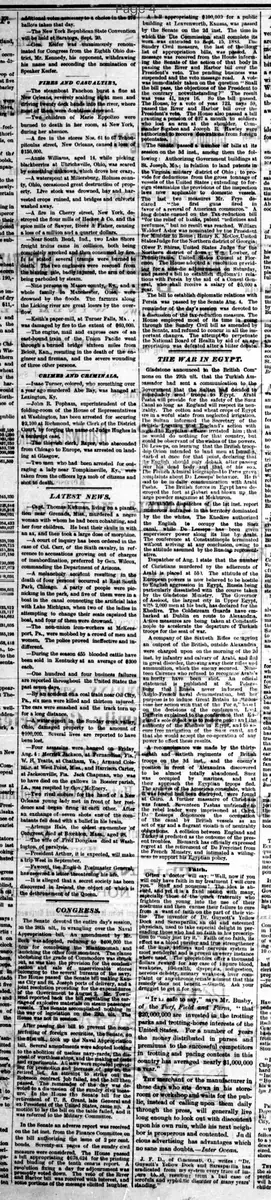
The Senate devoted the entire day's session, on the 28th ult., in wrangling over the Naval Appropriation bill. An amendment by Mr. Beck was adopted, reducing to $400,000 the terms for completing the Miantonomoh and launching the other four monitors. The clause abolishing the grade of Commodore was struck out, as was also the provision for the condemnation and sale of unserviceable stores belonging to the several bureaus of the navy. The House passed the Senate bill making Kansas City and St. Joseph ports of delivery, and a joint resolution providing for the expenditures of the Government to August 2. Mr. Townsend reported back the bill regulating the carriage of explosive materials on steam passenger vessels. The Senate accomplished nothing in the way of legislation on the 29th ult. The House was not in session.
After passing the bill to prevent the counterfeiting of foreign securities, the Senate, on the 30th ult., took up the Naval Appropriation bill. Several amendments were adopted looking to the abolition of useless navy-yards, the disposal of worthless ships, and the making of tests and experiments. All laws were repealed providing for promotion and increase of pay on the retired list. An attempt to strike out the Robeson contract job failed, and the bill then passed. The remainder of the day was devoted to a discussion of the sundry civil measure. In the House the Senate bill for the retirement of U. S. Grant, late General and ex-President of the United States, came up. A motion to lay the bill on the table failed, and it was referred to the Military Committee.
In the Senate an adverse report was received on the 1st inst. from the Finance Committee on the bill authorizing the issue of 2 per cent. bonds. Seventy-six pages of the sundry civil measure were considered. The House passed a bill appropriating $678,624 for the printing and binding of the tenth census report. A resolution fixing a day for adjournment was promptly voted down. The veto of the River and Harbor bill was received with interest, and some portions of the message elicited
A bill appropriating $100,000 for a public building at Leavenworth, Kansas, was passed by the Senate on the 2d inst. The time in which the Ute Commission shall complete its work was extended to Sept. 15, 1883. The Sundry Civil measure, the last of the long list of appropriation bills, was passed. A message was received from the House informing the Senate of the action of that body in passing the River and Harbor bill over the President's veto. The pending business was suspended and the veto message read. A vote was immediately taken on the question "Shall the bill pass, the objections of the President to the contrary notwithstanding?" The result was yeas 41, nays 16. So the bill passed. The House, by a vote of yeas 122, nays 59, passed the River and Harbor bill over the President's veto. The House also passed a bill granting a pension of $37 a month to a soldier who lost an arm at the shoulder. Commander Sigsbee and Joseph R. Hawley were authorized to receive decorations from foreign potentates.
The Senate passed a number of bills at its session on the 3d inst., among them the following: Authorizing Government buildings at St. Joseph, Mo.; in relation to land patents in the Virginia military district of Ohio; to provide for deductions from the gross tonnage of vessels of the United States; extending to foreign steamships the provisions of the inspection laws now applicable to domestic vessels. The last two measures Mr. Frye declared "the first guns fired in favor of a revival of American commerce."
A long debate ensued on the Tax-reduction bill "for the relief of banks, patent medicines and perfumes," but no result was reached. William Waldorf Astor was nominated by the President for Minister to Rome; Henry K. McCay, United States Judge for the Northern district of Georgia; Oliver P. Shiras, United States Judge for the Northern district of Iowa; Wm. Lowber, of Pennsylvania, United States Consul at Florence. The House adopted a resolution providing for a sine-die adjournment on Saturday, and passed a bill to establish diplomatic relations with Persia by the aid of a Consul General, who shall receive a salary of $5,000 a year.
The bill to establish diplomatic relations with Persia was passed by the Senate Aug. 4. The remainder of the day's session was devoted to a discussion of the tax-reduction measure. The House employed most of its time in going through the Sundry Civil bill as amended by the Senate, and refused to concur in all the important changes. The attempt to perpetuate the National Board of Health by aid of an appropriation was defeated after a bitter debate.
What sub-type of article is it?
What keywords are associated?
What entities or persons were involved?
Domestic News Details
Event Date
28th Ult. To Aug. 4
Key Persons
Outcome
naval appropriation bill passed with amendments; river and harbor bill passed over president's veto (senate: yeas 41, nays 16; house: yeas 122, nays 59); sundry civil measure passed; various other bills passed or debated; nominations made; adjournment resolution adopted.
Event Details
The Senate and House held sessions from July 28 to August 4, debating and passing bills including Naval Appropriation, Sundry Civil, River and Harbor (over veto), diplomatic relations with Persia, tax-reduction, and others; amendments adopted on navy matters; veto message read and overridden; nominations for diplomatic and judicial positions.