Thank you for visiting SNEWPapers!
Sign up free
Editorial
February 9, 1803
The Recorder
Richmond, Virginia
What is this article about?
This editorial vehemently attacks lawyer George Hay's character, accusing him of immorality, gambling exploitation, and political hypocrisy in criticizing James Callender and the Recorder newspaper, while defending Republican figures like Jefferson and Madison.
Clipping
OCR Quality
95%
Excellent
Full Text
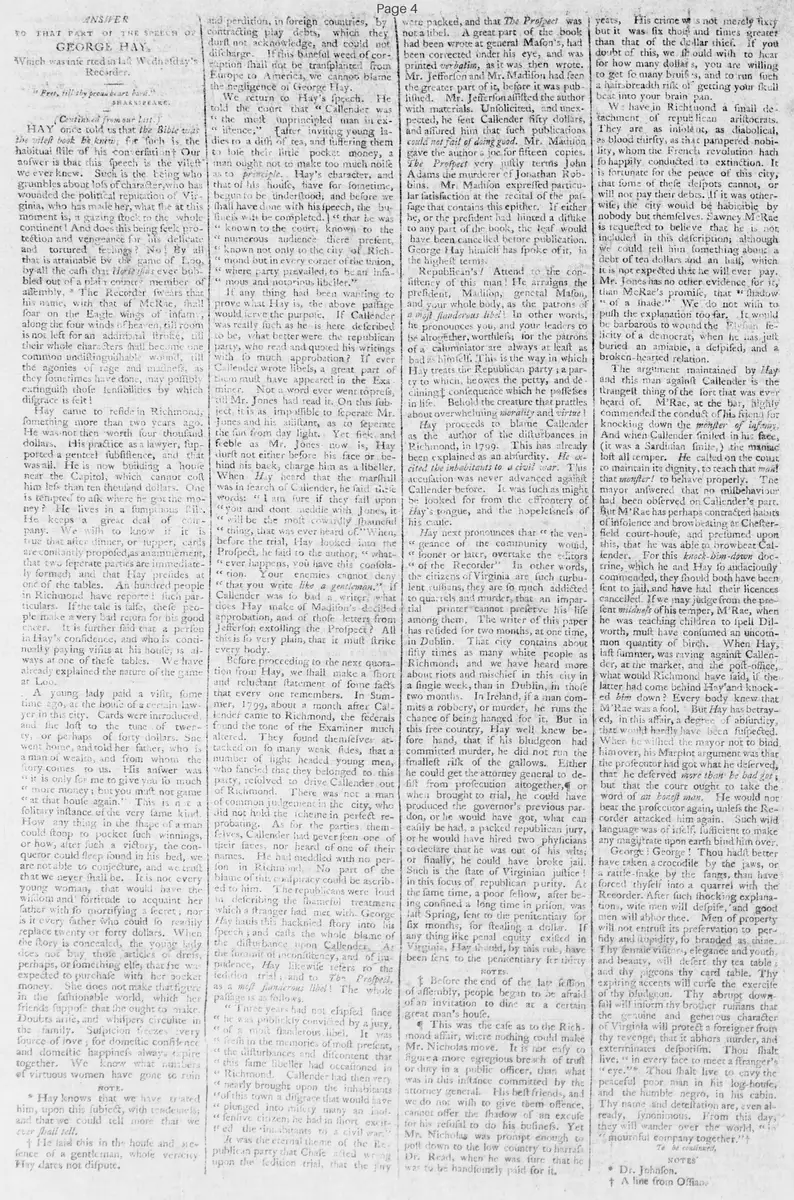
To that part of the speech of George Hay, which was inserted in last Wednesday's Recorder.
"Fear, till thy proud heart burst."
SHAKESPEARE.
(Continued from our last.)
Hay once told us that the Bible was the vilest book he knew: such is the habitual filth of his conversation. Our answer is that this speech is the vilest we ever knew. Such is the being who grumbles about loss of character, who has wounded the political reputation of Virginia, who has made her what she at this moment is, a gazing stock to the whole continent! And does this being seek protection and vengeance for his delicate and tortured feelings? No! By all that is attainable by this game of Loo, by all the cash that Horne has ever bubbled out of a plain country member of assembly. The Recorder swears that his name, with that of McRae, shall soar on the eagle wings of infamy, along the four winds of heaven, till room is not left for an additional stroke, till their whole characters shall become one common undistinguishable wound, till the agonies of rage and madness, as they sometimes have done, nay possibly extinguish those sensibilities by which disgrace is felt!
Hay came to reside in Richmond, something more than two years ago. He was not then worth four thousand dollars. His practice as a lawyer, supported a genteel subsistence, and that was all. He is now building a house near the Capitol, which cannot cost him less than ten thousand dollars. One is tempted to ask where he got the money? He lives in a sumptuous style. He keeps a great deal of company. We wish to know if it is true that after dinner, or supper, cards are constantly proposed, as an amusement, that two separate parties are immediately formed; and that Hay presides at one of the tables. An hundred people in Richmond have reported such particulars. If the tale is false, these people make a very bad return for his good cheer. It is further said that a person in Hay's confidence, and who is continually paying visits at his house, is always at one of these tables. We have already explained the nature of the game at Loo.
A young lady paid a visit, some time ago, at the house of a certain lawyer in this city. Cards were introduced, and she lost to the tune of twenty, or perhaps of forty dollars. She went home, and told her father, who is a man of wealth, and from whom the story comes to us. His answer was "it is only for me to give you so much more money; but you must not game at that house again." This is not a solitary instance of the very same kind. How anything in the shape of a man could stoop to pocket such winnings, or how, after such a victory, the conqueror could sleep sound in his bed, we are not able to conjecture, and we trust that we never shall be. It is not every young woman, that would have the wisdom and fortitude to acquaint her father with so mortifying a secret; nor is it every father who could so readily replace twenty or forty dollars. When the story is concealed, the young lady does not buy those articles of dress, perhaps, or something else, that she was expected to purchase with her pocket money. She does not make that figure in the fashionable world, which her friends suppose that she ought to make. Doubts arise, and whispers circulate in the family. Suspicion freezes every source of love: for domestic confidence and domestic happiness always expire together. We know what numbers of virtuous women have gone to ruin
NOTE.
"Hay knows that we have traced him, upon this subject, with tenderness; and that we could tell more than we ever shall tell."
He said this in the house and presence of a gentleman, whose veracity Hay dares not dispute.
and perdition, in foreign countries, by contracting play debts, which they durst not acknowledge, and could not discharge. If this baneful weed of corruption shall not be transplanted from Europe to America, we cannot blame the negligence of George Hay.
We return to Hay's speech. He told the court that "Callender was the most unprincipled man in existence:" after inviting young ladies to a dish of tea, and suffering them to lose their little pocket money, a man ought not to make too much noise as to principle. Hay's character, and that of his house, have for some time, begun to be understood; and before we shall have done with his speech, the business will be completed. That he was "known to the court, known to the numerous audience there present, known not only to the city of Richmond but in every corner of the union, where party prevailed, to be an infamous and notorious libeller."
If anything had been wanting to prove what Hay is, the above passage would serve the purpose. If Callender was really such as he is here described to be, what better were the republican party, who read and quoted his writings with so much approbation? If ever Callender wrote libels, a great part of them must have appeared in the Examiner. Not a word ever went to press, till Mr. Jones had read it. On this subject, it is as impossible to separate Mr. Jones and his assistant, as to separate the sun from day light. Yet sick, and feeble as Mr. Jones now is, Hay durst not either before his face or behind his back, charge him as a libeller. When Hay heard that the marshal was in search of Callender, he said these words: "I am sure if they fall upon you and don't meddle with Jones, it will be the most cowardly shameful thing, that was ever heard of." When, before the trial, Hay looked into the Prospect, he said to the author, "whatever happens, you have this consolation. Your enemies cannot deny that you write like a gentleman." If Callender was so bad a writer, what does Hay make of Madison's decided approbation, and of those letters from Jefferson extolling the Prospect? All this is so very plain, that it must strike everybody.
Before proceeding to the next quotation from Hay, we shall make a short and reluctant statement of some facts that every one remembers. In Summer, 1799, about a month after Callender came to Richmond, the federals found the tone of the Examiner much altered. They found themselves attacked on so many weak sides, that a number of light headed young men, who fancied that they belonged to this party, resolved to drive Callender out of Richmond. There was not a man of common judgment in the city, who did not hold the scheme in perfect reprobation. As for the parties themselves, Callender had never seen one of their faces, nor heard of one of their names. He had meddled with no person in Richmond. No part of the blame of this conspiracy could be ascribed to him. The republicans were loud in describing the shameful treatment which a stranger had met with. George Hay hauls this hackneyed story into his speech; and casts the whole blame of the disturbance upon Callender. As the summit of inconsistency, and of impudence, Hay likewise refers to the sedition trial; and to The Prospect, as a most seditious libel! The whole passage is as follows.
"Three years had not elapsed since he was publicly convicted by a jury, of a most slandrous libel. It was fresh in the memories of most present, the disturbances and discontent that this same libeller had occasioned in Richmond." Callender had then very nearly brought upon the inhabitants of this town a disgrace that would have plunged into misery many an innocent citizen: he had in short excited the inhabitants to civil war."
It was the eternal theme of the Republican party that Chase acted wrong upon the sedition trial, that the jury were packed, and that The Prospect was not a libel. A great part of the book had been wrote at general Mason's, had been corrected under his eye, and was printed verbatim, as it was then wrote. Mr. Jefferson and Mr. Madison had seen the greater part of it, before it was published. Mr. Jefferson assisted the author with materials. Unsolicited, and unexpected, he sent Callender fifty dollars, and assured him that such publications could not fail of doing good. Mr. Madison gave the author a joe for fifteen copies. The Prospect very justly terms John Adams the murderer of Jonathan Robbins. Mr. Madison expressed particular satisfaction at the recital of the passage that contains this epithet. If either he, or the president had hinted a dislike to any part of the book, the leaf would have been cancelled before publication. George Hay himself has spoke of it, in the highest terms.
Republicans! Attend to the consistency of this man! He arraigns the president, Madison, general Mason, and your whole body, as the patrons of a most slandrous libel! In other words, he pronounces you, and your leaders to be altogether worthless; for the patrons of a calumniator are always at least as bad as himself. This is the way in which Hay treats the Republican party; a party to which he owes the petty, and declining consequence which he possesses in life. Behold the creature that prattles about overwhelming morality and virtue!
Hay proceeds to blame Callender as the author of the disturbances in Richmond, in 1799. This has already been explained as an absurdity. He excited the inhabitants to a civil war. This accusation was never advanced against Callender before. It was such as might be looked for from the effrontery of Hay's tongue, and the hopelessness of his cause.
Hay next pronounces that "the vengeance of the community would, sooner or later, overtake the editors of the Recorder." In other words, the citizens of Virginia are such turbulent ruffians, they are so much addicted to quarrels and murder, that an impartial printer cannot preserve his life among them. The writer of this paper has resided for two months, at one time, in Dublin. That city contains about fifty times as many white people as Richmond: and we have heard more about riots and mischief in this city in a single week, than in Dublin, in those two months. In Ireland, if a man commits a robbery, or murder, he runs the chance of being hanged for it. But in this free country, Hay well knew beforehand, that if his bludgeon had committed murder, he did not run the smallest risk of the gallows. Either he could get the attorney general to desist from prosecution altogether, or when brought to trial, he could have produced the governor's previous pardon, or he would have got, what can easily be had, a packed republican jury, or he would have hired two physicians to declare that he was out of his wits; or finally, he could have broke jail. Such is the state of Virginian justice! in this focus of republican purity. At the same time, a poor fellow, after being confined a long time in prison, was last Spring, sent to the penitentiary for six months, for stealing a dollar. If anything like penal equity existed in Virginia, Hay should, by this rule, have been sent to the penitentiary for thirty years. His crime was not merely sixty, but it was six thousand times greater than that of the dollar thief. If you doubt of this, we should wish to hear for how many dollars, you are willing to get so many bruises, and to run such a hairsbreadth risk of getting your skull beat into your brain pan.
We have in Richmond a small detachment of republican aristocrats. They are as insolent, as diabolical, as blood thirsty, as that pampered nobility, whom the French revolution has so happily conducted to extinction. It is fortunate for the peace of this city, that some of these despots cannot, or will not pay their debts. If it was otherwise, the city would be habitable by nobody but themselves. Sawney McRae is requested to believe that he is not included in this description; although we could tell him something about a debt of ten dollars and an half, which it is not expected that he will ever pay. Mr. Jones has no other evidence for it, than McRae's promise, that "shadow of a shade." We do not wish to push the explanation too far. It would be barbarous to wound the Elysian felicity of a democrat: when he has just buried an amiable, a despised, and a broken-hearted relation.
The argument maintained by Hay and this man against Callender is the strangest thing of the sort that was ever heard of. McRae, at the bar, highly commended the conduct of his friend for knocking down the monster of infamy. And when Callender smiled in his face, (it was a Sardinian smile,) the maniac lost all temper. He called on the court to maintain its dignity, to teach that man! that monster! to behave properly. The mayor answered that no misbehaviour had been observed on Callender's part. But McRae has perhaps contracted habits of insolence and brow beating at Chesterfield court-house, and presumed upon this, that he was able to browbeat Callender. For this knock-him-down doctrine, which he and Hay so audaciously commended, they should both have been sent to jail, and have had their licences cancelled. If we may judge from the present mildness of his temper, McRae, when he was teaching children to spell Dilworth, must have consumed an uncommon quantity of birch. When Hay, last summer, was raving against Callender, at the market, and the post-office, what would Richmond have said, if the latter had come behind Hay and knocked him down? Everybody knew that McRae was a fool. But Hay has betrayed, in this affair, a degree of absurdity, that would hardly have been suspected. When he wished the mayor not to bind him over, his Marplot argument was that the prosecutor had got what he deserved, that he deserved more than he had got; but that the court ought to take the word of an honest man. He would not beat the prosecutor again, unless the Recorder attacked him again. Such wild language was of itself, sufficient to make any magistrate upon earth bind him over.
George! George! Thou hadst better have taken a crocodile by the jaws, or a rattle-snake by the fangs, than have forced thyself into a quarrel with the Recorder. After such shocking explanation, wise men will despise, and good men will abhor thee. Men of property will not entrust its preservation to perfidy and stupidity, so branded as thine. Thy female visitors, elegance and youth and beauty, will desert thy tea table: and thy pigeons thy card table. Thy expiring accents will curse the exercise of thy bludgeon. Thy abrupt downfall will inform thy brother ruffians that the genuine and generous character of Virginia will protect a foreigner from thy revenge; that it abhors murder, and exterminates despotism. Thou shalt live; "in every face to meet a stranger's eye." Thou shalt live to envy the peaceful poor man in his log-house, and the humble negro, in his cabin. Thy name and detestation are, even already, synonymous. From this day, they will wander over the world, "in mournful company together."
To be continued,
NOTES
* Dr. Johnson.
† A line from Ossian.
"Fear, till thy proud heart burst."
SHAKESPEARE.
(Continued from our last.)
Hay once told us that the Bible was the vilest book he knew: such is the habitual filth of his conversation. Our answer is that this speech is the vilest we ever knew. Such is the being who grumbles about loss of character, who has wounded the political reputation of Virginia, who has made her what she at this moment is, a gazing stock to the whole continent! And does this being seek protection and vengeance for his delicate and tortured feelings? No! By all that is attainable by this game of Loo, by all the cash that Horne has ever bubbled out of a plain country member of assembly. The Recorder swears that his name, with that of McRae, shall soar on the eagle wings of infamy, along the four winds of heaven, till room is not left for an additional stroke, till their whole characters shall become one common undistinguishable wound, till the agonies of rage and madness, as they sometimes have done, nay possibly extinguish those sensibilities by which disgrace is felt!
Hay came to reside in Richmond, something more than two years ago. He was not then worth four thousand dollars. His practice as a lawyer, supported a genteel subsistence, and that was all. He is now building a house near the Capitol, which cannot cost him less than ten thousand dollars. One is tempted to ask where he got the money? He lives in a sumptuous style. He keeps a great deal of company. We wish to know if it is true that after dinner, or supper, cards are constantly proposed, as an amusement, that two separate parties are immediately formed; and that Hay presides at one of the tables. An hundred people in Richmond have reported such particulars. If the tale is false, these people make a very bad return for his good cheer. It is further said that a person in Hay's confidence, and who is continually paying visits at his house, is always at one of these tables. We have already explained the nature of the game at Loo.
A young lady paid a visit, some time ago, at the house of a certain lawyer in this city. Cards were introduced, and she lost to the tune of twenty, or perhaps of forty dollars. She went home, and told her father, who is a man of wealth, and from whom the story comes to us. His answer was "it is only for me to give you so much more money; but you must not game at that house again." This is not a solitary instance of the very same kind. How anything in the shape of a man could stoop to pocket such winnings, or how, after such a victory, the conqueror could sleep sound in his bed, we are not able to conjecture, and we trust that we never shall be. It is not every young woman, that would have the wisdom and fortitude to acquaint her father with so mortifying a secret; nor is it every father who could so readily replace twenty or forty dollars. When the story is concealed, the young lady does not buy those articles of dress, perhaps, or something else, that she was expected to purchase with her pocket money. She does not make that figure in the fashionable world, which her friends suppose that she ought to make. Doubts arise, and whispers circulate in the family. Suspicion freezes every source of love: for domestic confidence and domestic happiness always expire together. We know what numbers of virtuous women have gone to ruin
NOTE.
"Hay knows that we have traced him, upon this subject, with tenderness; and that we could tell more than we ever shall tell."
He said this in the house and presence of a gentleman, whose veracity Hay dares not dispute.
and perdition, in foreign countries, by contracting play debts, which they durst not acknowledge, and could not discharge. If this baneful weed of corruption shall not be transplanted from Europe to America, we cannot blame the negligence of George Hay.
We return to Hay's speech. He told the court that "Callender was the most unprincipled man in existence:" after inviting young ladies to a dish of tea, and suffering them to lose their little pocket money, a man ought not to make too much noise as to principle. Hay's character, and that of his house, have for some time, begun to be understood; and before we shall have done with his speech, the business will be completed. That he was "known to the court, known to the numerous audience there present, known not only to the city of Richmond but in every corner of the union, where party prevailed, to be an infamous and notorious libeller."
If anything had been wanting to prove what Hay is, the above passage would serve the purpose. If Callender was really such as he is here described to be, what better were the republican party, who read and quoted his writings with so much approbation? If ever Callender wrote libels, a great part of them must have appeared in the Examiner. Not a word ever went to press, till Mr. Jones had read it. On this subject, it is as impossible to separate Mr. Jones and his assistant, as to separate the sun from day light. Yet sick, and feeble as Mr. Jones now is, Hay durst not either before his face or behind his back, charge him as a libeller. When Hay heard that the marshal was in search of Callender, he said these words: "I am sure if they fall upon you and don't meddle with Jones, it will be the most cowardly shameful thing, that was ever heard of." When, before the trial, Hay looked into the Prospect, he said to the author, "whatever happens, you have this consolation. Your enemies cannot deny that you write like a gentleman." If Callender was so bad a writer, what does Hay make of Madison's decided approbation, and of those letters from Jefferson extolling the Prospect? All this is so very plain, that it must strike everybody.
Before proceeding to the next quotation from Hay, we shall make a short and reluctant statement of some facts that every one remembers. In Summer, 1799, about a month after Callender came to Richmond, the federals found the tone of the Examiner much altered. They found themselves attacked on so many weak sides, that a number of light headed young men, who fancied that they belonged to this party, resolved to drive Callender out of Richmond. There was not a man of common judgment in the city, who did not hold the scheme in perfect reprobation. As for the parties themselves, Callender had never seen one of their faces, nor heard of one of their names. He had meddled with no person in Richmond. No part of the blame of this conspiracy could be ascribed to him. The republicans were loud in describing the shameful treatment which a stranger had met with. George Hay hauls this hackneyed story into his speech; and casts the whole blame of the disturbance upon Callender. As the summit of inconsistency, and of impudence, Hay likewise refers to the sedition trial; and to The Prospect, as a most seditious libel! The whole passage is as follows.
"Three years had not elapsed since he was publicly convicted by a jury, of a most slandrous libel. It was fresh in the memories of most present, the disturbances and discontent that this same libeller had occasioned in Richmond." Callender had then very nearly brought upon the inhabitants of this town a disgrace that would have plunged into misery many an innocent citizen: he had in short excited the inhabitants to civil war."
It was the eternal theme of the Republican party that Chase acted wrong upon the sedition trial, that the jury were packed, and that The Prospect was not a libel. A great part of the book had been wrote at general Mason's, had been corrected under his eye, and was printed verbatim, as it was then wrote. Mr. Jefferson and Mr. Madison had seen the greater part of it, before it was published. Mr. Jefferson assisted the author with materials. Unsolicited, and unexpected, he sent Callender fifty dollars, and assured him that such publications could not fail of doing good. Mr. Madison gave the author a joe for fifteen copies. The Prospect very justly terms John Adams the murderer of Jonathan Robbins. Mr. Madison expressed particular satisfaction at the recital of the passage that contains this epithet. If either he, or the president had hinted a dislike to any part of the book, the leaf would have been cancelled before publication. George Hay himself has spoke of it, in the highest terms.
Republicans! Attend to the consistency of this man! He arraigns the president, Madison, general Mason, and your whole body, as the patrons of a most slandrous libel! In other words, he pronounces you, and your leaders to be altogether worthless; for the patrons of a calumniator are always at least as bad as himself. This is the way in which Hay treats the Republican party; a party to which he owes the petty, and declining consequence which he possesses in life. Behold the creature that prattles about overwhelming morality and virtue!
Hay proceeds to blame Callender as the author of the disturbances in Richmond, in 1799. This has already been explained as an absurdity. He excited the inhabitants to a civil war. This accusation was never advanced against Callender before. It was such as might be looked for from the effrontery of Hay's tongue, and the hopelessness of his cause.
Hay next pronounces that "the vengeance of the community would, sooner or later, overtake the editors of the Recorder." In other words, the citizens of Virginia are such turbulent ruffians, they are so much addicted to quarrels and murder, that an impartial printer cannot preserve his life among them. The writer of this paper has resided for two months, at one time, in Dublin. That city contains about fifty times as many white people as Richmond: and we have heard more about riots and mischief in this city in a single week, than in Dublin, in those two months. In Ireland, if a man commits a robbery, or murder, he runs the chance of being hanged for it. But in this free country, Hay well knew beforehand, that if his bludgeon had committed murder, he did not run the smallest risk of the gallows. Either he could get the attorney general to desist from prosecution altogether, or when brought to trial, he could have produced the governor's previous pardon, or he would have got, what can easily be had, a packed republican jury, or he would have hired two physicians to declare that he was out of his wits; or finally, he could have broke jail. Such is the state of Virginian justice! in this focus of republican purity. At the same time, a poor fellow, after being confined a long time in prison, was last Spring, sent to the penitentiary for six months, for stealing a dollar. If anything like penal equity existed in Virginia, Hay should, by this rule, have been sent to the penitentiary for thirty years. His crime was not merely sixty, but it was six thousand times greater than that of the dollar thief. If you doubt of this, we should wish to hear for how many dollars, you are willing to get so many bruises, and to run such a hairsbreadth risk of getting your skull beat into your brain pan.
We have in Richmond a small detachment of republican aristocrats. They are as insolent, as diabolical, as blood thirsty, as that pampered nobility, whom the French revolution has so happily conducted to extinction. It is fortunate for the peace of this city, that some of these despots cannot, or will not pay their debts. If it was otherwise, the city would be habitable by nobody but themselves. Sawney McRae is requested to believe that he is not included in this description; although we could tell him something about a debt of ten dollars and an half, which it is not expected that he will ever pay. Mr. Jones has no other evidence for it, than McRae's promise, that "shadow of a shade." We do not wish to push the explanation too far. It would be barbarous to wound the Elysian felicity of a democrat: when he has just buried an amiable, a despised, and a broken-hearted relation.
The argument maintained by Hay and this man against Callender is the strangest thing of the sort that was ever heard of. McRae, at the bar, highly commended the conduct of his friend for knocking down the monster of infamy. And when Callender smiled in his face, (it was a Sardinian smile,) the maniac lost all temper. He called on the court to maintain its dignity, to teach that man! that monster! to behave properly. The mayor answered that no misbehaviour had been observed on Callender's part. But McRae has perhaps contracted habits of insolence and brow beating at Chesterfield court-house, and presumed upon this, that he was able to browbeat Callender. For this knock-him-down doctrine, which he and Hay so audaciously commended, they should both have been sent to jail, and have had their licences cancelled. If we may judge from the present mildness of his temper, McRae, when he was teaching children to spell Dilworth, must have consumed an uncommon quantity of birch. When Hay, last summer, was raving against Callender, at the market, and the post-office, what would Richmond have said, if the latter had come behind Hay and knocked him down? Everybody knew that McRae was a fool. But Hay has betrayed, in this affair, a degree of absurdity, that would hardly have been suspected. When he wished the mayor not to bind him over, his Marplot argument was that the prosecutor had got what he deserved, that he deserved more than he had got; but that the court ought to take the word of an honest man. He would not beat the prosecutor again, unless the Recorder attacked him again. Such wild language was of itself, sufficient to make any magistrate upon earth bind him over.
George! George! Thou hadst better have taken a crocodile by the jaws, or a rattle-snake by the fangs, than have forced thyself into a quarrel with the Recorder. After such shocking explanation, wise men will despise, and good men will abhor thee. Men of property will not entrust its preservation to perfidy and stupidity, so branded as thine. Thy female visitors, elegance and youth and beauty, will desert thy tea table: and thy pigeons thy card table. Thy expiring accents will curse the exercise of thy bludgeon. Thy abrupt downfall will inform thy brother ruffians that the genuine and generous character of Virginia will protect a foreigner from thy revenge; that it abhors murder, and exterminates despotism. Thou shalt live; "in every face to meet a stranger's eye." Thou shalt live to envy the peaceful poor man in his log-house, and the humble negro, in his cabin. Thy name and detestation are, even already, synonymous. From this day, they will wander over the world, "in mournful company together."
To be continued,
NOTES
* Dr. Johnson.
† A line from Ossian.
What sub-type of article is it?
Partisan Politics
Moral Or Religious
Press Freedom
What keywords are associated?
George Hay
James Callender
Gambling Vice
Partisan Hypocrisy
Richmond Politics
Republican Party
Press Libel
Sedition Trial
What entities or persons were involved?
George Hay
James Callender
Mcrae
Thomas Jefferson
James Madison
Mr. Jones
General Mason
John Adams
Chase
Editorial Details
Primary Topic
Attack On George Hay's Character And Defense Of James Callender
Stance / Tone
Vehemently Critical Of Hay, Supportive Of Callender And Republican Press
Key Figures
George Hay
James Callender
Mcrae
Thomas Jefferson
James Madison
Mr. Jones
General Mason
John Adams
Chase
Key Arguments
Hay's Speech Is Vile And Hypocritical
Hay Engages In Immoral Gambling, Exploiting Young Women
Hay's Wealth Source Is Suspicious
Callender's Writings Approved By Jefferson And Madison
Hay Inconsistently Attacks Republican Patrons
Disturbances In Richmond Not Callender's Fault
Virginian Justice Favors Republicans Like Hay
Hay And Mcrae's Violent Conduct Indefensible