Thank you for visiting SNEWPapers!
Sign up free
Martinsburg Gazette
Martinsburg, Berkeley County, West Virginia
What is this article about?
Compilation of 1842 newspaper opinions from Fredericksburg, New York, Philadelphia, Boston, and others harshly criticizing President John Tyler's fourth veto of a revenue bill combining tariff and distribution policies, accusing him of abusing veto power, dictatorial tendencies, and damaging the nation's economy and harmony.
Clipping
OCR Quality
Full Text
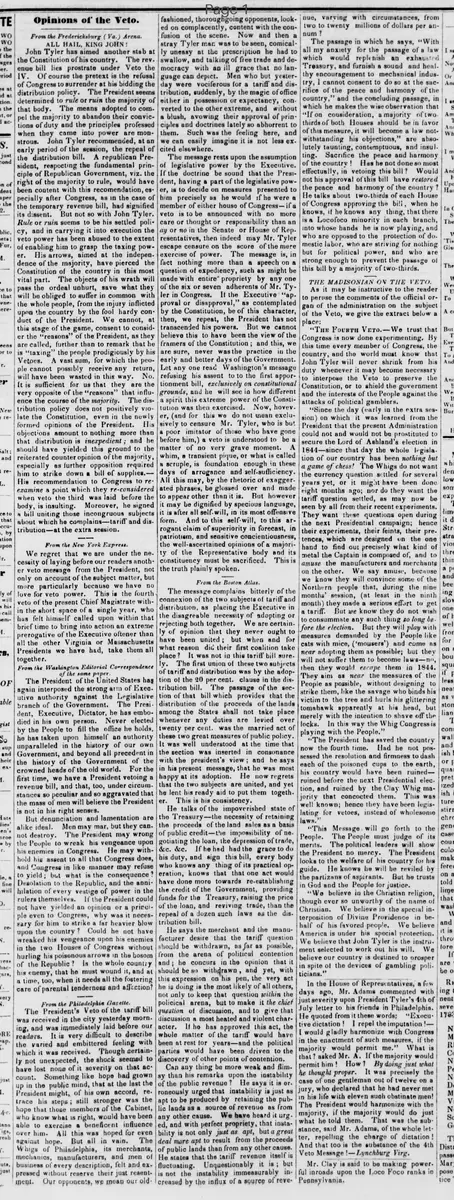
From the Fredericksburg (Va.) Arena.
ALL HAIL. KING JOHN!
John Tyler has aimed another stab at the Constitution of his country. The revenue bill lies prostrate under Veto the IV. Of course the pretext is the refusal of Congress to surrender at his bidding the distribution policy. The President seems determined to rule or ruin the majority of that body. The means adopted to compel the majority to abandon their convictions of duty and the principles professed when they came into power are monstrous. John Tyler recommenced, at an early period of the session, the repeal of the distribution bill. A republican President, respecting the fundamental principle of Republican Government, viz. the right of the majority to rule, would have been content with this recommendation, especially after Congress, as in the case of the temporary revenue bill, had signified its dissent. But not so with John Tyler. Rule or ruin seems to be his settled policy, and in carrying it into execution the veto power has been abused to the extent of enabling him to grasp the taxing power. His arrows, aimed at the independence of the majority, have pierced the Constitution of the country in this most vital part. The objects of his wrath will pass the ordeal unhurt, save what they will be obliged to suffer in common with the whole people, from the injury inflicted upon the country by the fool hardy conduct of the President. We cannot, at this stage of the game, consent to consider the "reasons" of the President, as they are called, further than to remark that he is "taxing" the people prodigiously by his Vetoes. A vast sum, for which the people cannot possibly receive any return, will have been wasted in this way. No. It is sufficient for us that they are the very opposite of the "reasons" that influence the course of the majority. The distribution policy does not positively violate the Constitution, even in the newly formed opinions of the President. His objections amount to nothing more than that distribution is inexpedient; and he should have yielded this ground to the reiterated counter opinion of the majority, especially as further opposition required him to strike down a bill of supplies. His recommendation to Congress to re-examine a point which they re-considered when veto the third was laid before the body, is insulting. Moreover, he signed a bill uniting those incongruous subjects about which he complains—tariff and distribution—at the extra session.
From the New York Express.
We regret that we are under the necessity of laying before our readers another veto message from the President, not only on account of the subject matter, but more particularly because we have no love for veto power. This is the fourth veto of the present Chief Magistrate within the short space of a single year, who has felt himself called upon within that brief time to bring into action an extreme prerogative of the Executive oftener than all the other Virginia or Massachusetts Presidents we have had, take them all together.
From the Washington Editorial Correspondence of the same paper.
The President of the United States has again interposed the strong arm of Executive authority against the Legislative branch of the Government. The President, Executive, Dictator, he has embodied in his own person. Never elected by the People to fill the office he holds, he has taken upon himself an authority unparalleled in the history of our own Government, and beyond all precedent in the history of the Government of the crowned heads of the old world. For the first time, we have a President vetoing a revenue bill, and that, too, under circumstances so peculiar and so aggravated that the mass of men will believe the President is not in his right senses. But denunciation and lamentation are alike idle. Men may mar, but they cannot destroy. The President may wrong the People to wreak his vengeance upon his enemies in Congress. He may withhold his assent to all that Congress does, and Congress in like manner may refuse to yield; but what is the consequence? Desolation to the Republic, and the annihilation of every vestige of power in the rulers themselves. If the President could not have yielded an opinion or a principle even to Congress, why was it necessary for him to strike a far heavier blow upon the country? Could he not have wreaked his vengeance upon his enemies in the two Houses of Congress without hurling his poisonous arrows in the bosom of the Republic? Is the whole country his enemy, that he must wound it, and at a time, too, when it needs all the fostering care of parental tenderness and affection?
From the Philadelphia Gazette.
The President's Veto of the tariff bill was received in the city yesterday morning, and was immediately laid before our readers. It is very difficult to describe the varied and embittered feeling with which it was received. Though certainly not unexpected, the shock seemed to have lost none of its severity on that account. Something like hope had grown up in the public mind, that at the last the President might, of his own accord, retrace his steps; still stronger was the hope that those members of the Cabinet, who know what is right, would have been able to exercise a beneficent influence over him. All this was hoped for even against hope. But all in vain. The Whigs of Philadelphia, its merchants, mechanics, manufacturers, and men of business of every description, felt and expressed without reserve their just resentment. Our opponents, we mean our old fashioned, thoroughgoing opponents, looked on complacently, content with the confusion of the scene. Now and then a stray Tyler man was to be seen, comically uneasy at the prescription he had to swallow, and talking of free trade and democracy with an ill grace that no language can depict. Men who but yesterday were vociferous for a tariff and distribution, suddenly, by the magic of office either in possession or expectancy, converted to the other extreme, and without a blush, avowing their approval of principles and doctrines lately so abhorrent to them. Such was the feeling here, and we can easily imagine it is not less excited elsewhere.
The message rests upon the assumption of legislative power by the Executive. If the doctrine be sound that the President, having a part of the legislative power, is to decide on measures presented to him precisely as he would if he were a member of either house of Congress—if a veto is to be announced with no more care or thought or responsibility than an ay or no in the Senate or House of Representatives, then indeed may Mr. Tyler escape censure on the score of the mere exercise of power. The message is, in fact, nothing more than a speech on a question of expediency, such as might be made with entire propriety by any one of the six or seven adherents of Mr. Tyler in Congress. If the Executive "approval or disapproval," as contemplated by the Constitution, be of this character, then, we repeat, the President has not transgressed his powers. But we cannot believe this to have been the view of the framers of the Constitution; and this, we are sure, never was the practice in the early and better days of the Government. Let any one read Washington's message refusing his assent to the first apportionment bill, exclusively on constitutional grounds, and he will see in how different a spirit this extreme power of the Constitution was then exercised. Now, however, (and for this we do not mean exclusively to censure Mr. Tyler, who is but a poor imitator of those who have gone before him,) a veto is understood to be a matter of no very grave moment. A whim, a transient pique, or what is called a scruple, is foundation enough in these days of arrogance and self-sufficiency. All this may, by the rhetoric of exaggerated phrases, be glossed over and made to appear other than it is. But however it may be dignified by specious language, it is after all self-will, in its most offensive form. And to this self-will, to this arrogant claim of superiority in forecast, in patriotism, and sensitive conscientiousness, the well-ascertained opinions of a majority of the Representative body and its constituency must be sacrificed. This is the truth plainly spoken.
From the Boston Atlas.
The message complains bitterly of the connection of the two subjects of tariff and distribution, as placing the Executive in the disagreeable necessity of adopting or rejecting both together. We are certainly of opinion that they never ought to have been united; but when and for what reason did their first coalition take place? It was not in this tariff bill surely. The first union of these two subjects of tariff and distribution was by the adoption of the 20 per cent. clause in the distribution bill. The passage of the section of that bill which provides that the distribution of the proceeds of the lands among the States shall not take place whenever any duties are levied over twenty per cent. was the marriage act of these two great measures of public policy. It was well understood at the time that the section was inserted in consonance with the president's view; and he says in his present message, that he was most happy at its adoption. He now regrets that the two subjects are united, and yet he lent his ready aid to put them together. This is his consistency.
He talks of the impoverished state of the Treasury—the necessity of retaining the proceeds of the land sales as a basis of public credit—the impossibility of negotiating the loan, the depression of trade, &c. &c. If he had had the grace to do his duty, and sign this bill, every body who knows any thing of its practical operation, knows that that one act would have done more towards re-establishing the credit of the Government, providing funds for the Treasury, raising the price of the loan, and reviving trade, than the repeal of a dozen such laws as the distribution bill.
He says the merchant and the manufacturer desire that the tariff question should be withdrawn, as far as possible, from the arena of political contention and; he concurs in the opinion that it should be so withdrawn, and yet, with this expression on his pen, the very act he is doing is the most likely of all others, not only to keep that question within the political arena, but to make it the chief question of discussion, and to give that discussion a most heated and violent character. If he has approved this act, the whole matter of the tariff would have been at rest for years—and the political parties would have been driven to the discovery of other points of contention.
Can any thing be more weak and flimsy than his remarks upon the instability of the public revenue? He says it is erroneously urged that instability is just as apt to be produced by retaining the public lands as a source of revenue as from any other cause. We have heard it urged, and with perfect propriety, that instability is not only just as apt, but a great deal more apt to result from the proceeds of public lands than from any other cause. He states that the tariff revenue itself is fluctuating. Unquestionably it is; but is not the instability immeasurably increased by the influx of a source of revenue, varying with circumstances, from two to twenty millions of dollars per annum?
The passage in which he says, "With all my anxiety for the passage of a law which would replenish an exhausted Treasury, and furnish a sound and healthy encouragement to mechanical industry, I cannot consent to do so at the sacrifice of the peace and harmony of the country," and the concluding passage, in which he makes the wise observation that "If on consideration, a majority of two-thirds of both Houses should be in favor of this measure, it will become a law notwithstanding his objections," are absolutely taunting, contemptuous, and insulting. Sacrifice the peace and harmony of the country! Has he not done so most effectually, in vetoing this bill? Would not his approval of this bill have restored the peace and harmony of the country? He talks about two-thirds of each House of Congress approving the bill, when he knows, if he knows any thing, that there is a Locofoco minority in each branch, into whose hands he is now playing, and who are opposed to the protection of domestic labor, who are striving for nothing but political power, and who are strong enough to prevent the passage of this bill by a majority of two-thirds.
THE MADISONIAN ON THE VETO.
As it may be instructive to the reader to peruse the comments of the official organ of the administration on the subject of the Veto, we give the extract below a place:
"The Fourth Veto.—We trust that Congress is now done experimenting. By this time every member of Congress, the country, and the world must know that John Tyler will never shrink from his duty whenever it may become necessary to interpose the Veto to preserve the Constitution, or to shield the government and the interests of the People against the attacks of political gamblers.
"Since the day (early in the extra session) on which it was learned from the President that the present Administration could not and would not be prostituted to secure the Lord of Ashland's election in 1844—since that day the whole legislation of our country has been nothing but a game of chess! The Whigs do not want the currency question settled for several years yet, or it might have been done eight months ago; nor do they want the tariff question settled, as may now be seen by all from their recent experiments. They want these questions open during the next Presidential campaign; hence their experiments, their feints, their pretences, which are designed on the one hand to find out precisely what kind of metal the Captain is composed of, and to amuse the manufacturers and merchants on the other. We say amuse, because we know they will convince some of the Northern people that, during the nine months' session, (at least in the ninth month) they made a serious effort to get a tariff. But we know they do not wish to consummate any such thing so long before the election. But they will play with measures demanded by the People like cats with mice, ('mousers') and come as near adopting them as possible; but they will not suffer them to become laws—no, then they would escape them in 1844. They aim as near the measures of the People as possible, without designing to strike them, like the savage who binds his victim to the tree and hurls his glittering tomahawk apparently at his head, but merely with the intention to shave off the locks. In this way the Whig Congress is playing with the People."
"The President has saved the country now the fourth time. Had he not possessed the resolution and firmness to dash each of the poisoned cups to the earth, his country would have been ruined—ruined before the next Presidential election, and ruined by the Clay Whig majority that concocted them. This was well known; hence they have been legislating for vetoes, instead of wholesome laws.
"This Message will go forth to the People. The People must judge of its merits. The political leaders will show the President no mercy. The President looks to the welfare of his country for his guide. He knows he will be reviled by the partisans of aspirants. But he trusts in God and the People for justice.
"We believe in the Christian religion, though ever so unworthy of the name of Christian. We believe in the special interposition of Divine Providence in behalf of his favored people. We believe America is under his special protection. We believe that John Tyler is the instrument selected to work out his will. We believe our country is destined to prosper in spite of the devices of gambling politicians."
In the House of Representatives, a few days ago, Mr. Adams commented with just severity upon President Tyler's 4th of July letter to his friends in Philadelphia. He quoted from it these words; "Executive dictation! I repel the imputation!—I would gladly harmonize with Congress in the enactment of such measures, if the majority would permit me." What is that? asked Mr. A. If the majority would permit him! How! By doing just what he thought proper. It was precisely the case of one gentleman out of twelve on a jury, who declared that he had never met in his life with eleven such obstinate men! The President would harmonize with the majority, if the majority would do just what he told them. That was the substance, said Mr. Adams, of the whole letter, repelling the charge of dictation! And that too is the substance of the 4th Veto Message!—Lynchburg Virg.
Mr. Clay is said to be making powerful inroads upon the Loco Foco ranks in Pennsylvania.
What sub-type of article is it?
What themes does it cover?
What keywords are associated?
What entities or persons were involved?
Where did it happen?
Story Details
Key Persons
Location
United States
Event Date
1842
Story Details
Newspaper excerpts criticize President Tyler's fourth veto of a revenue bill uniting tariff and distribution, accusing him of constitutional abuse, dictatorial rule, and national harm, while the administration's organ defends it as protecting the Constitution against political games.