Thank you for visiting SNEWPapers!
Sign up free
Story
September 1, 1834
Lynchburg Virginian
Lynchburg, Virginia
What is this article about?
In 1834, Amherst Whigs honored Congressman William F. Gordon with a dinner at the court-house for his staunch defense of constitutional rights against President Jackson's administration. The event featured eloquent speeches, enthusiastic toasts, and correspondence expressing gratitude and patriotism.
Clipping
OCR Quality
95%
Excellent
Full Text
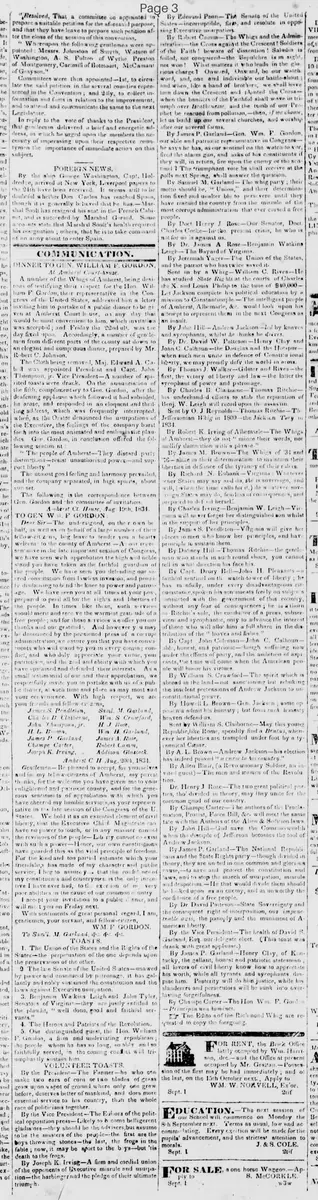
COMMUNICATION.
DINNER TO GEN. WILLIAM F. GORDON
At Amherst Court-house.
A number of the Whigs of Amherst, being desirous of testifying their respect for the Hon. William F. Gordon, their representative in the Congress of the United States, addressed him a letter inviting him to partake of a public dinner to be given at Amherst Court-house, on any day that would be most convenient to him, which invitation was accepted; and Friday the 22nd ult. was the day fixed upon. Accordingly, a number of gentlemen from different parts of the county sat down to an elegant and sumptuous dinner, prepared by Mr. Robert C. Johnson.
The cloth being removed, Maj. Edward A. Campbell was appointed President and Capt. John Thompson, Jr. Vice President—A number of spirited toasts were drank. On the annunciation of the fifth, complimentary to Gen. Gordon, after the deafening applause which followed it had subsided he arose, and responded in an eloquent and thrilling address, which was frequently interrupted. when, as the Orator denounced the usurpations of the Executive, the feelings of the company burst forth into the most animated and enthusiastic plaudits. Gen. Gordon, in conclusion offered the following sentiment :
"The people of Amherst—They discard party distinctions—resist unauthorised power—and support liberty"
The utmost good feeling and harmony prevailed, and the company separated, in high spirits, about sun set.
The following is the correspondence between Gen. Gordon and his committee of invitation
Amherst Ct. House, Aug 18th, 1834
TO GEN W. F. GORDON.
Dear Sir—The undersigned, on their own behalf, as well as on behalf of a large number of their fellow-citizens, beg leave to tender you a hearty welcome to the county of Amherst —As our representative in the late important session of Congress we have seen with approbation the high and noble stand you have taken as the faithful guardian of the people. We have seen you defending our sacred constitution from lawless invasion, and proudly disdaining to bend the knee to power and patronage. We have seen you at all times at your post, prepared to peril all for the rights and liberties of the people. In times like these, such services should merit and receive the warmest gratitude of a free people; and for these services we offer you our thanks and our gratitude. And however you may be denounced by the venal press of a corrupt administration, we assure you that you have constituents who will stand by you in every coming conflict, and who duly appreciate your virtue, your patriotism, and the zeal and ability with which you have sustained and defended their interests. As a small testimonial of our and their approbation, we respectfully invite you to partake with us of a public dinner, at such time and place as may most suit your convenience. With high respect, we are you friends and fellow citizens,
James S Pendleton,
Saml. M. Garland,
Charles B Claiborne,
Wm. S Crawford,
John Thompson,jr.
H J Rose,
H.L.Brown,
Wm. H. Garland,
James P Garland
James A. Rose,
Champe Carter;
Robert Cann,
Joseph K. Irving,
Addison Glascock.
Amherst C H Aug. 20th, 1834.
Gentlemen—Be pleased to accept, for yourselves and for my fellow-citizens of Amherst, my purest thanks, for the welcome you have given me to your enlightened and patriotic county, and for the generous sentiments of approbation with which you have cheered my humble services, as your representative in the late session of the Congress of the U States. We hold it as an essential element of civil liberty, that the Executive Chief Magistrate can have no power to touch, or in any manner control the revenues of the people—Liberty cannot co-exist with such a power—Hence, our own constitutions have guarded this as the vital principle of freedom. For the kind and too partial estimate which your friendship, has made of my character and public service, I beg to assure you that the confidence of my constituents and countrymen is the only incentive I have ever had, to the exertion of my very poor abilities in the cause of our common country I accept your invitation to a public dinner, and will meet you on Friday next.
With sentiments of great personal regard, I am gentlemen, your servant, and fellow-citizen,
WM GORDON,
To Saml. M. Garland, & qc. qc.
TOASTS.
1. The Union of the States and the Rights of the States—the perpetuation of the one depends upon the preservation of the other.
2. The late Senate of the United States—unawed by power and unseduced by patronage, it has gallantly and nobly sustained the constitution and the laws against Executive usurpation.
3. Benjamin Watkins Leigh and John Tyler, Senators of Virginia—they are justly entitled to the plaudit, "well done, good and faithful servants."
4. The Heroes and Patriots of the Revolution.
5. Our distinguished guest, the Hon. William F. Gordon, a firm and undeviating republican; the people whom he has so long, so ably and so faithfully served, in the coming contest will triumphantly sustain him
VOLUNTEER TOASTS.
By the President—The Farmer—he who can make two ears of corn or two blades of grass grow upon a spot of ground where only one grew before, deserves better of mankind, and does more essential service to his country, than the whole race of politicians together.
By the Vice President—The Editors of the political opposition press—Likely to become belligerent gladiators—they should be the advisers, but assume to be the masters of the people—the first are the boys throwing stones—the last, the frogs in the fable ; now, it may be sport to the boys—but 'tis death to the frogs.
By Joseph K. Irving—A firm and cordial union of the opponents of Executive misrule and usurpation—the harbinger and the pledge of their ultimate triumph.
By Edmund Penn—The Senate of the United States—incorruptible, firm, and resolute in opposing Executive usurpation
By Robert Cann—The Whigs and the Administration—the Cross against the Crescent! Soldiers of the Faith ! beware of dissention ! Saladin is foiled, not conquered—the Sepulchre is in sight, not won! What matters it who leads in the glorious charge? Onward, Onward, be our watch word, and, one and indivisible our battle-shout ; and when, like a band of brothers, we shall have torn down the Crescent and planted the Cross- when the banners of the Faithful shall wave in triumph over Heathenesse. and the tomb of our Prophet be rescued from pollution,—then, if we choose, let us build up our several churches, and worship after our several forms.
By James P. Garland—Gen. Wm. F. Gordon Our able and patriotic representative in Congress— he says he has, as our sentinel on the watch-tower, fired the alarm gun, and asks of his constituents if they will, in return, fire upon the enemy or the sentinel ? The triumphant vote he shall receive at the polls next Spring, shall answer the question.
By Samuel M. Garland— The whig party ; their motto should be, "Union." and their determination fixed and unalterable to persevere until they have rescued the country from the misrule of the most corrupt administration that ever cursed a free people.
By Doct. Henry J Rose—Our Senator, Doct Charles Coke—In the present crisis, he who is not for us is against us.
By Dr. James A Rose—Benjamin Watkins Leigh—The Bayard of Virginia
By Jeremiah Yager—'The Union of the States, and the patriot who has twice saved it.
Sent in by a Whig—William C. Rives—He has studied State Rights at the courts of Charles the X. and Louis Philippe to the tune of $40,000— Let Jackson complete his political education by a mission to Constantinople —The intelligent people of Amherst, Albemarle, &c. would look upon his attempt to represent them in the next Congress as an insult.
By John Hill— Andrew Jackson —led by knaves and sycophants, whilst he thinks he directs.
By Dr. David W. Patterson—Henry Clay and John C. Calhoun—the Douglas and the Hotspur— when such men unite in defence of Constitutional liberty, we may proudly defy the world in arms.
By Thomas J. Walker—Gilmer and Rives—the first, the victor of liberty and law—the latter the sycophant of power and patronage.
By Charles B. Claiborne—Thomas Ritchie— his underhanded efforts to stab the reputation of Benj. W. Leigh will recoil upon the assassin.
Sent by O. J Reynolds—Thomas Ritchie—The Jeffersonian Whig in 1800—the Jackson Tory in 1834.
By Robert K. Irving of Albemarle—The Whig of Amherst—they do not "mince their words, nor mollify damnation with a phrase."
By James M. Brown—'The Whigs of '76 and of '34—alike in their determination to maintain their liberties in defiance of the tyranny of their rulers.
By Richard N. Eubank—Virginia: Whatever "her States may say and do, she is sovereign, and will, (when the time calls for it,) do whatever sovereign States may do, fearless of consequences, and prepared to defend herself.
By Charles Irving—Benjamin W. Leigh—Virginia will never forget her distinguished son whilst in the support of her principles
By James S. Pendleton—Virginia will give her places to men who know her principles, and have principle to sustain them.
By Dabney Hill —Thomas Ritchie—the gentleman who stands in such round shoes, you cannot tell in what direction his face is.
By Capt. Drury Bell—John H. Pleasants —a faithful sentinel on the watch-tower of liberty ; he has manfully, under every disadvantageous circumstance, spoken his sentiments freely on subjects connected with the government of this country. without any fear of consequences; he is a thorn in Ritchie's side. the conductor of a press, subservient and sycophantic, only to advance the interest of those who will allow him a full share in the distribution of the "loaves and fishes."
By Capt John Coleman—John C. Calhoun— able, honest, and patriotic—though suffering now under the effects of party, and the ambition of aspir ants,the time will come when the American people will honor his virtues
By William S. Crawford—The spirit which is abroad in the land—not sanctioning but rebuking the insolent pretensions of Andrew Jackson to unconstitutional power.
By Floyd L. Brown—Gen. Jackson , some opponents admit his honesty; but from such honesty heaven defend us.
Sent by William S. Claiborne—May this young Republic,like Rome, speedily find a Brutus, whenever her liberties are trampled under foot by a tyrannical Caesar.
By A. L. Brown—Andrew Jackson—his election has indeed proved "a curse to his country."
By Allen Blair, (a Revolutionary Soldier, an invited guest)—The men and women of the Revolution.
Dr. Henry J Rose—The two great political parties, though divided in theory, may they unite for the common good of our country.
By Champe Carter— The authors of the Proclamation, Protest, Force Bill, &c. will meet the same fate with the Authors of the Alien & Sedition laws
By John Hill—God save the Commonwealth when the disciple of Jefferson becomes the tool of Andrew Jackson.
By James P. Garland—The National Republican cause and the State Rights party —though divided in theory, they are united in one common and glorious cause,—to save and protect the constitution and laws, and to stop the march of usurpation, misrule and despotism.—He that would divide them should be looked upon as an enemy, and as unworthy the confidence of a free people.
By Dr David Patterson—State Sovereignty and the consequent right of interposition, our impenetrable aegis, the panoply and the muniment of American liberty
By the Vice President—The health of David S. Garland, Esq our delegate elect. (This toast was drank with great applause.)
By James P. Garland—Henry Clay, of Kentucky, the gallant, honest and patriotic statesman, all lovers of civil liberty know how to appreciate his worth, while all tyrants and sycophants despise him. Posterity will do him justice, while his slanderers and persecutors will be sunk into everlasting forgetfulness.
By Champe Carter—The Hon Wm. F. Gordon mPiincipianonhomines.
The Editors of the Richmond Whig are requested to copy the foregoing.
DINNER TO GEN. WILLIAM F. GORDON
At Amherst Court-house.
A number of the Whigs of Amherst, being desirous of testifying their respect for the Hon. William F. Gordon, their representative in the Congress of the United States, addressed him a letter inviting him to partake of a public dinner to be given at Amherst Court-house, on any day that would be most convenient to him, which invitation was accepted; and Friday the 22nd ult. was the day fixed upon. Accordingly, a number of gentlemen from different parts of the county sat down to an elegant and sumptuous dinner, prepared by Mr. Robert C. Johnson.
The cloth being removed, Maj. Edward A. Campbell was appointed President and Capt. John Thompson, Jr. Vice President—A number of spirited toasts were drank. On the annunciation of the fifth, complimentary to Gen. Gordon, after the deafening applause which followed it had subsided he arose, and responded in an eloquent and thrilling address, which was frequently interrupted. when, as the Orator denounced the usurpations of the Executive, the feelings of the company burst forth into the most animated and enthusiastic plaudits. Gen. Gordon, in conclusion offered the following sentiment :
"The people of Amherst—They discard party distinctions—resist unauthorised power—and support liberty"
The utmost good feeling and harmony prevailed, and the company separated, in high spirits, about sun set.
The following is the correspondence between Gen. Gordon and his committee of invitation
Amherst Ct. House, Aug 18th, 1834
TO GEN W. F. GORDON.
Dear Sir—The undersigned, on their own behalf, as well as on behalf of a large number of their fellow-citizens, beg leave to tender you a hearty welcome to the county of Amherst —As our representative in the late important session of Congress we have seen with approbation the high and noble stand you have taken as the faithful guardian of the people. We have seen you defending our sacred constitution from lawless invasion, and proudly disdaining to bend the knee to power and patronage. We have seen you at all times at your post, prepared to peril all for the rights and liberties of the people. In times like these, such services should merit and receive the warmest gratitude of a free people; and for these services we offer you our thanks and our gratitude. And however you may be denounced by the venal press of a corrupt administration, we assure you that you have constituents who will stand by you in every coming conflict, and who duly appreciate your virtue, your patriotism, and the zeal and ability with which you have sustained and defended their interests. As a small testimonial of our and their approbation, we respectfully invite you to partake with us of a public dinner, at such time and place as may most suit your convenience. With high respect, we are you friends and fellow citizens,
James S Pendleton,
Saml. M. Garland,
Charles B Claiborne,
Wm. S Crawford,
John Thompson,jr.
H J Rose,
H.L.Brown,
Wm. H. Garland,
James P Garland
James A. Rose,
Champe Carter;
Robert Cann,
Joseph K. Irving,
Addison Glascock.
Amherst C H Aug. 20th, 1834.
Gentlemen—Be pleased to accept, for yourselves and for my fellow-citizens of Amherst, my purest thanks, for the welcome you have given me to your enlightened and patriotic county, and for the generous sentiments of approbation with which you have cheered my humble services, as your representative in the late session of the Congress of the U States. We hold it as an essential element of civil liberty, that the Executive Chief Magistrate can have no power to touch, or in any manner control the revenues of the people—Liberty cannot co-exist with such a power—Hence, our own constitutions have guarded this as the vital principle of freedom. For the kind and too partial estimate which your friendship, has made of my character and public service, I beg to assure you that the confidence of my constituents and countrymen is the only incentive I have ever had, to the exertion of my very poor abilities in the cause of our common country I accept your invitation to a public dinner, and will meet you on Friday next.
With sentiments of great personal regard, I am gentlemen, your servant, and fellow-citizen,
WM GORDON,
To Saml. M. Garland, & qc. qc.
TOASTS.
1. The Union of the States and the Rights of the States—the perpetuation of the one depends upon the preservation of the other.
2. The late Senate of the United States—unawed by power and unseduced by patronage, it has gallantly and nobly sustained the constitution and the laws against Executive usurpation.
3. Benjamin Watkins Leigh and John Tyler, Senators of Virginia—they are justly entitled to the plaudit, "well done, good and faithful servants."
4. The Heroes and Patriots of the Revolution.
5. Our distinguished guest, the Hon. William F. Gordon, a firm and undeviating republican; the people whom he has so long, so ably and so faithfully served, in the coming contest will triumphantly sustain him
VOLUNTEER TOASTS.
By the President—The Farmer—he who can make two ears of corn or two blades of grass grow upon a spot of ground where only one grew before, deserves better of mankind, and does more essential service to his country, than the whole race of politicians together.
By the Vice President—The Editors of the political opposition press—Likely to become belligerent gladiators—they should be the advisers, but assume to be the masters of the people—the first are the boys throwing stones—the last, the frogs in the fable ; now, it may be sport to the boys—but 'tis death to the frogs.
By Joseph K. Irving—A firm and cordial union of the opponents of Executive misrule and usurpation—the harbinger and the pledge of their ultimate triumph.
By Edmund Penn—The Senate of the United States—incorruptible, firm, and resolute in opposing Executive usurpation
By Robert Cann—The Whigs and the Administration—the Cross against the Crescent! Soldiers of the Faith ! beware of dissention ! Saladin is foiled, not conquered—the Sepulchre is in sight, not won! What matters it who leads in the glorious charge? Onward, Onward, be our watch word, and, one and indivisible our battle-shout ; and when, like a band of brothers, we shall have torn down the Crescent and planted the Cross- when the banners of the Faithful shall wave in triumph over Heathenesse. and the tomb of our Prophet be rescued from pollution,—then, if we choose, let us build up our several churches, and worship after our several forms.
By James P. Garland—Gen. Wm. F. Gordon Our able and patriotic representative in Congress— he says he has, as our sentinel on the watch-tower, fired the alarm gun, and asks of his constituents if they will, in return, fire upon the enemy or the sentinel ? The triumphant vote he shall receive at the polls next Spring, shall answer the question.
By Samuel M. Garland— The whig party ; their motto should be, "Union." and their determination fixed and unalterable to persevere until they have rescued the country from the misrule of the most corrupt administration that ever cursed a free people.
By Doct. Henry J Rose—Our Senator, Doct Charles Coke—In the present crisis, he who is not for us is against us.
By Dr. James A Rose—Benjamin Watkins Leigh—The Bayard of Virginia
By Jeremiah Yager—'The Union of the States, and the patriot who has twice saved it.
Sent in by a Whig—William C. Rives—He has studied State Rights at the courts of Charles the X. and Louis Philippe to the tune of $40,000— Let Jackson complete his political education by a mission to Constantinople —The intelligent people of Amherst, Albemarle, &c. would look upon his attempt to represent them in the next Congress as an insult.
By John Hill— Andrew Jackson —led by knaves and sycophants, whilst he thinks he directs.
By Dr. David W. Patterson—Henry Clay and John C. Calhoun—the Douglas and the Hotspur— when such men unite in defence of Constitutional liberty, we may proudly defy the world in arms.
By Thomas J. Walker—Gilmer and Rives—the first, the victor of liberty and law—the latter the sycophant of power and patronage.
By Charles B. Claiborne—Thomas Ritchie— his underhanded efforts to stab the reputation of Benj. W. Leigh will recoil upon the assassin.
Sent by O. J Reynolds—Thomas Ritchie—The Jeffersonian Whig in 1800—the Jackson Tory in 1834.
By Robert K. Irving of Albemarle—The Whig of Amherst—they do not "mince their words, nor mollify damnation with a phrase."
By James M. Brown—'The Whigs of '76 and of '34—alike in their determination to maintain their liberties in defiance of the tyranny of their rulers.
By Richard N. Eubank—Virginia: Whatever "her States may say and do, she is sovereign, and will, (when the time calls for it,) do whatever sovereign States may do, fearless of consequences, and prepared to defend herself.
By Charles Irving—Benjamin W. Leigh—Virginia will never forget her distinguished son whilst in the support of her principles
By James S. Pendleton—Virginia will give her places to men who know her principles, and have principle to sustain them.
By Dabney Hill —Thomas Ritchie—the gentleman who stands in such round shoes, you cannot tell in what direction his face is.
By Capt. Drury Bell—John H. Pleasants —a faithful sentinel on the watch-tower of liberty ; he has manfully, under every disadvantageous circumstance, spoken his sentiments freely on subjects connected with the government of this country. without any fear of consequences; he is a thorn in Ritchie's side. the conductor of a press, subservient and sycophantic, only to advance the interest of those who will allow him a full share in the distribution of the "loaves and fishes."
By Capt John Coleman—John C. Calhoun— able, honest, and patriotic—though suffering now under the effects of party, and the ambition of aspir ants,the time will come when the American people will honor his virtues
By William S. Crawford—The spirit which is abroad in the land—not sanctioning but rebuking the insolent pretensions of Andrew Jackson to unconstitutional power.
By Floyd L. Brown—Gen. Jackson , some opponents admit his honesty; but from such honesty heaven defend us.
Sent by William S. Claiborne—May this young Republic,like Rome, speedily find a Brutus, whenever her liberties are trampled under foot by a tyrannical Caesar.
By A. L. Brown—Andrew Jackson—his election has indeed proved "a curse to his country."
By Allen Blair, (a Revolutionary Soldier, an invited guest)—The men and women of the Revolution.
Dr. Henry J Rose—The two great political parties, though divided in theory, may they unite for the common good of our country.
By Champe Carter— The authors of the Proclamation, Protest, Force Bill, &c. will meet the same fate with the Authors of the Alien & Sedition laws
By John Hill—God save the Commonwealth when the disciple of Jefferson becomes the tool of Andrew Jackson.
By James P. Garland—The National Republican cause and the State Rights party —though divided in theory, they are united in one common and glorious cause,—to save and protect the constitution and laws, and to stop the march of usurpation, misrule and despotism.—He that would divide them should be looked upon as an enemy, and as unworthy the confidence of a free people.
By Dr David Patterson—State Sovereignty and the consequent right of interposition, our impenetrable aegis, the panoply and the muniment of American liberty
By the Vice President—The health of David S. Garland, Esq our delegate elect. (This toast was drank with great applause.)
By James P. Garland—Henry Clay, of Kentucky, the gallant, honest and patriotic statesman, all lovers of civil liberty know how to appreciate his worth, while all tyrants and sycophants despise him. Posterity will do him justice, while his slanderers and persecutors will be sunk into everlasting forgetfulness.
By Champe Carter—The Hon Wm. F. Gordon mPiincipianonhomines.
The Editors of the Richmond Whig are requested to copy the foregoing.
What sub-type of article is it?
Historical Event
Personal Triumph
What themes does it cover?
Bravery Heroism
Justice
Triumph
What keywords are associated?
Political Dinner
Whig Gathering
William Gordon
Amherst Court House
Constitutional Defense
Executive Usurpation
Party Toasts
What entities or persons were involved?
William F. Gordon
Edward A. Campbell
John Thompson Jr.
James S Pendleton
Saml. M. Garland
Charles B Claiborne
Wm. S Crawford
H J Rose
H.L.Brown
Wm. H. Garland
James P Garland
James A. Rose
Champe Carter
Robert Cann
Joseph K. Irving
Addison Glascock
Where did it happen?
Amherst Court House
Story Details
Key Persons
William F. Gordon
Edward A. Campbell
John Thompson Jr.
James S Pendleton
Saml. M. Garland
Charles B Claiborne
Wm. S Crawford
H J Rose
H.L.Brown
Wm. H. Garland
James P Garland
James A. Rose
Champe Carter
Robert Cann
Joseph K. Irving
Addison Glascock
Location
Amherst Court House
Event Date
August 22, 1834
Story Details
Whigs of Amherst hosted a public dinner for Congressman William F. Gordon to honor his defense of the constitution against executive usurpation. The event included speeches, toasts praising anti-administration figures, and Gordon's response emphasizing resistance to unauthorized power.