Thank you for visiting SNEWPapers!
Sign up free
Deming Graphic
Deming, Luna County, New Mexico
What is this article about?
Article details the congressional appropriation to raise and preserve the Niagara, Commodore Perry's 1813 Battle of Lake Erie flagship, as a memorial in Erie, PA. Recounts the battle's heroism, from the Lawrence's disablement to Perry's triumphant command of the Niagara securing victory over British ships.
Clipping
OCR Quality
Full Text
The Niagara Will Be Preserved as a Memorial of the First American Naval Victory.
For seven years now there has been a growing sentiment for the raising of the Niagara, the famous old flagship of Commodore Perry when he fought with the British fleet in Misery bay, Lake Erie. This sentiment assumed practical form during the last session of congress and that body appropriated $20,000 for the raising of the old ship, under the direction of the secretary of the navy. The ship will be placed in a permanent building of brick and stone on the grounds of the soldiers' and sailors' home at Erie, Pa., as a memorial of the first victory of an American fleet over a foreign foe.
The fact that the Niagara lies at the bottom of Misery bay was first called to the attention of the public by Former Representative S. A. Davenport, of Erie, as a result of a conversation in Washington in the spring of 1899. At that time the question of the rehabilitation of other historic ships was being widely discussed, and it was suggested that among other famous ships the old Constitution should be restored.
Then some one announced that the Niagara was still intact in the little bay near Erie. The knowledge that Perry's flagship was still in existence came as a surprise to many representatives, who manifested the greatest interest in the project soon after proposed by Mr. Davenport.
The events of the next session of congress were so closely crowded one upon the other that no opportunity was found for introducing the measure, but the matter was suggested to Mr. Bates, who succeeded Mr. Davenport, and the result was the law of last session.
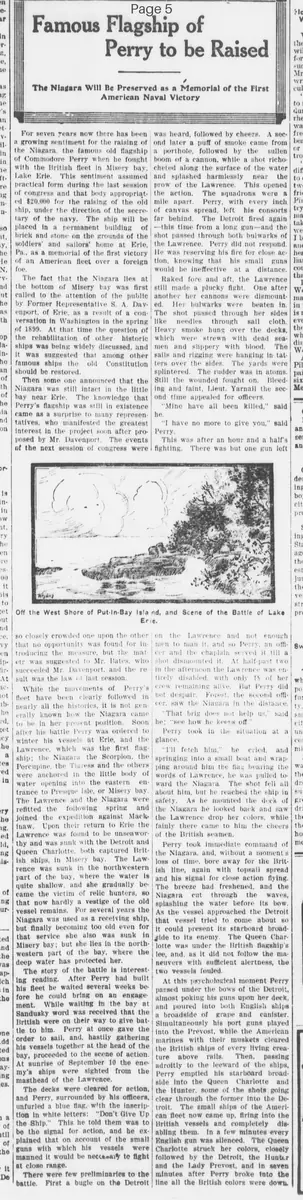
While the movements of Perry's fleet have been clearly followed in nearly all the histories, it is not generally known how the Niagara came to be in her present position. Soon after his battle Perry was ordered to winter his vessels at Erie, and the Lawrence, which was the first flagship; the Niagara the Scorpion, the Porcupine, the Tigress and the others were anchored in the little body of water opening into the eastern entrance to Presque Isle, or Misery bay.
The Lawrence and the Niagara were refitted the following spring and joined the expedition against Mackinaw. Upon their return to Erie the Lawrence was found to be unseaworthy and was sunk with the Detroit and Queen Charlotte, both captured British ships, in Misery bay. The Lawrence was sunk in the northwestern part of the bay, where the water is quite shallow, and she gradually became the victim of relic hunters, so that now hardly a vestige of the old vessel remains. For several years the Niagara was used as a receiving ship, but finally becoming too old even for that service she also was sunk in Misery bay; but she lies in the northwestern part of the bay, where the deep water has protected her.
The story of the battle is interesting reading.
After Perry had built his fleet he waited several weeks before he could bring on an engagement.
While waiting in the bay at Sandusky word was received that the British were on their way to give battle to him.
Perry at once gave the order to sail, and, hastily gathering his vessels together at the head of the bay, proceeded to the scene of action.
At sunrise of September 10 the enemy's ships were sighted from the masthead of the Lawrence.
The decks were cleared for action, and Perry, surrounded by his officers, unfurled a blue flag, with the inscription in white letters:
"Don't Give Up the Ship."
This he told them was to be the signal for action, and he explained that on account of the small guns with which his vessels were manned it would be necessary to fight at close range.
There were few preliminaries to the battle. First a bugle on the Detroit was heard, followed by cheers. A second later a puff of smoke came from a porthole, followed by the sullen boom of a cannon, while a shot ricocheted along the surface of the water and splashed harmlessly near the prow of the Lawrence.
This opened the action.
The squadrons were a mile apart.
Perry, with every inch of canvas spread, left his consorts far behind.
The Detroit fired again—this time from a long gun—and the shot passed through both bulwarks of the Lawrence. Perry did not respond. He was reserving his fire for close action, knowing that his small guns would be ineffective at a distance.
Raked fore and aft, the Lawrence still made a plucky fight.
One after another her cannons were dismounted. Her bulwarks were beaten in.
The shot passed through her sides like needles through sail cloth.
Heavy smoke hung over the decks, which were strewn with dead men and slippery with blood.
The sails and rigging were hanging in tatters over the sides. The yards were splintered. The rudder was in atoms.
Still the wounded fought on. Bleeding and faint, Lieut. Yarnall the second time appealed for officers.
"Mine have all been killed," said he.
"I have no more to give you," said Perry.
This was after an hour and a half's fighting. There was but one gun left on the Lawrence and not enough men to man it, and so Perry, an officer and the chaplain served it till a shot dismounted it. At half-past two in the afternoon the Lawrence was entirely disabled, with only 15 of her crew remaining alive. But Perry did not despair. Forest, the second officer, saw the Niagara in the distance.
"That brig does not help us," said he; "see how he keeps off."
Perry took in the situation at a glance.
"I'll fetch him," he cried, and springing into a small boat and wrapping around him the flag bearing the words of Lawrence, he was pulled toward the Niagara. The shot fell all about him, but he reached the ship in safety. As he mounted the deck of the Niagara he looked back and saw the Lawrence drop her colors, while faintly there came to him the cheers of the British seamen.
Perry took immediate command of the Niagara, and, without a moment's loss of time, bore away for the British line, again with topsail spread and his signal for close action flying.
The breeze had freshened, and the Niagara cut through the waves, splashing the water before its bow.
As the vessel approached the Detroit that vessel tried to come about so it could present its starboard broadside to its enemy. The Queen Charlotte was under the British flagship's lee, and, as it did not follow the maneuvers with sufficient alertness, the two vessels fouled.
At this psychological moment Perry passed under the bows of the Detroit, almost poking his guns upon her deck, and poured into both English ships a broadside of grape and canister.
Simultaneously his port guns played into the Prevost, while the American marines with their muskets cleared the British ships of every living creature above rails.
Then, passing adroitly to the leeward of the ships, Perry emptied his starboard broadside into the Queen Charlotte and the Hunter, some of the shots going clear through the former into the Detroit. The small ships of the American fleet now came up, firing into the British vessels and completely disabling them.
In a few minutes every English gun was silenced. The Queen Charlotte struck her colors, closely followed by the Detroit, the Hunter and the Lady Prevost, and in seven minutes after Perry broke into the line all the British colors were down.
What sub-type of article is it?
What themes does it cover?
What keywords are associated?
What entities or persons were involved?
Where did it happen?
Story Details
Key Persons
Location
Misery Bay, Lake Erie, Erie, Pa.
Event Date
September 10, 1813; Spring Of 1899
Story Details
Congress appropriates $20,000 to raise the Niagara, Perry's flagship from the 1813 Battle of Lake Erie, for preservation as a memorial. The article details the battle where Perry, after his first ship Lawrence is disabled, transfers to the Niagara and leads a victorious close-range assault on the British fleet.