Thank you for visiting SNEWPapers!
Sign up free
Story
April 26, 1954
Trainman News
Indianapolis, Marion County, Indiana
What is this article about?
Q&A from the April 1954 Railroad Retirement Board publication on survivor benefits under the Railroad Retirement Act, covering eligibility for children, parents, widows, application processes, durations, and work restrictions for beneficiaries.
Clipping
OCR Quality
98%
Excellent
Full Text
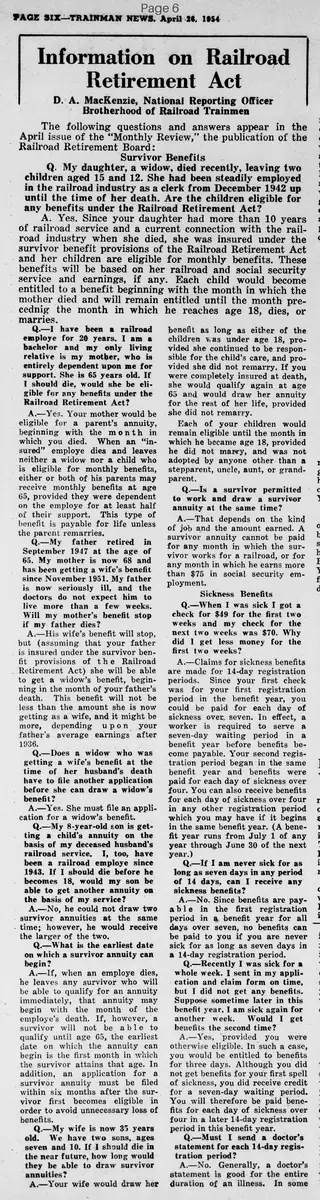
PAGE SIX - TRAINMAN NEWS. April 26, 1954
Information on Railroad Retirement Act
D. A. MacKenzie, National Reporting Officer
Brotherhood of Railroad Trainmen
The following questions and answers appear in the April issue of the "Monthly Review," the publication of the Railroad Retirement Board:
Survivor Benefits
Q. My daughter, a widow, died recently, leaving two children aged 15 and 12. She had been steadily employed in the railroad industry as a clerk from December 1942 up until the time of her death. Are the children eligible for any benefits under the Railroad Retirement Act?
A. Yes. Since your daughter had more than 10 years of railroad service and a current connection with the railroad industry when she died, she was insured under the survivor benefit provisions of the Railroad Retirement Act and her children are eligible for monthly benefits. These benefits will be based on her railroad and social security service and earnings, if any. Each child would become entitled to a benefit beginning with the month in which the mother died and will remain entitled until the month preceding the month in which he reaches age 18, dies, or marries.
Q. I have been a railroad employee for 20 years. I am a bachelor and my only living relative is my mother, who is entirely dependent upon me for support. She is 65 years old. If I should die, would she be eligible for any benefits under the Railroad Retirement Act?
A. Yes. Your mother would be eligible for a parent's annuity, beginning with the month in which you died. When an "insured" employee dies and leaves neither a widow nor a child who is eligible for monthly benefits, either or both of his parents may receive monthly benefits at age 65, provided they were dependent on the employee for at least half of their support. This type of benefit is payable for life unless the parent remarries.
Q. My father retired in September 1947 at the age of 65. My mother is now 68 and has been getting a wife's benefit since November 1951. My father is now seriously ill, and the doctors do not expect him to live more than a few weeks. Will my mother's benefit stop if my father dies?
A. His wife's benefit will stop, but (assuming that your father is insured under the survivor benefit provisions of the Railroad Retirement Act) she will be able to get a widow's benefit, beginning in the month of your father's death. This benefit will not be less than the amount she is now getting as a wife, and it might be more, depending upon your father's average earnings after 1936.
Q. Does a widow who was getting a wife's benefit at the time of her husband's death have to file another application before she can draw a widow's benefit?
A. Yes. She must file an application for a widow's benefit.
Q. My 8-year-old son is getting a child's annuity on the basis of my deceased husband's railroad service. I, too, have been a railroad employee since 1943. If I should die before he becomes 18, would my son be able to get another annuity on the basis of my service?
A. No. He could not draw two survivor annuities at the same time; however, he would receive the larger of the two.
Q. What is the earliest date on which a survivor annuity can begin?
A. If, when an employee dies, he leaves any survivor who will be able to qualify for an annuity immediately, that annuity may begin with the month of the employee's death. If, however, a survivor will not be able to qualify until age 65, the earliest date on which the annuity can begin is the first month in which the survivor attains that age. In addition, an application for a survivor annuity must be filed within six months after the survivor first becomes eligible in order to avoid unnecessary loss of benefits.
Q. My wife is now 35 years old. We have two sons, ages seven and 10. If I should die in the near future, how long would they be able to draw survivor annuities?
A. Your wife would draw her benefit as long as either of the children was under age 18, provided she continued to be responsible for the child's care, and provided she did not remarry. If you were completely insured at death, she would qualify again at age 65 and would draw her annuity for the rest of her life, provided she did not remarry.
Each of your children would remain eligible until the month in which he became age 18, provided he did not marry, and was not adopted by anyone other than a stepparent, uncle, aunt, or grandparent.
Q. Is a survivor permitted to work and draw a survivor annuity at the same time?
A. That depends on the kind of job and the amount earned. A survivor annuity cannot be paid for any month in which the survivor works for a railroad, or for any month in which he earns more than $75 in social security employment.
Information on Railroad Retirement Act
D. A. MacKenzie, National Reporting Officer
Brotherhood of Railroad Trainmen
The following questions and answers appear in the April issue of the "Monthly Review," the publication of the Railroad Retirement Board:
Survivor Benefits
Q. My daughter, a widow, died recently, leaving two children aged 15 and 12. She had been steadily employed in the railroad industry as a clerk from December 1942 up until the time of her death. Are the children eligible for any benefits under the Railroad Retirement Act?
A. Yes. Since your daughter had more than 10 years of railroad service and a current connection with the railroad industry when she died, she was insured under the survivor benefit provisions of the Railroad Retirement Act and her children are eligible for monthly benefits. These benefits will be based on her railroad and social security service and earnings, if any. Each child would become entitled to a benefit beginning with the month in which the mother died and will remain entitled until the month preceding the month in which he reaches age 18, dies, or marries.
Q. I have been a railroad employee for 20 years. I am a bachelor and my only living relative is my mother, who is entirely dependent upon me for support. She is 65 years old. If I should die, would she be eligible for any benefits under the Railroad Retirement Act?
A. Yes. Your mother would be eligible for a parent's annuity, beginning with the month in which you died. When an "insured" employee dies and leaves neither a widow nor a child who is eligible for monthly benefits, either or both of his parents may receive monthly benefits at age 65, provided they were dependent on the employee for at least half of their support. This type of benefit is payable for life unless the parent remarries.
Q. My father retired in September 1947 at the age of 65. My mother is now 68 and has been getting a wife's benefit since November 1951. My father is now seriously ill, and the doctors do not expect him to live more than a few weeks. Will my mother's benefit stop if my father dies?
A. His wife's benefit will stop, but (assuming that your father is insured under the survivor benefit provisions of the Railroad Retirement Act) she will be able to get a widow's benefit, beginning in the month of your father's death. This benefit will not be less than the amount she is now getting as a wife, and it might be more, depending upon your father's average earnings after 1936.
Q. Does a widow who was getting a wife's benefit at the time of her husband's death have to file another application before she can draw a widow's benefit?
A. Yes. She must file an application for a widow's benefit.
Q. My 8-year-old son is getting a child's annuity on the basis of my deceased husband's railroad service. I, too, have been a railroad employee since 1943. If I should die before he becomes 18, would my son be able to get another annuity on the basis of my service?
A. No. He could not draw two survivor annuities at the same time; however, he would receive the larger of the two.
Q. What is the earliest date on which a survivor annuity can begin?
A. If, when an employee dies, he leaves any survivor who will be able to qualify for an annuity immediately, that annuity may begin with the month of the employee's death. If, however, a survivor will not be able to qualify until age 65, the earliest date on which the annuity can begin is the first month in which the survivor attains that age. In addition, an application for a survivor annuity must be filed within six months after the survivor first becomes eligible in order to avoid unnecessary loss of benefits.
Q. My wife is now 35 years old. We have two sons, ages seven and 10. If I should die in the near future, how long would they be able to draw survivor annuities?
A. Your wife would draw her benefit as long as either of the children was under age 18, provided she continued to be responsible for the child's care, and provided she did not remarry. If you were completely insured at death, she would qualify again at age 65 and would draw her annuity for the rest of her life, provided she did not remarry.
Each of your children would remain eligible until the month in which he became age 18, provided he did not marry, and was not adopted by anyone other than a stepparent, uncle, aunt, or grandparent.
Q. Is a survivor permitted to work and draw a survivor annuity at the same time?
A. That depends on the kind of job and the amount earned. A survivor annuity cannot be paid for any month in which the survivor works for a railroad, or for any month in which he earns more than $75 in social security employment.
What sub-type of article is it?
Informational Qa
Benefits Guide
What keywords are associated?
Railroad Retirement Act
Survivor Benefits
Annuities
Eligibility
Widows
Children
Parents
Applications
What entities or persons were involved?
D. A. Mackenzie
Story Details
Key Persons
D. A. Mackenzie
Event Date
April 26, 1954
Story Details
Series of questions and answers explaining eligibility, duration, application requirements, and restrictions for survivor annuities under the Railroad Retirement Act, including benefits for children, parents, and widows of railroad employees.