Thank you for visiting SNEWPapers!
Sign up free
Literary
August 22, 1866
American Citizen
Butler, Butler County, Pennsylvania
What is this article about?
A travel narrative recounting tiger encounters in Singhbhum, India: a village girl's abduction and her fiancé's fatal battle with the tiger; an old man's family ambushing and killing a tiger; and the narrator's tense night vigil nearly encountering one.
Clipping
OCR Quality
95%
Excellent
Full Text
VOLUME 3.
Select Miscellany.
TRAVELS IN INDIA.
CONFLICTS WITH THE TIGER.
Many years ago, official duties led me to a small village in Singhbhum, one of the remotest and wildest divisions of that wild country, the Kolehan, on the south-west frontier. The hamlet consisted of some five or six cottages in a cleared space of as many acres, surrounded by a forest. A brook, whence the women of the village procured water, ran by the bottom of a slope, about two hundred yards from the house, and (a usual feature in Kole villages) a few large slabs of slaty rocks fixed in the ground marked where "the rude forefathers of the hamlet sleep."
Near one of those I observed a pole erected, on which grinned the skull of a tiger, with the bones of one of its arms dismembered half way up. I turned to the villagers near me for an explanation, and heard this:
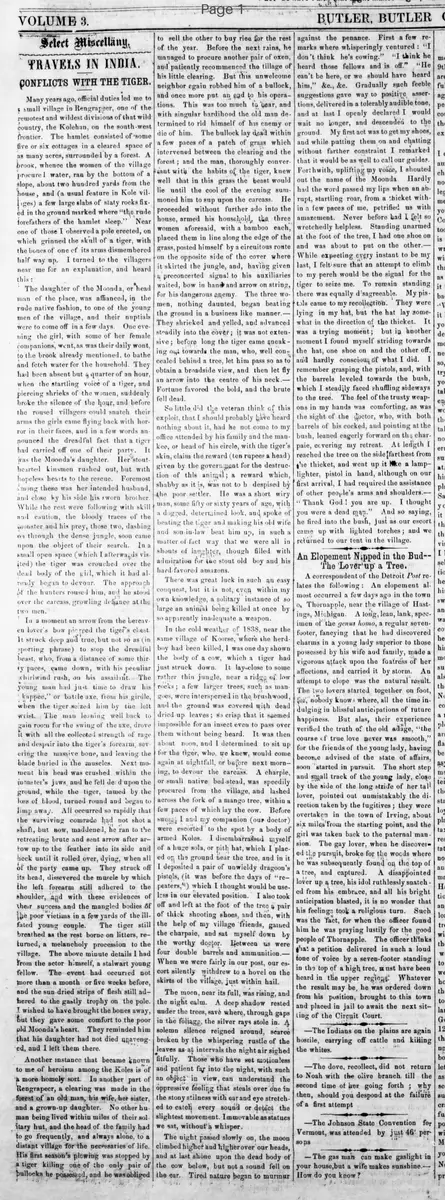
The daughter of the Moonda, or head man of the place, was affianced, in the rude native fashion, to one of the young men of the village, and their nuptials were to come off in a few days. One evening the girl, with some of her female companions, went, as was their daily wont, to the brook already mentioned, to bathe and fetch water for the household. They had been absent but a quarter of an hour, when the startling voice of a tiger, and piercing shrieks of the women, suddenly broke the silence of the hour, and before the roused villagers could snatch their arms the girls came flying back with horror in their faces, and in a few words announced the dreadful fact that a tiger had carried off one of their party. It was the Moonda's daughter. Her stout-hearted kinsmen rushed out, but with hopeless hearts to the rescue. Foremost among these was her intended husband, and close by his side his sworn brother. While the rest were following with skill and caution, the bloody traces of the monster and his prey, those two, dashing on through the dense jungle, soon came upon the object of their search. In a small open space (which I afterwards visited) the tiger was crouched over the dead body of the girl, which it had already began to devour. The approach of the hunters roused him, and he stood over the carcass, growling defiance at the two men.
In a moment an arrow from the bereaved lover's bow pierced the tiger's chest. It struck deep and true, but not so as (in sporting phrase) to stop the dreadful beast, who, from a distance of some thirty paces, came down, with his peculiar whirlwind rush, on his assailant. The young man had just time to draw his "kappee," or battle axe, from his girdle, when the tiger seized him by the left wrist. The man leaning well back to gain room for the swing of the axe, drove it with all the collected strength of rage and despair into the tiger's forearm, severing the massive bone, and leaving the blade buried in the muscles. Next moment his head was crushed within the monster's jaws, and he fell dead upon the ground, while the tiger, tamed by the loss of blood, turned round and began to limp away. All occurred so rapidly that the surviving comrade had not shot a shaft, but now, maddened, he ran to the retreating brute and sent arrow after arrow up to the feather into its side and neck until it rolled over, dying, when all of the party came up. They struck off its head, dissevered the muscle by which the left forearm still adhered to the shoulder, and with these evidences of their success and the mangled bodies of the poor victims in a few yards of the ill-fated young couple. The tiger still breathed as the rest borne on litters, returned, a melancholy procession to the village. The above minute details I had from the actor himself, a stalwart young fellow. The event had occurred not more than a month or five weeks before, and the sun-dried strips of flesh still adhered to the ghastly trophy on the pole. I wished to have brought the bones away, but they gave some comfort to the poor old Moonda's heart. They reminded him that his daughter had not died unavenged, and I left them there.
Another instance that became known to me of heroism among the Koles is of a more homely sort. In another part of Singhbhum, a clearing was made in the forest of an old man, his wife, her sister and a grown-up daughter. No other human being lived within miles of their solitary hut, and the head of the family had to go frequently, and always alone, to a distant village for the necessaries of life. His first season's plowing was stopped by a tiger killing one of the only pair of bullocks he possessed, and he was obliged and to sell the other to buy rice for the rest of the year. Before the next rains, he managed to procure another pair of oxen, and patiently recommenced the tillage of his little clearing. But this unwelcome neighbor again robbed him of a bullock, and once more put an end to his operations. This was too much to bear, and with singular hardihood the old man determined to rid himself of his enemy or die of him. The bullock lay dead within a few paces of a patch of grass which intervened between the clearing and the forest; and the man, thoroughly conversant with the habits of the tiger, knew well that in this grass the beast would lie until the cool of the evening summoned him to sup upon the carcass. He proceeded without further ado into the house, armed his household, the three women aforesaid, with a bamboo each, placed them in line along the edge of the grass, posted himself by a circuitous route on the opposite side of the cover where it skirted the jungle, and, having given a preconcerted signal to his auxiliaries waited, bow in hand and arrow on string for his dangerous enemy. The three women, nothing daunted, began beating the ground in a business-like manner. They shrieked and yelled, and advanced steadily into the cover: it was not extensive: before long the tiger came sneaking out towards the man, who, well concealed behind a tree, let him pass so as to obtain a broadside view, and then let fly an arrow into the centre of his neck. Fortune favored the bold, and the brute fell dead.
So little did the veteran think of this exploit, that I should probably have heard nothing about it, had he not come to my office attended by his family and the mankee, or head of his circle, with the tiger's skin, claim the reward (ten rupees a head) given by the government for the destruction of this animal; a reward which, shabby as it is, was not to be despised by the poor settler. He was a short wiry man, some fifty or sixty years of age, with a dogged, determined look, and spoke of beating the tiger and making his old wife and son-in-law beat him up, in such a matter-of-fact way that we were all in shouts of laughter, though filled with admiration for the stout old boy and his hard-favored amazons.
There was great luck in such an easy conquest, but it is not, even within my own knowledge, a solitary instance of so large an animal being killed at once by so apparently inadequate a weapon. In the cold weather of 1838, near the same village of Koorsee, where the herd-boy had been killed, I was one day shown the body of a cow, which a tiger had just struck down. It lay close to some rather thin jungle, near a ridge of low rocks; a few larger trees, such as mangoes, were interspersed in the brushwood and the ground was covered with dead dried up leaves: so crisp that it seemed impossible for an insect even to pass over them without being heard. It was then about noon, and I determined to sit up for the tiger, who, we knew, would come again at nightfall, or before next morning, to devour the carcass. A charpoy, or small native bed-stead, was speedily procured from the village, and lashed across the fork of a mango tree, within a few paces of which lay the cow. Before sunset I and my companion (our doctor) were escorted to the spot by a body of armed Koles. I disembarrassed myself of a huge sola, or pith hat, which I placed on the ground near the tree, and in it I deposited a pair of unwieldy dragoon's pistols, (it was before the days of "repeaters,") which I thought would be useless in our elevated position. I also took off and left at the foot of the tree a pair of thick shooting shoes, and then, with the help of my village friends, gained the charpoy, and sat myself down by the worthy doctor. Between us were four double barrels and ammunition. When we were fairly in our post, our escort silently withdrew to a hovel on the skirts of the village, just within hail. The moon, near its full, was rising, and the night calm. A deep shadow rested under the trees, save where, through gaps in the foliage, the silver rays stole in. A solemn silence reigned around, scarcely broken by the whispering rustle of the leaves as at intervals the night air sighed fitfully. Those who have set motionless and patient far into the night, with such an object in view, can understand the oppressive feeling that steals over one in the stony stillness with ear and eye stretched to catch every sound or detect the slightest movement. Immovable as statues we sat, without a whisper.
The night passed slowly on, the moon climbed higher and higher over our heads, and at last shone upon the dead body of the cow below, but not a sound fell on the ear. Tired nature began to murmur against the penance. First a few remarks were whisperingly ventured: "I don't think he's coming." "I think he heard those fellows and is off." "He can't be here, or we should have heard him," &c., &c. Gradually such feeble suggestions gave way to positive assertions, delivered in a tolerably audible tone, and at last I openly declared I would wait no longer, and descended to the ground. My first act was to get my shoes and while putting them on and chatting without farther constraint I remarked that it would be as well to call our guides. Forthwith, uplifting my voice, I shouted out the name of the Moonda. Hardly had the word passed my lips when an abrupt, startling roar, from a thicket within a few paces of me, petrified us with amazement. Never before had I felt so wretchedly helpless. Standing unarmed at the foot of the tree, I had one shoe on and was about to put on the other. While expecting every instant to be my last, I felt sure that an attempt to climb to my perch would be the signal for the tiger to seize me. To remain standing there was equally disagreeable. My pistols came to my recollection. They were lying in my hat, but the hat lay somewhat in the direction of the thicket. It was a trying moment; but in another moment I found myself striding towards the hat, one shoe on and the other off, and hardly conscious of what I did. I remember grasping the pistols, and, with the barrels leveled towards the bush which I steadily faced shuffling sideways to the tree. The feel of the trusty weapons in my hands was comforting, as was the sight of the doctor, who, with both barrels of his cocked, and pointing at the bush, leaned eagerly forward on the charpoy, covering my retreat. At length I reached the tree on the side farthest from the thicket, and went up it like a lamp-lighter, pistol in hand, although on our first arrival, I had required the assistance of other people's arms and shoulders. "Thank God! you are up. I thought you were a dead man." And so saying he fired into the bush, just as our escort came up with lighted torches; and we returned to our tent in the village.
Select Miscellany.
TRAVELS IN INDIA.
CONFLICTS WITH THE TIGER.
Many years ago, official duties led me to a small village in Singhbhum, one of the remotest and wildest divisions of that wild country, the Kolehan, on the south-west frontier. The hamlet consisted of some five or six cottages in a cleared space of as many acres, surrounded by a forest. A brook, whence the women of the village procured water, ran by the bottom of a slope, about two hundred yards from the house, and (a usual feature in Kole villages) a few large slabs of slaty rocks fixed in the ground marked where "the rude forefathers of the hamlet sleep."
Near one of those I observed a pole erected, on which grinned the skull of a tiger, with the bones of one of its arms dismembered half way up. I turned to the villagers near me for an explanation, and heard this:
The daughter of the Moonda, or head man of the place, was affianced, in the rude native fashion, to one of the young men of the village, and their nuptials were to come off in a few days. One evening the girl, with some of her female companions, went, as was their daily wont, to the brook already mentioned, to bathe and fetch water for the household. They had been absent but a quarter of an hour, when the startling voice of a tiger, and piercing shrieks of the women, suddenly broke the silence of the hour, and before the roused villagers could snatch their arms the girls came flying back with horror in their faces, and in a few words announced the dreadful fact that a tiger had carried off one of their party. It was the Moonda's daughter. Her stout-hearted kinsmen rushed out, but with hopeless hearts to the rescue. Foremost among these was her intended husband, and close by his side his sworn brother. While the rest were following with skill and caution, the bloody traces of the monster and his prey, those two, dashing on through the dense jungle, soon came upon the object of their search. In a small open space (which I afterwards visited) the tiger was crouched over the dead body of the girl, which it had already began to devour. The approach of the hunters roused him, and he stood over the carcass, growling defiance at the two men.
In a moment an arrow from the bereaved lover's bow pierced the tiger's chest. It struck deep and true, but not so as (in sporting phrase) to stop the dreadful beast, who, from a distance of some thirty paces, came down, with his peculiar whirlwind rush, on his assailant. The young man had just time to draw his "kappee," or battle axe, from his girdle, when the tiger seized him by the left wrist. The man leaning well back to gain room for the swing of the axe, drove it with all the collected strength of rage and despair into the tiger's forearm, severing the massive bone, and leaving the blade buried in the muscles. Next moment his head was crushed within the monster's jaws, and he fell dead upon the ground, while the tiger, tamed by the loss of blood, turned round and began to limp away. All occurred so rapidly that the surviving comrade had not shot a shaft, but now, maddened, he ran to the retreating brute and sent arrow after arrow up to the feather into its side and neck until it rolled over, dying, when all of the party came up. They struck off its head, dissevered the muscle by which the left forearm still adhered to the shoulder, and with these evidences of their success and the mangled bodies of the poor victims in a few yards of the ill-fated young couple. The tiger still breathed as the rest borne on litters, returned, a melancholy procession to the village. The above minute details I had from the actor himself, a stalwart young fellow. The event had occurred not more than a month or five weeks before, and the sun-dried strips of flesh still adhered to the ghastly trophy on the pole. I wished to have brought the bones away, but they gave some comfort to the poor old Moonda's heart. They reminded him that his daughter had not died unavenged, and I left them there.
Another instance that became known to me of heroism among the Koles is of a more homely sort. In another part of Singhbhum, a clearing was made in the forest of an old man, his wife, her sister and a grown-up daughter. No other human being lived within miles of their solitary hut, and the head of the family had to go frequently, and always alone, to a distant village for the necessaries of life. His first season's plowing was stopped by a tiger killing one of the only pair of bullocks he possessed, and he was obliged and to sell the other to buy rice for the rest of the year. Before the next rains, he managed to procure another pair of oxen, and patiently recommenced the tillage of his little clearing. But this unwelcome neighbor again robbed him of a bullock, and once more put an end to his operations. This was too much to bear, and with singular hardihood the old man determined to rid himself of his enemy or die of him. The bullock lay dead within a few paces of a patch of grass which intervened between the clearing and the forest; and the man, thoroughly conversant with the habits of the tiger, knew well that in this grass the beast would lie until the cool of the evening summoned him to sup upon the carcass. He proceeded without further ado into the house, armed his household, the three women aforesaid, with a bamboo each, placed them in line along the edge of the grass, posted himself by a circuitous route on the opposite side of the cover where it skirted the jungle, and, having given a preconcerted signal to his auxiliaries waited, bow in hand and arrow on string for his dangerous enemy. The three women, nothing daunted, began beating the ground in a business-like manner. They shrieked and yelled, and advanced steadily into the cover: it was not extensive: before long the tiger came sneaking out towards the man, who, well concealed behind a tree, let him pass so as to obtain a broadside view, and then let fly an arrow into the centre of his neck. Fortune favored the bold, and the brute fell dead.
So little did the veteran think of this exploit, that I should probably have heard nothing about it, had he not come to my office attended by his family and the mankee, or head of his circle, with the tiger's skin, claim the reward (ten rupees a head) given by the government for the destruction of this animal; a reward which, shabby as it is, was not to be despised by the poor settler. He was a short wiry man, some fifty or sixty years of age, with a dogged, determined look, and spoke of beating the tiger and making his old wife and son-in-law beat him up, in such a matter-of-fact way that we were all in shouts of laughter, though filled with admiration for the stout old boy and his hard-favored amazons.
There was great luck in such an easy conquest, but it is not, even within my own knowledge, a solitary instance of so large an animal being killed at once by so apparently inadequate a weapon. In the cold weather of 1838, near the same village of Koorsee, where the herd-boy had been killed, I was one day shown the body of a cow, which a tiger had just struck down. It lay close to some rather thin jungle, near a ridge of low rocks; a few larger trees, such as mangoes, were interspersed in the brushwood and the ground was covered with dead dried up leaves: so crisp that it seemed impossible for an insect even to pass over them without being heard. It was then about noon, and I determined to sit up for the tiger, who, we knew, would come again at nightfall, or before next morning, to devour the carcass. A charpoy, or small native bed-stead, was speedily procured from the village, and lashed across the fork of a mango tree, within a few paces of which lay the cow. Before sunset I and my companion (our doctor) were escorted to the spot by a body of armed Koles. I disembarrassed myself of a huge sola, or pith hat, which I placed on the ground near the tree, and in it I deposited a pair of unwieldy dragoon's pistols, (it was before the days of "repeaters,") which I thought would be useless in our elevated position. I also took off and left at the foot of the tree a pair of thick shooting shoes, and then, with the help of my village friends, gained the charpoy, and sat myself down by the worthy doctor. Between us were four double barrels and ammunition. When we were fairly in our post, our escort silently withdrew to a hovel on the skirts of the village, just within hail. The moon, near its full, was rising, and the night calm. A deep shadow rested under the trees, save where, through gaps in the foliage, the silver rays stole in. A solemn silence reigned around, scarcely broken by the whispering rustle of the leaves as at intervals the night air sighed fitfully. Those who have set motionless and patient far into the night, with such an object in view, can understand the oppressive feeling that steals over one in the stony stillness with ear and eye stretched to catch every sound or detect the slightest movement. Immovable as statues we sat, without a whisper.
The night passed slowly on, the moon climbed higher and higher over our heads, and at last shone upon the dead body of the cow below, but not a sound fell on the ear. Tired nature began to murmur against the penance. First a few remarks were whisperingly ventured: "I don't think he's coming." "I think he heard those fellows and is off." "He can't be here, or we should have heard him," &c., &c. Gradually such feeble suggestions gave way to positive assertions, delivered in a tolerably audible tone, and at last I openly declared I would wait no longer, and descended to the ground. My first act was to get my shoes and while putting them on and chatting without farther constraint I remarked that it would be as well to call our guides. Forthwith, uplifting my voice, I shouted out the name of the Moonda. Hardly had the word passed my lips when an abrupt, startling roar, from a thicket within a few paces of me, petrified us with amazement. Never before had I felt so wretchedly helpless. Standing unarmed at the foot of the tree, I had one shoe on and was about to put on the other. While expecting every instant to be my last, I felt sure that an attempt to climb to my perch would be the signal for the tiger to seize me. To remain standing there was equally disagreeable. My pistols came to my recollection. They were lying in my hat, but the hat lay somewhat in the direction of the thicket. It was a trying moment; but in another moment I found myself striding towards the hat, one shoe on and the other off, and hardly conscious of what I did. I remember grasping the pistols, and, with the barrels leveled towards the bush which I steadily faced shuffling sideways to the tree. The feel of the trusty weapons in my hands was comforting, as was the sight of the doctor, who, with both barrels of his cocked, and pointing at the bush, leaned eagerly forward on the charpoy, covering my retreat. At length I reached the tree on the side farthest from the thicket, and went up it like a lamp-lighter, pistol in hand, although on our first arrival, I had required the assistance of other people's arms and shoulders. "Thank God! you are up. I thought you were a dead man." And so saying he fired into the bush, just as our escort came up with lighted torches; and we returned to our tent in the village.
What sub-type of article is it?
Journey Narrative
Essay
What themes does it cover?
Nature
Moral Virtue
What keywords are associated?
Tiger Encounters
Singhbhum
Kole Heroism
Village Life
Animal Hunt
Literary Details
Title
Travels In India. Conflicts With The Tiger.
Subject
Tiger Encounters In Singhbhum Villages
Form / Style
Prose Anecdotes Of Adventure And Heroism
Key Lines
The Daughter Of The Moonda... A Tiger Had Carried Off One Of Their Party. It Was The Moonda's Daughter.
In A Moment An Arrow From The Bereaved Lover's Bow Pierced The Tiger's Chest.
The Three Women, Nothing Daunted, Began Beating The Ground In A Business Like Manner.
Hardly Had The Word Passed My Lips When An Abrupt, Startling Roar, From A Thicket Within A Few Paces Of Me, Petrified Us With Amazement.