Thank you for visiting SNEWPapers!
Sign up free
The Enquirer
Richmond, Henrico County, Virginia
What is this article about?
Intelligence from Paris (July 12-27, 1804) details appointments to Empress Josephine's household, Vice-Admiral Latouche as Mediterranean coast inspector, Cardinal Fesch as Grand Almoner, establishments for Napoleon's sisters, coronation dress description, and imperial decree regulating Freemason lodges under police oversight.
Clipping
OCR Quality
Full Text
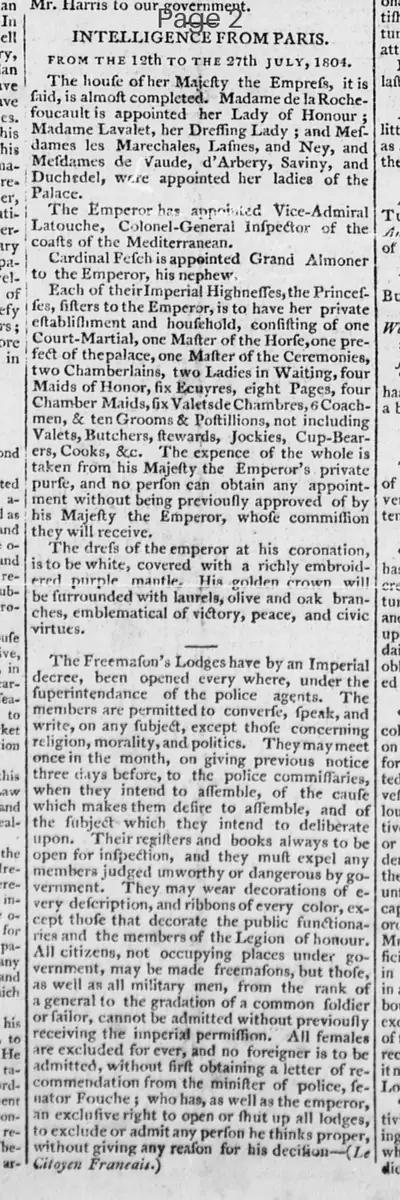
FROM THE 12th TO THE 27th JULY, 1804.
The house of her Majesty the Empress, it is said, is almost completed. Madame de la Rochefoucault is appointed her Lady of Honour ; Madame Lavalet, her Dressing Lady ; and Mesdames les Marechales, Lannes, and Ney, and Mesdames de Vaude, d'Abresy, Savary, and Duchesnel, were appointed her ladies of the Palace.
The Emperor has appointed Vice-Admiral Latouche, Colonel-General Inspector of the coasts of the Mediterranean.
Cardinal Fesch is appointed Grand Almoner to the Emperor, his nephew,
Each of their Imperial Highnesses, the Princesses, sisters to the Emperor, is to have her private establishment and household, consisting of one Court-Martial, one Master of the Horse, one prefect of the palace, one Master of the Ceremonies, two Chamberlains, two Ladies in Waiting, four Maids of Honor, six Ecuyers, eight Pages, four Chamber Maids, six Valets de Chambres, 6 Coachmen, & ten Grooms & Postillions, not including Valets, Butlers, stewards, Jockeys, Cup-Bearers, Cooks, &c. The expense of the whole is taken from his Majesty the Emperor's private purse, and no person can obtain any appointment without being previously approved of by his Majesty the Emperor, whose commission they will receive.
The dress of the emperor at his coronation, is to be white, covered with a richly embroidered purple mantle. His golden crown will be surrounded with laurels, olive and oak branches, emblematical of victory, peace, and civic virtues.
The Free-mason's Lodges have by an Imperial decree, been opened every where, under the superintendence of the police agents. The members are permitted to converse, speak, and write, on any subject, except those concerning religion, morality, and politics. They may meet once in the month, on giving previous notice three days before, to the police commissaries, when they intend to assemble, of the cause which makes them desire to assemble, and of the subject which they intend to deliberate upon. Their registers and books always to be open for inspection, and they must expel any members judged unworthy or dangerous by government. They may wear decorations of every description, and ribbons of every color, except those that decorate the public functionaries and the members of the Legion of honour. All citizens, not occupying places under government, may be made free-masons, but those, as well as all military men, from the rank of a general to the gradation of a common soldier or sailor, cannot be admitted without previously receiving the imperial permission. All females are excluded for ever, and no foreigner is to be admitted, without first obtaining a letter of recommendation from the minister of police, senator Fouche ; who has, as well as the emperor, an exclusive right to open or shut up all lodges, to exclude or admit any person he thinks proper, without giving any reason for his decision-(Le Citoyen Francois.)
What sub-type of article is it?
What keywords are associated?
What entities or persons were involved?
Where did it happen?
Foreign News Details
Primary Location
Paris
Event Date
From The 12th To The 27th July, 1804
Key Persons
Outcome
appointments to imperial household completed; vice-admiral latouche appointed inspector; cardinal fesch as grand almoner; private households established for princesses; coronation dress specified; freemason lodges reopened under strict police regulations excluding politics, religion, women, and requiring permissions.
Event Details
Reports detail the near-completion of the Empress's household with specific appointments; Emperor's appointment of Vice-Admiral Latouche and Cardinal Fesch; establishment of private households for the Emperor's sisters funded by his purse; description of the Emperor's coronation attire symbolizing victory, peace, and virtues; imperial decree allowing Freemason lodges to operate under police supervision with restrictions on topics, membership, and activities.