Thank you for visiting SNEWPapers!
Sign up free
Story
April 20, 1840
Lynchburg Virginian
Lynchburg, Virginia
What is this article about?
A 1840 article debates Martin Van Buren's War of 1812 stance, reprinting Senator Silas Wright's letter denying Van Buren led an anti-war meeting in Hudson, NY, in 1812. The editor questions the defense, citing Van Buren's summer 1812 alliance with peace candidate DeWitt Clinton against Madison.
Clipping
OCR Quality
95%
Excellent
Full Text
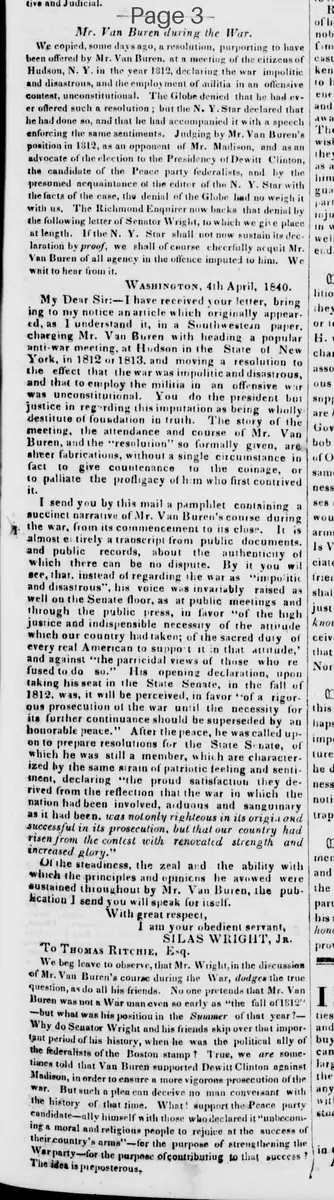
Mr. Van Buren during the War.
We copied, some days ago, a resolution, purporting to have been offered by Mr. Van Buren, at a meeting of the citizens of Hudson, N. Y. in the year 1812, declaring the war impolitic and disastrous, and the employment of militia in an offensive contest, unconstitutional. The Globe denied that he had ever offered such a resolution: but the N. Y. Star declared that he had done so, and that he had accompanied it with a speech enforcing the same sentiments. Judging by Mr. Van Buren's position in 1812, as an opponent of Mr. Madison, and as an advocate of the election to the Presidency of DeWitt Clinton, the candidate of the Peace party federalists, and by the presumed acquaintance of the editor of the N. Y. Star with the facts of the case, the denial of the Globe had no weight with us. The Richmond Enquirer now backs that denial by the following letter of Senator Wright, to which we give place at length. If the N. Y. Star shall not now sustain its declaration by proof, we shall of course cheerfully acquit Mr. Van Buren of all agency in the offence imputed to him. We wait to hear from it.
Washington, 4th April, 1840.
My Dear Sir:—I have received your letter, bringing to my notice an article which originally appeared, as I understand it, in a Southwestern paper, charging Mr. Van Buren with heading a popular anti-war meeting, at Hudson in the State of New York, in 1812 or 1813, and moving a resolution to the effect that the war was impolitic and disastrous, and that to employ the militia in an offensive war was unconstitutional. You do the President but justice in regarding this imputation as being wholly destitute of foundation in truth. The story of the meeting, the attendance and course of Mr. Van Buren, and the "resolution" so formally given, are sheer fabrications, without a single circumstance in fact to give countenance to the coinage, or to palliate the profligacy of him who first contrived it.
I send you by this mail a pamphlet containing a succinct narrative of Mr. Van Buren's course during the war, from its commencement to its close. It is almost entirely a transcript from public documents and public records, about the authenticity of which there can be no dispute. By it you will see, that, instead of regarding the war as "impolitic and disastrous", his voice was invariably raised as well on the Senate floor, as at public meetings and through the public press, in favor "of the high justice and indispensable necessity of the attitude which our country had taken; of the sacred duty of every real American to support it in that attitude," and against the parricidal views of those who refused to do so." His opening declaration, upon taking his seat in the State Senate, in the fall of 1812, was, it will be perceived, in favor "of a rigorous prosecution of the war until the necessity for its further continuance should be superseded by an honorable peace." After the peace, he was called upon to prepare resolutions for the State Senate, of which he was still a member, which are characterized by the same strain of patriotic feeling and sentiment, declaring "the proud satisfaction they derived from the reflection that the war in which the nation had been involved, arduous and sanguinary as it had been, was not only righteous in its origin and successful in its prosecution, but that our country had risen from the contest with renovated strength and increased glory."
Of the steadiness, the zeal and the ability with which the principles and opinions he avowed were sustained throughout by Mr. Van Buren, the publication I send you will speak for itself.
With great respect,
I am your obedient servant,
SILAS WRIGHT, Jr.
To Thomas Ritchie, Esq.
We beg leave to observe, that Mr. Wright, in the discussion of Mr. Van Buren's course during the War, dodges the true question, as do all his friends. No one pretends that Mr. Van Buren was not a War man even so early as "the fall of 1812"—but what was his position in the Summer of that year?—Why do Senator Wright and his friends skip over that important period of his history, when he was the political ally of the federalists of the Boston stamp? True, we are sometimes told that Van Buren supported DeWitt Clinton against Madison, in order to ensure a more vigorous prosecution of the war. But such a plea can deceive no man conversant with the history of that time. What! support the Peace party candidate—ally himself with those who declared it "unbecoming a moral and religious people to rejoice at the success of their country's arms for the purpose of strengthening the War party—for the purpose of contributing to that success? The idea is preposterous,
We copied, some days ago, a resolution, purporting to have been offered by Mr. Van Buren, at a meeting of the citizens of Hudson, N. Y. in the year 1812, declaring the war impolitic and disastrous, and the employment of militia in an offensive contest, unconstitutional. The Globe denied that he had ever offered such a resolution: but the N. Y. Star declared that he had done so, and that he had accompanied it with a speech enforcing the same sentiments. Judging by Mr. Van Buren's position in 1812, as an opponent of Mr. Madison, and as an advocate of the election to the Presidency of DeWitt Clinton, the candidate of the Peace party federalists, and by the presumed acquaintance of the editor of the N. Y. Star with the facts of the case, the denial of the Globe had no weight with us. The Richmond Enquirer now backs that denial by the following letter of Senator Wright, to which we give place at length. If the N. Y. Star shall not now sustain its declaration by proof, we shall of course cheerfully acquit Mr. Van Buren of all agency in the offence imputed to him. We wait to hear from it.
Washington, 4th April, 1840.
My Dear Sir:—I have received your letter, bringing to my notice an article which originally appeared, as I understand it, in a Southwestern paper, charging Mr. Van Buren with heading a popular anti-war meeting, at Hudson in the State of New York, in 1812 or 1813, and moving a resolution to the effect that the war was impolitic and disastrous, and that to employ the militia in an offensive war was unconstitutional. You do the President but justice in regarding this imputation as being wholly destitute of foundation in truth. The story of the meeting, the attendance and course of Mr. Van Buren, and the "resolution" so formally given, are sheer fabrications, without a single circumstance in fact to give countenance to the coinage, or to palliate the profligacy of him who first contrived it.
I send you by this mail a pamphlet containing a succinct narrative of Mr. Van Buren's course during the war, from its commencement to its close. It is almost entirely a transcript from public documents and public records, about the authenticity of which there can be no dispute. By it you will see, that, instead of regarding the war as "impolitic and disastrous", his voice was invariably raised as well on the Senate floor, as at public meetings and through the public press, in favor "of the high justice and indispensable necessity of the attitude which our country had taken; of the sacred duty of every real American to support it in that attitude," and against the parricidal views of those who refused to do so." His opening declaration, upon taking his seat in the State Senate, in the fall of 1812, was, it will be perceived, in favor "of a rigorous prosecution of the war until the necessity for its further continuance should be superseded by an honorable peace." After the peace, he was called upon to prepare resolutions for the State Senate, of which he was still a member, which are characterized by the same strain of patriotic feeling and sentiment, declaring "the proud satisfaction they derived from the reflection that the war in which the nation had been involved, arduous and sanguinary as it had been, was not only righteous in its origin and successful in its prosecution, but that our country had risen from the contest with renovated strength and increased glory."
Of the steadiness, the zeal and the ability with which the principles and opinions he avowed were sustained throughout by Mr. Van Buren, the publication I send you will speak for itself.
With great respect,
I am your obedient servant,
SILAS WRIGHT, Jr.
To Thomas Ritchie, Esq.
We beg leave to observe, that Mr. Wright, in the discussion of Mr. Van Buren's course during the War, dodges the true question, as do all his friends. No one pretends that Mr. Van Buren was not a War man even so early as "the fall of 1812"—but what was his position in the Summer of that year?—Why do Senator Wright and his friends skip over that important period of his history, when he was the political ally of the federalists of the Boston stamp? True, we are sometimes told that Van Buren supported DeWitt Clinton against Madison, in order to ensure a more vigorous prosecution of the war. But such a plea can deceive no man conversant with the history of that time. What! support the Peace party candidate—ally himself with those who declared it "unbecoming a moral and religious people to rejoice at the success of their country's arms for the purpose of strengthening the War party—for the purpose of contributing to that success? The idea is preposterous,
What sub-type of article is it?
Historical Event
Biography
What themes does it cover?
Deception
Justice
What keywords are associated?
Van Buren
War Of 1812
Anti War Resolution
Political Controversy
Dewitt Clinton
Silas Wright
What entities or persons were involved?
Mr. Van Buren
Silas Wright Jr.
Dewitt Clinton
Mr. Madison
Thomas Ritchie
Where did it happen?
Hudson, N. Y.; Washington
Story Details
Key Persons
Mr. Van Buren
Silas Wright Jr.
Dewitt Clinton
Mr. Madison
Thomas Ritchie
Location
Hudson, N. Y.; Washington
Event Date
1812
Story Details
Article reprints Senator Wright's 1840 letter denying Van Buren led an anti-war meeting in Hudson in 1812, affirming his pro-war stance from fall 1812 onward. Editor questions omission of Van Buren's summer 1812 support for peace candidate Clinton against Madison.