Thank you for visiting SNEWPapers!
Sign up free
Editorial
February 3, 1947
The Daily Alaska Empire
Juneau, Juneau County, Alaska
What is this article about?
The editorial expresses hope that Gen. George C. Marshall's appointment as Secretary of State will shift U.S. diplomatic focus from Europe to the pressing issues in China and Russia, where tensions risk escalating to global war, contrasting with progress achieved under Secretary Byrnes in Europe.
Clipping
OCR Quality
98%
Excellent
Full Text
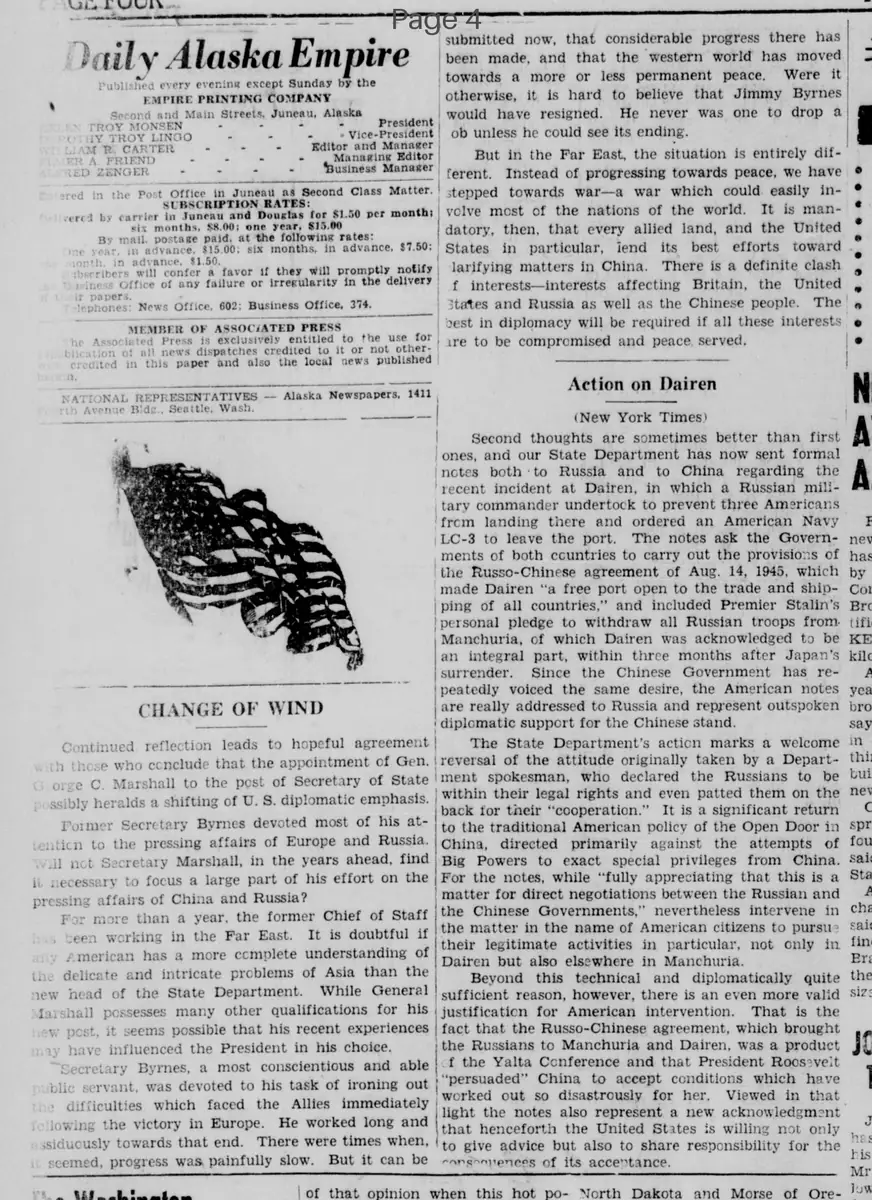
CHANGE OF WIND
Continued reflection leads to hopeful agreement
with those who conclude that the appointment of Gen.
George C. Marshall to the post of Secretary of State
possibly heralds a shifting of U. S. diplomatic emphasis.
Former Secretary Byrnes devoted most of his at-
tention to the pressing affairs of Europe and Russia.
Will not Secretary Marshall, in the years ahead, find
it necessary to focus a large part of his effort on the
pressing affairs of China and Russia?
For more than a year, the former Chief of Staff
has been working in the Far East. It is doubtful if
any American has a more complete understanding of
the delicate and intricate problems of Asia than the
new head of the State Department. While General
Marshall possesses many other qualifications for his
new post, it seems possible that his recent experiences
in it have influenced the President in his choice.
Secretary Byrnes, a most conscientious and able
public servant, was devoted to his task of ironing out
difficulties which faced the Allies immediately
following the victory in Europe. He worked long and
assiduously towards that end. There were times when,
it seemed, progress was painfully slow. But it can be
submitted now, that considerable progress there has
been made, and that the western world has moved
towards a more or less permanent peace. Were it
otherwise, it is hard to believe that Jimmy Byrnes
would have resigned. He never was one to drop a
job unless he could see its ending.
But in the Far East, the situation is entirely dif-
ferent. Instead of progressing towards peace, we have
stepped towards war—a war which could easily in-
volve most of the nations of the world. It is man-
datory, then, that every allied land, and the United
States in particular, lend its best efforts toward
clarifying matters in China. There is a definite clash
of interests—interests affecting Britain, the United
States and Russia as well as the Chinese people. The
best in diplomacy will be required if all these interests
are to be compromised and peace served.
Continued reflection leads to hopeful agreement
with those who conclude that the appointment of Gen.
George C. Marshall to the post of Secretary of State
possibly heralds a shifting of U. S. diplomatic emphasis.
Former Secretary Byrnes devoted most of his at-
tention to the pressing affairs of Europe and Russia.
Will not Secretary Marshall, in the years ahead, find
it necessary to focus a large part of his effort on the
pressing affairs of China and Russia?
For more than a year, the former Chief of Staff
has been working in the Far East. It is doubtful if
any American has a more complete understanding of
the delicate and intricate problems of Asia than the
new head of the State Department. While General
Marshall possesses many other qualifications for his
new post, it seems possible that his recent experiences
in it have influenced the President in his choice.
Secretary Byrnes, a most conscientious and able
public servant, was devoted to his task of ironing out
difficulties which faced the Allies immediately
following the victory in Europe. He worked long and
assiduously towards that end. There were times when,
it seemed, progress was painfully slow. But it can be
submitted now, that considerable progress there has
been made, and that the western world has moved
towards a more or less permanent peace. Were it
otherwise, it is hard to believe that Jimmy Byrnes
would have resigned. He never was one to drop a
job unless he could see its ending.
But in the Far East, the situation is entirely dif-
ferent. Instead of progressing towards peace, we have
stepped towards war—a war which could easily in-
volve most of the nations of the world. It is man-
datory, then, that every allied land, and the United
States in particular, lend its best efforts toward
clarifying matters in China. There is a definite clash
of interests—interests affecting Britain, the United
States and Russia as well as the Chinese people. The
best in diplomacy will be required if all these interests
are to be compromised and peace served.
What sub-type of article is it?
Foreign Affairs
War Or Peace
What keywords are associated?
George Marshall
Secretary Of State
China Diplomacy
Far East
Post War Peace
Russia Interests
Europe Progress
What entities or persons were involved?
Gen. George C. Marshall
Secretary Byrnes
Jimmy Byrnes
President
China
Russia
Britain
United States
Editorial Details
Primary Topic
Shift In U.S. Diplomatic Emphasis To China And Russia
Stance / Tone
Hopeful On Marshall's Appointment And Need For Focus On Asian Peace
Key Figures
Gen. George C. Marshall
Secretary Byrnes
Jimmy Byrnes
President
China
Russia
Britain
United States
Key Arguments
Appointment Of Marshall Heralds Shift From Europe To Asia Focus
Byrnes Focused On Europe And Russia Post Victory
Marshall's Far East Experience Qualifies Him For State Department Role
Progress Toward Peace Achieved In Western World Under Byrnes
Far East Situation Deteriorating Toward War Involving World Nations
U.S. Must Lead Efforts To Clarify Clashes In China
Diplomacy Needed To Compromise Interests Of Britain, U.S., Russia, And China