Thank you for visiting SNEWPapers!
Sign up free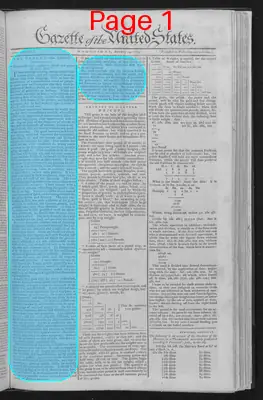
Editorial
August 19, 1789
Gazette Of The United States
New York, New York County, New York
What is this article about?
This editorial reflects on how personal experiences shape contrasting public opinions about the new constitution and government. It contrasts the bitter critic Ignatius, driven by envy, with the supportive Placidus, urging calm judgment and common sense to preserve tranquility and counter divisive rhetoric.
Clipping
OCR Quality
98%
Excellent
Full Text
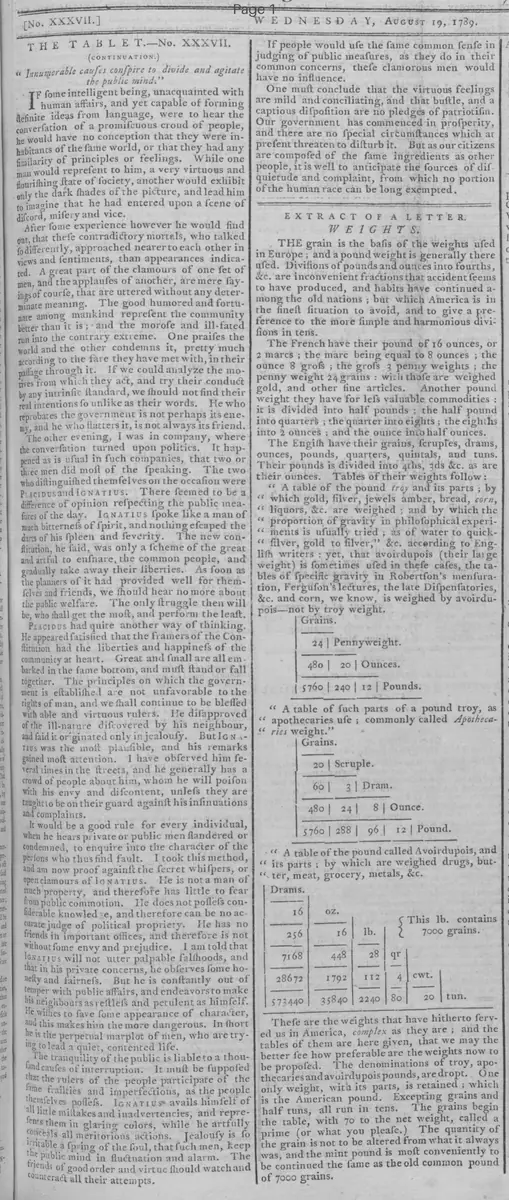
[No. XXXVII.]
THE TABLET.-No. XXXVII.
(Continuation.)
"Innumerable causes conspire to divide and agitate the public mind."
If some intelligent being, unacquainted with human affairs, and yet capable of forming definite ideas from language, were to hear the conversation of a promiscuous crowd of people, he would have no conception that they were inhabitants of the same world, or that they had any similarity of principles or feelings. While one man would represent to him, a very virtuous and flourishing state of society, another would exhibit only the dark shades of the picture, and lead him to imagine that he had entered upon a scene of discord, misery and vice.
After some experience however he would find out, that these contradictory mortals, who talked so differently, approached nearer to each other in views and sentiments, than appearances indicated. A great part of the clamours of one set of men, and the applauses of another, are mere sayings of course, that are uttered without any determinate meaning. The good humored and fortunate among mankind represent the community better than it is; and the morose and ill-fated run into the contrary extreme. One praises the world and the other condemns it, pretty much according to the fare they have met with, in their passage through it. If we could analyze the motives from which they act, and try their conduct by any intrinsic standard, we should not find their real intentions so unlike as their words. He who reprobates the government is not perhaps its enemy, and he who flatters it, is not always its friend.
The other evening, I was in company, where the conversation turned upon politics. It happened as is usual in such companies, that two or three men did most of the speaking. The two who distinguished themselves on the occasion were Placidus and Ignatius. There seemed to be a difference of opinion respecting the public measures of the day. Ignatius spoke like a man of much bitterness of spirit, and nothing escaped the darts of his spleen and severity. The new constitution, he said, was only a scheme of the great and artful to ensnare, the common people, and gradually take away their liberties. As soon as the planners of it had provided well for themselves and friends, we should hear no more about the public welfare. The only struggle then will be, who shall get the most, and perform the least.
Placidus had quite another way of thinking. He appeared satisfied that the framers of the Constitution had the liberties and happiness of the community at heart. Great and small are all embarked in the same bottom, and must stand or fall together. The principles on which the government is established are not unfavorable to the rights of man, and we shall continue to be blessed with able and virtuous rulers. He disapproved of the ill-nature discovered by his neighbour, and said it originated only in jealousy. But Ignatius was the most plausible, and his remarks gained most attention. I have observed him several times in the streets, and he generally has a crowd of people about him, whom he will poison with his envy and discontent, unless they are taught to be on their guard against his insinuations and complaints.
It would be a good rule for every individual, when he hears private or public men slandered or condemned, to enquire into the character of the persons who thus find fault. I took this method, and am now proof against the secret whispers, or open clamours of Ignatius. He is not a man of much property, and therefore has little to fear from public commotion. He does not possess considerable knowledge, and therefore can be no accurate judge of political propriety. He has no friends in important offices, and therefore is not without some envy and prejudice. I am told that Ignatius will not utter palpable falsehoods, and that in his private concerns, he observes some honesty and fairness. But he is constantly out of temper with public affairs, and endeavors to make his neighbours as restless and petulant as himself. He wishes to save some appearance of character, and this makes him the more dangerous. In short he is the perpetual marplot of men, who are trying to lead a quiet, contented life.
The tranquility of the public is liable to a thousand causes of interruption. It must be supposed that the rulers of the people participate of the same frailties and imperfections, as the people themselves possess. Ignatius avails himself of all little mistakes and inadvertencies, and represents them in glaring colors, while he artfully conceals all meritorious actions. Jealousy is so irritable a spring of the soul, that such men, keep the public mind in fluctuation friends of good order and virtue should watch and counteract all their attempts.
If people would use the same common sense in judging of public measures, as they do in their common concerns, these clamorous men would have no influence.
One must conclude that the virtuous feelings are mild and conciliating, and that bustle, and a captious disposition are no pledges of patriotism.
Our government has commenced in prosperity, and there are no special circumstances which at present threaten to disturb it. But as our citizens are composed of the same ingredients as other people, it is well to anticipate the sources of disquietude and complaint, from which no portion of the human race can be long exempted.
THE TABLET.-No. XXXVII.
(Continuation.)
"Innumerable causes conspire to divide and agitate the public mind."
If some intelligent being, unacquainted with human affairs, and yet capable of forming definite ideas from language, were to hear the conversation of a promiscuous crowd of people, he would have no conception that they were inhabitants of the same world, or that they had any similarity of principles or feelings. While one man would represent to him, a very virtuous and flourishing state of society, another would exhibit only the dark shades of the picture, and lead him to imagine that he had entered upon a scene of discord, misery and vice.
After some experience however he would find out, that these contradictory mortals, who talked so differently, approached nearer to each other in views and sentiments, than appearances indicated. A great part of the clamours of one set of men, and the applauses of another, are mere sayings of course, that are uttered without any determinate meaning. The good humored and fortunate among mankind represent the community better than it is; and the morose and ill-fated run into the contrary extreme. One praises the world and the other condemns it, pretty much according to the fare they have met with, in their passage through it. If we could analyze the motives from which they act, and try their conduct by any intrinsic standard, we should not find their real intentions so unlike as their words. He who reprobates the government is not perhaps its enemy, and he who flatters it, is not always its friend.
The other evening, I was in company, where the conversation turned upon politics. It happened as is usual in such companies, that two or three men did most of the speaking. The two who distinguished themselves on the occasion were Placidus and Ignatius. There seemed to be a difference of opinion respecting the public measures of the day. Ignatius spoke like a man of much bitterness of spirit, and nothing escaped the darts of his spleen and severity. The new constitution, he said, was only a scheme of the great and artful to ensnare, the common people, and gradually take away their liberties. As soon as the planners of it had provided well for themselves and friends, we should hear no more about the public welfare. The only struggle then will be, who shall get the most, and perform the least.
Placidus had quite another way of thinking. He appeared satisfied that the framers of the Constitution had the liberties and happiness of the community at heart. Great and small are all embarked in the same bottom, and must stand or fall together. The principles on which the government is established are not unfavorable to the rights of man, and we shall continue to be blessed with able and virtuous rulers. He disapproved of the ill-nature discovered by his neighbour, and said it originated only in jealousy. But Ignatius was the most plausible, and his remarks gained most attention. I have observed him several times in the streets, and he generally has a crowd of people about him, whom he will poison with his envy and discontent, unless they are taught to be on their guard against his insinuations and complaints.
It would be a good rule for every individual, when he hears private or public men slandered or condemned, to enquire into the character of the persons who thus find fault. I took this method, and am now proof against the secret whispers, or open clamours of Ignatius. He is not a man of much property, and therefore has little to fear from public commotion. He does not possess considerable knowledge, and therefore can be no accurate judge of political propriety. He has no friends in important offices, and therefore is not without some envy and prejudice. I am told that Ignatius will not utter palpable falsehoods, and that in his private concerns, he observes some honesty and fairness. But he is constantly out of temper with public affairs, and endeavors to make his neighbours as restless and petulant as himself. He wishes to save some appearance of character, and this makes him the more dangerous. In short he is the perpetual marplot of men, who are trying to lead a quiet, contented life.
The tranquility of the public is liable to a thousand causes of interruption. It must be supposed that the rulers of the people participate of the same frailties and imperfections, as the people themselves possess. Ignatius avails himself of all little mistakes and inadvertencies, and represents them in glaring colors, while he artfully conceals all meritorious actions. Jealousy is so irritable a spring of the soul, that such men, keep the public mind in fluctuation friends of good order and virtue should watch and counteract all their attempts.
If people would use the same common sense in judging of public measures, as they do in their common concerns, these clamorous men would have no influence.
One must conclude that the virtuous feelings are mild and conciliating, and that bustle, and a captious disposition are no pledges of patriotism.
Our government has commenced in prosperity, and there are no special circumstances which at present threaten to disturb it. But as our citizens are composed of the same ingredients as other people, it is well to anticipate the sources of disquietude and complaint, from which no portion of the human race can be long exempted.
What sub-type of article is it?
Constitutional
Partisan Politics
Moral Or Religious
What keywords are associated?
Public Opinion
New Constitution
Political Criticism
Envy
Jealousy
Government Tranquility
Virtue
Common Sense
What entities or persons were involved?
Placidus
Ignatius
Framers Of The Constitution
New Government
Editorial Details
Primary Topic
Public Opinion And Criticism Of The New Constitution
Stance / Tone
Supportive Of The Constitution, Cautionary Against Envious Critics
Key Figures
Placidus
Ignatius
Framers Of The Constitution
New Government
Key Arguments
Contrasting Public Opinions Arise From Personal Experiences Rather Than True Differences In Intent.
Critics Like Ignatius Are Driven By Envy And Lack Of Property Or Connections, Not Genuine Insight.
The New Constitution Protects Liberties And Benefits All, With Virtuous Rulers Expected.
Enquire Into The Character Of Critics Before Accepting Their Views.
Common Sense In Judging Public Measures Would Neutralize Clamorous Dissenters.
Virtuous Feelings Are Mild, Not Marked By Bustle Or Captiousness.
Anticipate Sources Of Disquietude To Maintain Tranquility.