Thank you for visiting SNEWPapers!
Sign up free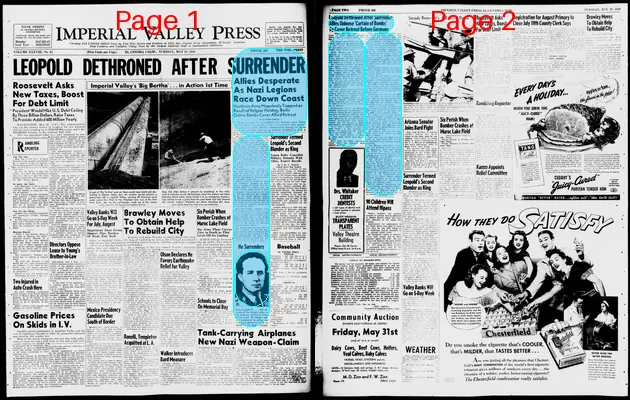
Imperial Valley Press
El Centro, Imperial County, California
What is this article about?
King Leopold III of Belgium surrendered to German forces on Tuesday, leading to his dethronement by the Belgian cabinet in exile. This trapped Allied armies in Flanders, prompting desperate retreats and aerial bombardments to cover evacuation from Dunkirk amid Nazi advances.
Merged-components note: Continuation of story across pages; image merged due to spatial overlap with text.
Clippings
1 of 2
OCR Quality
Full Text
Northern Army Hopelessly Trapped as Result of Belgian Yielding. Berlin Claims: Bombs Cover Allied Retreat
By UNITED PRESS
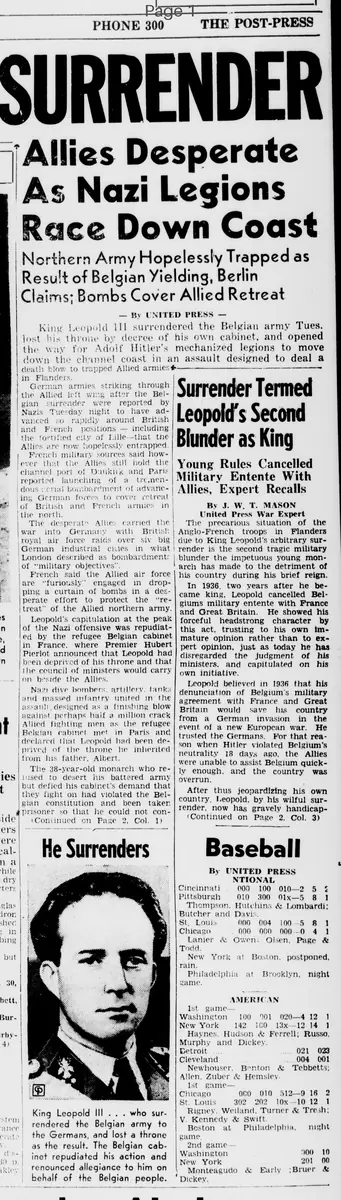
King Leopold III surrendered the Belgian army Tuesday, lost his throne by decree of his own cabinet, and opened the way for Adolf Hitler's mechanized legions to move down the channel coast in an assault designed to deal a death blow to trapped Allied armies in Flanders.
German armies striking through the Allied left wing after the Belgian surrender were reported by Nazis Tuesday night to have advanced so rapidly around British and French positions--including the fortified city of Lille--that the Allies are now hopelessly entrapped.
French military sources said, however, that the Allies still hold the channel port of Dunkirk and Paris reported launching of a tremendous aerial bombardment of advancing German forces to cover retreat of British and French armies in the north.
The desperate Allies carried the war into Germany with British royal air force raids over six big German industrial cities in what London described as bombardment of "military objectives".
French said the Allied air force are "furiously" engaged in dropping a curtain of bombs in a desperate effort to protect the "retreat" of the Allied northern army.
Leopold's capitulation at the peak of the Nazi offensive was repudiated by the refugee Belgian cabinet in France, where Premier Hubert Pierlot announced that Leopold had been deprived of his throne and that the council of ministers would carry on beside the Allies.
Nazi dive bombers, artillery, tanks and massed infantry united in the assault designed as a finishing blow against perhaps half a million crack Allied fighting men as the refugee Belgian cabinet met in Paris and declared that Leopold had been deprived of the throne he inherited from his father, Albert.
The 38-year-old monarch who refused to desert his battered army but defied his cabinet's demand that they fight on had violated the Belgian constitution and been taken prisoner so that he could not continue to reign. Belgian Premier Pierlot said in a radio speech from Paris.
The refugee cabinet will take over Pierlot said, and "Belgium will fight on until victory Whatever happens we will remain worthy of those who fought from 1914 to 1918"
Great Britain and France are fighting on stubbornly and "with good heart," according to British Prime Minister Winston Churchill and French Premier Paul Reynaud and expect to triumph in the end.
But, Churchill warned, the people must expect "hard and heavy tidings." These tidings, it was believed would concern the tragic plight of the trapped British and French troops-probably now 600,000 of the finest Allied fighting men-battling Nazi attacks from three sides and from the air and faced with loss or destruction of their last remaining communication lines through the channel ports.
Only an Allied counter-offensive from the south-and there is no definite sign of a successful thrust from that direction-appears likely to save the trapped armies, it was said by British military sources which indicated that there was little hope of retreat across the channel at present.
Furthermore, while the Belgian collapse permitted the Germans to advance toward Bruges, Ostend and Dunkirk, the German offensive from the south squeezed the trapped armies tighter by an advance through French fortifications near Valenciennes and the capture of Douai and Orchies, according to the Nazis
"It is only a matter of days or even hours," it was asserted in Berlin. "It would not be surprising if the terrible blow . . . were to cause the Allied armies to throw up their arms rather than be destroyed."
After that, the Nazis indicated, would come the climactic blow against England.
That the British expected such an attack was more evident every hour and the admiralty took over management and control of all coast guard stations throughout Great Britain as part of the preparations to fight off an invading army.
There was much bitterness over Leopold's surrender, especially in Paris, but Churchill warned that he should not be judged hastily It was reported in London that the Belgian monarch said his troops (about 400,000 to 500,000) had eaten only biscuits for four days and had in some cases fired their last ammunition.
Some Belgian refugee government leaders charged Leopold with being a traitor and said that his order would be defied.
London military experts said that the British expeditionary force stranded in Belgium and northern France would continue to fight.
The BEF, it was said, would continue to fight with the intention of giving the French time to strengthen their front on the Somme and Aisne rivers.
Indicating that part of the BEF has not been cut off by the Germans, British military quarters said that although the greater part of the BEF was in northern France the entire force is not there.
“…There is no need to emphasize the critical situation in which the BEF finds itself," it was said. "but the BEF is not a beaten force."
The experts said it was obvious from the present situation, that it is almost impossible for the BEF to re-orient its front since it was being attacked from all directions but, they said, the BEF will continue to fight beside French units in northern France.
The experts said that the Germans never have driven the BEF back in battle.
They said that the BEF had retired its lines from time to time in accordance with general strategic situation.
The Belgian capitulation meant that the German army was given an apparently open road around the Allied left flank to Bruges (which the Germans said they were approaching) and the Belgian ports of Zeebrugge and Ostend
This advance, designed to join up with German mechanized units that had swung around the Allied armies to Boulogne, Calais and St Omer, was coordinated with massive German frontal attacks on the Allied line from Menin, in the Lille sector, to the Valenciennes area and in the Douai region. (Berlin claimed advances on all of these fronts Tuesday, with Valenciennes Douai and Orchies taken.)
British experts emphasized that it had become increasingly difficult to supply Allied forces in North France and Belgium because of German capture or destruction by air bombing of channel ports.
What sub-type of article is it?
What keywords are associated?
What entities or persons were involved?
Where did it happen?
Foreign News Details
Primary Location
Belgium
Event Date
Tuesday
Key Persons
Outcome
belgian army surrendered; king leopold dethroned by cabinet; allied armies trapped in flanders; german advances toward dunkirk, bruges, ostend; captures of valenciennes, douai, orchies; allied aerial bombardments to cover retreat.
Event Details
King Leopold III surrendered the Belgian army to German forces, leading to his dethronement by the exiled Belgian cabinet under Premier Pierlot. This opened the channel coast for Nazi mechanized legions, trapping Allied forces in Flanders. Germans advanced rapidly around Lille, squeezing Allies from multiple fronts. Allies held Dunkirk and launched heavy bombings to protect retreating British and French troops. British RAF raided German cities. Belgian cabinet vowed to fight on with Allies.