Thank you for visiting SNEWPapers!
Sign up free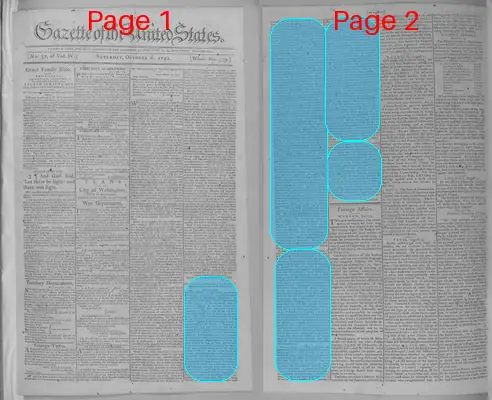
Gazette Of The United States
New York, New York County, New York
What is this article about?
Concluding observations defending the U.S. federal funding system, banks, and excise laws against 'A Farmer's' criticisms. Argues that federal measures restore public credit, reduce interest burdens, and follow state examples, while critiquing state neglect of debts.
Merged-components note: Continuation of the editorial 'Observations on the Letters of "A Farmer," (CONCLUDED)' across pages 1 and 2. The second component was incorrectly labeled as letter_to_editor, but the text directly continues the funding system discussion from the first component.
Clippings
1 of 2
OCR Quality
Full Text
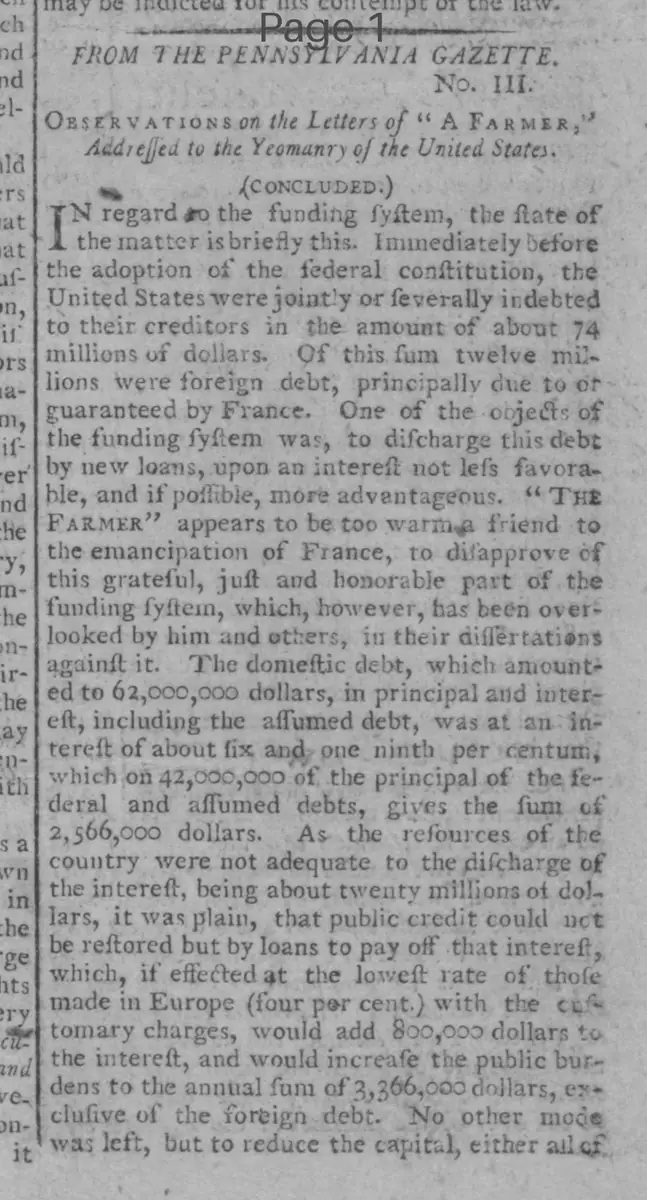
NO. III.
Observations on the Letters of "A Farmer," Addressed to the Yeomanry of the United States.
(CONCLUDED.)
IN regard to the funding system, the state of the matter is briefly this. Immediately before the adoption of the federal constitution, the United States were jointly or severally indebted to their creditors in the amount of about 74 millions of dollars. Of this sum twelve millions were foreign debt, principally due to or guaranteed by France. One of the objects of the funding system was, to discharge this debt by new loans, upon an interest not less favorable, and if possible, more advantageous. "THE FARMER" appears to be too warm a friend to the emancipation of France, to disapprove of this grateful, just and honorable part of the funding system, which, however, has been overlooked by him and others, in their dissertations against it. The domestic debt, which amounted to 62,000,000 dollars, in principal and interest, including the assumed debt, was at an interest of about six and one ninth per centum, which on 42,000,000 of the principal of the federal and assumed debts, gives the sum of 2,566,000 dollars. As the resources of the country were not adequate to the discharge of the interest, being about twenty millions of dollars, it was plain, that public credit could not be restored but by loans to pay off that interest, which, if effected at the lowest rate of those made in Europe (four per cent.) with the customary charges, would add 800,000 dollars to the interest, and would increase the public burdens to the annual sum of 3,366,000 dollars, exclusive of the foreign debt. No other mode was left, but to reduce the capital, either all at once to the creditors, or of the purchasing creditors the which idea had been rejected in the practice of all the whole people, or an attempt to re-loan with several other States, forming a large majority of Virginia, Pennsylvania, Massachusetts, and some advantages, which would induce the consent of the creditors to a reduction of the interest. The latter mode has been tried successfully, and the interest will thereby be reduced to about four and one half per cent. including the full value of the deferred debt, making the annual sum of 2,790,000 dollars. Thus it appears that a saving has been made of 570,000 dollars per annum. It is moreover to be remembered, that the United States, have always owed the same sum, whether the debt was depreciated or not, and that they ought therefore to have shown the same regard for the terms of the original contracts, which the old Congress, and the several States, to the amount of a large majority, had actually done, and which Pennsylvania (the "Farmer's" own State) and Maryland have since done, by giving more to the creditors (without discrimination too) than Congress have done. It is not to be forgotten that Congress do not lose one single dollar, as they do not pay more than the contract, but, have induced the creditors to give six per cent. interest to a large number of the identical creditors, who now agree to take four and a half per cent. of Congress, and that of the other remaining State debt, without discrimination-that all the foreign world applaud and admire, as wise and efficient, the measures of the general government to restore public credit -that the credit of the Union is much better than that of any one State, as is manifest from this fact, that the unassumed debt of every State is less valuable than the debts of Congress -that the "Farmer's" State enjoys a very large part of the profits from the rise of the debt, by holding continental certificates, to an immense amount, procured for lands, at six shillings per acre, &c. which they now offer for one shilling in specie-that they are exonerated from all their debts, by several sales of their public securities, to the amount, in a single instance, of near a million of dollars-and it should be particularly, very particularly remembered, that the original creditors have not suffered from the raising the debt by Congress, but from the neglect of the States to pay the interest, or their refusal to enable the old confederation to do it, before the establishment of the present efficient government. If the States had not depreciated the debt by such omissions and refusals, the speculators and gamblers, which the "Farmer" mentions, would not have made their profits, nor would they ever have existed. They have manifestly been created by, and grown out of, the discordant and inadequate financial operations of the States. which, by depreciating the debt, opened a door for speculation and gambling. Had they sustained the debt at its just and intrinsic value, by paying only the interest and declaring the principal inviolable, the original creditor would not have had cause to complain, nor would the purchaser have had an opportunity to speculate in the property of the soldier, the widow, the orphan and the patriotic lender in the hour of public need. These are solid, unquestionable truths. and will not be denied, nor can they be disproved. The general government, on account of an honest performance of old contracts, ought not be charged with consequences which are only ascribable to the want of justice, or the want of ability, or the want of order and system in the State governments, during the time of the confederation. The difficult part, a just provision, has been executed by the existing national government, and it is entitled to all the merit of being an efficient instrument of public justice, honor and prosperity. The impartial foreign world consider the conduct of the federal legislature in this honorable light at the present moment.
In regard to the establishment of banks, if that were a crime or a public injury, it might be fairly asked who set the example? The state of which "The Farmer," from the place of publication, is presumed to be a citizen. The power of issuing paper was unlimited in the charter granted by that State, but is carefully guarded by the act of Congress establishing the bank of the United States. Other State legislatures have been guilty of the crime of establishing banks. But it is become too plain that Congress may not do, without censure, the same things, which are unnoticed or applauded when done by a State. With respect to the opportunity, which "The Farmer" alleges is given to a few men to acquire what he calls "hideous" fortunes, it is impossible to give a rational answer to it, because it is not possible to ascertain his meaning. His presumptive meaning rests upon the same principle as his ideas about the public debt, and, on a fair estimate and summing up of the account, would really amount to this, that seeing that former measures, or neglects, or disorders in the States, or in the old confederation had occasioned a depreciation of the public securities, or certificates, and several other large portions or descriptions of property, the general government ought to be held responsible for all the past evils resulting from such injuries to the original owners of those properties, if they should by wise and honest measures restore them to their natural and proper value, though such restoration should not cost the people of the United States one dollar more than their old government had solemnly promised in their behalf to pay.
The last charge in "The Farmer's" impeachment is, that the United States have enacted an excise law, which provides for the collection of a lower excise (by near two-pence per gallon) from the people of Pennsylvania than they were obliged to pay by a law of their own State when the federal constitution was adopted, and at the very moment when the act of Congress was passed. It may be fairly asked in regard to "The Farmer" did he ever petition the legislature of Pennsylvania to repeal their excise act laying the above higher duty, or (if he has ever been a member of the legislature of the State) why did he not move in his place for a repeal of the State excise law, which has existed many, very many years. But Congress might surely have presumed, that no part of the people of a State, which had a like equal excise, would be very severe in their censures upon them for following an example laying an excise upon spirit, which was set by themselves. The federal legislature could not but presume, that, when the people of the United States vested them, in express terms, with the power of raising money by excise, they might innocently exercise that power. - They knew too, that Massachusetts and Connecticut had set examples of the same kind, and that those two States and moiety of the free people of the United States. Pennsylvania contain within one sixth of a full. It was also well known, that there were not more than four or five free governments upon the face of the earth, and that each of them collected money by excise. The objections to them in England were examined, and were found to be two: 1st, that trial by jury was infringed, and therefore Congress provided that jury trials should be had in all cases under their excise law, and 2dly, it was objected that the dwelling or mansion house of the citizen might be searched without formal information, at any hour of the night-Congress therefore provided, that no house which was really reserved exclusively as a dwelling, should be entered at the pleasure of an excise officer, and only after formal information before a civil magistrate, upon oath, and then only in the day time and in company with a civil officer. and that the excise officers should be confined in their own searches to the day time also, and to the places, which were previously declared to be intended for the use of storing or making distilled spirits. If a person does not perceive the difference between the British excise law and that of the United States in these two great and essential particulars, it really must be from want of that sober attention and dispassionate consideration, with which the laws of the best country in the world ought to be read and examined by every reflecting, worthy, well-intentioned citizen.
In the 11th page "THE FARMER," amid numerous expressions of concern for equality of advantages, and for the poorer citizens, undertakes to make the following assertion, "that the rich necessarily in all countries administer government, for they alone (says he) have skill and leisure for its functions!" That part of the yeomanry of the United States, who are not wealthy, need no comment upon a declaration, that those of them who are not "rich" really are inadequate to the duties of government from want of the requisite knowledge. Though it might be asked here, whether the "Farmer" can be the friend of the people, I will rather do that writer the justice to believe, that he really did not mean all he says in the above passage, but at the same time it is to be hoped, that it will increase the weighty arguments which reflection will suggest to men of understanding, not to place their faith upon "The Farmer's Letters."
A FREEMAN.
What sub-type of article is it?
What keywords are associated?
What entities or persons were involved?
Editorial Details
Primary Topic
Defense Of Federal Funding System, Banks, And Excise Against 'A Farmer'
Stance / Tone
Supportive Of Federal Measures, Critical Of 'A Farmer' And State Neglect
Key Figures
Key Arguments