Thank you for visiting SNEWPapers!
Sign up free
The Evening Telegraph
Philadelphia, Philadelphia County, Pennsylvania
What is this article about?
Analysis from the Herald on Napoleon's policy in the current war, highlighting concurrent opinions from Russia, England, and New York that the Czar opposes French dominance in Europe, particularly regarding Venetia, Italy, and the balance of power. Russia aims to check Napoleon's ambitions while pursuing its own interests, potentially allying with Prussia against France.
Clipping
OCR Quality
Full Text
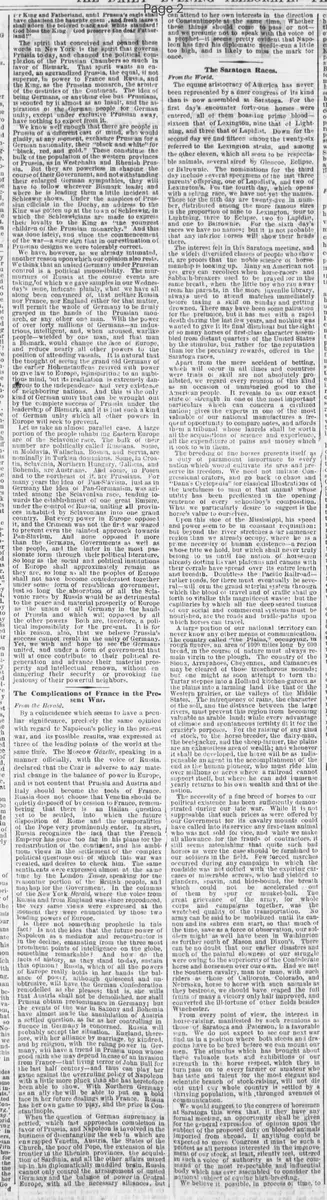
From the Herald.
By a coincidence which seems to have a peculiar significance, precisely the same opinion with regard to Napoleon's policy in the present war, and its possible results, was expressed at three of the leading points of the world at the same time. The Moscow Gazette, speaking officially, with the voice of Russia, declared that the Czar is adverse to any material change in the balance of power in Europe, and is not content that Prussia and Austria and Italy should become the tools of France. Russia does not choose that Venetia should be quietly disposed of by cession to France, remembering that there is an Italian question yet to be settled, into which the future disposition of Rome and the temporalities of the Pope very prominently enter. In short, Russia recognizes the fact that the French Emperor has gone too far in his plans for the redistribution of the continent, and his ambitious views in the settlement of the complex political questions out of which this war was created, and desires to check him. The same sentiments were expressed almost at the same time by the London Times, speaking for the reasoning portion of the British people, and mayhap for the Government. In the columns of the New York Herald, where the voice from Russia and from England was since reproduced, the very same views were expressed at the moment they were enunciated by those two leading powers of Europe.
Is there not something prophetic in this fact? Is not the idea that the future power of Napoleon as a mediator and reconstructor is in the decline, emanating from the three most prominent points of intelligence on the globe, something remarkable? And how do the facts of history, as they stand to-day, sustain this opinion? "Russia, which of all the powers of Europe really holds in her hands the balance of power, although quiescent and unobtrusive, will have the German Confederation remodelled as she pleases; that is, she wills that Austria shall not be demolished, nor shall Prussia obtain predominance in Germany; but the events of the war in Saxony and Bohemia have almost made the annihilation of Austria a settled question, as far as her controlling influence in Germany is concerned. Russia will probably accept the situation. England, therefore, with her alliance by marriage, by kindred, and by religion with many, will have a friend in Prussia upon whose good faith she may depend in case of an invasion from France—that living the last half century—and thus can play her game against the overruling policy of Napoleon with little more pluck than she has heretofore been able to show. With Northern Germany as an ally she will face in her future dealings with France. Russia has her own game to play, and the prize is Constantinople.
When the question of German supremacy is settled, which fast approaches completion in favor of Prussia, and Napoleon is involved in the business of disentangling the web in which are enwrapped Venetia, Austria, the States of the Church, the poor old Pope, the extension of his frontier in the Rhenish provinces, the acquisition of Sardinia, and all the other affairs mixed up in his diplomatically muddled brain, Russia cannot only control the arrangement of united Germany and the balance of power in Central Europe, with all the necessary alliances, but can attend to her own interests in the direction of Constantinople at the same time. Whether these things should come to pass or not—and we presume not to speak with the voice of a prophet—it seems pretty evident that Napoleon has fired his diplomatic needle-gun a little too high, and is likely to miss the mark for once.
What sub-type of article is it?
What keywords are associated?
What entities or persons were involved?
Where did it happen?
Foreign News Details
Primary Location
Europe
Key Persons
Outcome
russia desires to check napoleon's ambitious plans for redistribution of europe; potential prussian alliance with england against france; russia to control german confederation and pursue interests in constantinople
Event Details
Opinions from Moscow Gazette, London Times, and New York Herald express that Russia opposes French dominance in Europe, particularly cession of Venetia, Italian question involving Rome and Pope; Russia holds balance of power, accepts situation in Saxony and Bohemia; England may ally with Prussia; Napoleon entangled in complex affairs including Venetia, Austria, Church States, Rhenish provinces, Sardinia