Thank you for visiting SNEWPapers!

Sign up free
Page thumbnail for The Daily Crescent
Editorial March 24, 1849

The Daily Crescent

New Orleans, Orleans County, Louisiana

What is this article about?

The editorial critiques the causal link between Britain's navigation laws and its naval power, advocates for free trade principles from Adam Smith, supports repealing navigation laws, and endorses a US-UK reciprocity treaty as proposed by Mr. Bancroft. It argues that natural commerce, not statutes, sustains American sailors and maritime strength.

Merged-components note: These two sequential components continue the same discussion on navigation laws and free trade, forming a single coherent editorial piece.

Clipping

OCR Quality

97% Excellent

Full Text

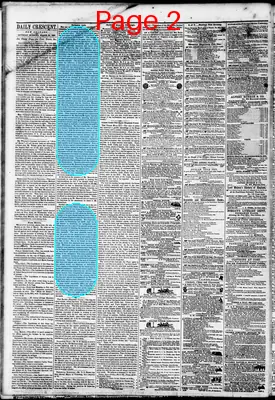
Men are constantly mistaking coincidence for causation, the accidental juxtaposition of facts and events for the necessary and absolute connection of cause and effect. Thus, the naval greatness of England dates from the days of the commonwealth and protectorate of Cromwell. The navigation laws had their origin in the same epoch. Hence, many, on these very slender foundations, conclude that the navigation laws are the cause and agents of British maritime enterprise and naval consequence. Forgetting that other nations have obtained the supremacy of the seas without any restrictions on foreign vessels or bounty to home-ships, statesmen-especially English statesmen-have fixed their eyes on the history of the British islands, and drawn general deductions from a single and very peculiar example. Our early legislators were much under the influence of British facts and British opinions; and in endeavoring to lay the foundations of a new and vast naval power, they had recourse to British precedents and British expedients. Adam Smith, about the time the American colonies declared their independence of the British empire, put forth a strong and irrefutable argument in favor of the doctrine of free-trade; and since then, men have been slowly travelling towards the point at which the illustrious economist aimed in his 'Wealth of Nations.' The repeal of the navigation laws is but a branch of the great subject of free-trade; and since the abolition of the corn laws, a leading member of Parliament, Mr. Labouchere, has been attempting to carry the reform into the shipping statutes. The London journals tell us that Mr. Labouchere's movement promises to be successful; and Mr. Labouchere himself, in answering some questions put to him by an opposing member, has informed us that the American Minister, Mr. Bancroft, declared his opinion that the Government of the United States would, at any time, enter into a reciprocity treaty with Great Britain in regard to free navigation and unrestricted maritime intercourse. Some American journals have represented this statement of Mr. Bancroft, as highly improper, and in fact unconstitutional, asserting that under the guise of a treaty, such agreements as he speaks of, would be a virtual repeal of our navigation laws, and that he might as well talk of modifying the tariff by treaty stipulations. But this is hardly fair. A treaty is a contract between two nations; and the President, by and with the advice and consent of the Senate, has full power to enter into such a contract. A law of Congress is a contract between the citizens of the United States, individually and collected in various separate sovereignties; and such a law, when it has reference to our foreign relations, bears equally on all foreign Governments. Now, a treaty, being a special contract between us and one or more nations, cannot be made unless by modifying some Congressional law which regulates our intercourse with all other foreign Governments. It is of the essence of a treaty to be special, and is, as to nations, of the nature of an act for the private relief of a single individual. The treaty, on certain conditions, grants peculiar privileges to all the citizens of some foreign power. Far then, from such a treaty as the one favored by Mr. Bancroft, being an illegal and unconstitutional modification, by the President and Senate, of our general navigation laws, it would be nothing more than the usual power granted by the constitution, and habitually exercised by the executive department.

Another question, however, arises as to the propriety of the United States waiting for British action before they do anything themselves in regard to this important matter. It may be worthy of consideration, whether we will allow the British Government to be more liberal than our own; whether we will permit England to take the first step towards free and unrestricted navigation. We were before all others in liberalizing our tariff: shall we be left behind in modifying our navigation laws? These last are but a part of the general system men have invented for fettering the operations of trade, and directing industry into channels it would not take naturally. The most plausible reason that can be given for the maintenance of our navigation laws, is that they build up and sustain a mercantile marine which we may draw upon for sailors in time of war. But as we hinted in the beginning, we think this argument more specious than solid. Merchants must have naval carriers, and wherever most maritime commerce exists there will be the largest demand for ships and sailors. Natural laws would prevent any scarcity of American sailors if the navigation laws were entirely abolished. American seamen are now the best in the world; but this can hardly be attributed to statutory enactments. Take away all the acts of Congress that were ever passed, and our word for it, American sailors would not diminish or deteriorate. Their number is determined by the wants and demands of commerce: legislation cannot regulate it. Their efficiency and superiority are derived from higher sources than Congressional statutes; they are due to the constitution of the country, and to that free and natural development of the faculties, secured as a right to every American citizen. We doubt much whether a repeal of our navigation laws would materially affect the price of freights from American ports. But if Great Britain and the United States were to set the example of free navigation, other governments would adopt the principle. Thus we might eventually become carriers for a larger proportion of the merchants of the earth.

What sub-type of article is it?

Economic Policy Trade Or Commerce Foreign Affairs

What keywords are associated?

Navigation Laws Free Trade Reciprocity Treaty Maritime Commerce American Sailors British Naval Power Adam Smith

What entities or persons were involved?

Adam Smith Cromwell Mr. Labouchere Mr. Bancroft British Parliament United States Government Congress

Editorial Details

Primary Topic

Repeal Of Navigation Laws And Free Trade Reciprocity

Stance / Tone

Advocacy For Free Navigation And Critique Of Protectionist Laws

Key Figures

Adam Smith Cromwell Mr. Labouchere Mr. Bancroft British Parliament United States Government Congress

Key Arguments

Coincidence Mistaken For Causation In Linking Navigation Laws To British Naval Power Other Nations Achieved Sea Supremacy Without Navigation Restrictions Adam Smith's Free Trade Doctrine Supports Repealing Navigation Laws Us Should Not Wait For Britain To Lead In Free Navigation Reciprocity Treaty With Britain Is Constitutional And Within Presidential Powers Navigation Laws Do Not Sustain American Sailors; Commerce Does American Seamen's Superiority Stems From National Character, Not Statutes Free Navigation Would Expand Us Maritime Commerce Globally

Are you sure?