Thank you for visiting SNEWPapers!
Sign up free
Editorial
October 20, 1872
New Orleans Republican
New Orleans, Orleans County, Louisiana
What is this article about?
Editorial criticizes the illegal violence of New Orleans levee strikers, linking it to a community custom of neglecting law for mob action, especially without federal military presence. Advocates patient legal remedies over violence to prevent breeding more lawlessness.
Clipping
OCR Quality
98%
Excellent
Full Text
A DISEASE THAT BREEDS DISEASE
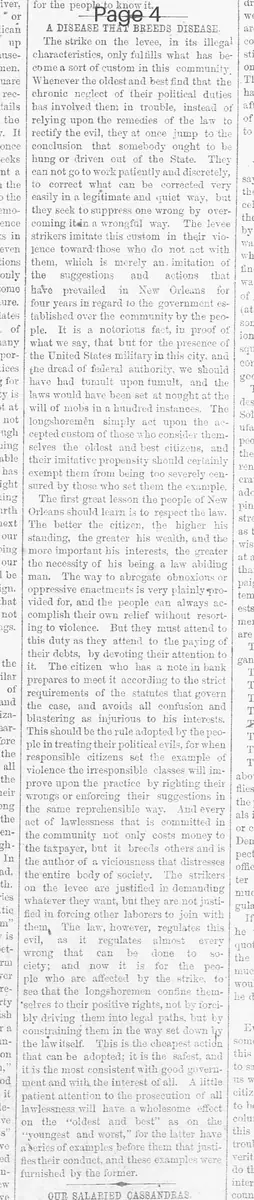
The strike on the levee, in its illegal characteristics, only fulfills what has become a sort of custom in this community. Whenever the oldest and best find that the chronic neglect of their political duties has involved them in trouble, instead of relying upon the remedies of the law to rectify the evil, they at once jump to the conclusion that somebody ought to be hung or driven out of the State. They can not go to work patiently and discreetly, to correct what can be corrected very easily in a legitimate and quiet way, but they seek to suppress one wrong by overcoming it in a wrongful way. The levee strikers imitate this custom in their violence toward those who do not act with them, which is merely an imitation of the suggestions and actions that have prevailed in New Orleans for four years in regard to the government established over the community by the people. It is a notorious fact, in proof of what we say, that but for the presence of the United States military in this city, and the dread of federal authority, we should have had tumult upon tumult, and the laws would have been set at nought at the will of mobs in a hundred instances. The longshoremen simply act upon the accepted custom of those who consider themselves the oldest and best citizens, and their imitative propensity should certainly exempt them from being too severely censured by those who set them the example. The first great lesson the people of New Orleans should learn is to respect the law. The better the citizen, the higher his standing, the greater his wealth, and the more important his interests, the greater the necessity of his being a law abiding man. The way to abrogate obnoxious or oppressive enactments is very plainly provided for, and the people can always accomplish their own relief without resorting to violence. But they must attend to this duty as they attend to the paying of their debts, by devoting their attention to it. The citizen who has a note in bank prepares to meet it according to the strict requirements of the statutes that govern the case, and avoids all confusion and blustering as injurious to his interests. This should be the rule adopted by the people in treating their political evils, for when responsible citizens set the example of violence the irresponsible classes will improve upon the practice by righting their wrongs or enforcing their suggestions in the same reprehensible way. And every act of lawlessness that is committed in the community not only costs money to the taxpayer, but it breeds others and is the author of a viciousness that distresses the entire body of society. The strikers on the levee are justified in demanding whatever they want, but they are not justified in forcing other laborers to join with them. The law, however, regulates this evil, as it regulates almost every wrong that can be done to society; and now it is for the people who are affected by the strike, to see that the longshoremen confine themselves to their positive rights, not by forcibly driving them into legal paths, but by constraining them in the way set down by the law itself. This is the cheapest action that can be adopted: it is the safest, and it is the most consistent with good government and with the interest of all. A little patient attention to the prosecution of all lawlessness will have a wholesome effect on the "oldest and best" as on the "youngest and worst," for the latter have a series of examples before them that instifies their conduct, and these examples were furnished by the former.
The strike on the levee, in its illegal characteristics, only fulfills what has become a sort of custom in this community. Whenever the oldest and best find that the chronic neglect of their political duties has involved them in trouble, instead of relying upon the remedies of the law to rectify the evil, they at once jump to the conclusion that somebody ought to be hung or driven out of the State. They can not go to work patiently and discreetly, to correct what can be corrected very easily in a legitimate and quiet way, but they seek to suppress one wrong by overcoming it in a wrongful way. The levee strikers imitate this custom in their violence toward those who do not act with them, which is merely an imitation of the suggestions and actions that have prevailed in New Orleans for four years in regard to the government established over the community by the people. It is a notorious fact, in proof of what we say, that but for the presence of the United States military in this city, and the dread of federal authority, we should have had tumult upon tumult, and the laws would have been set at nought at the will of mobs in a hundred instances. The longshoremen simply act upon the accepted custom of those who consider themselves the oldest and best citizens, and their imitative propensity should certainly exempt them from being too severely censured by those who set them the example. The first great lesson the people of New Orleans should learn is to respect the law. The better the citizen, the higher his standing, the greater his wealth, and the more important his interests, the greater the necessity of his being a law abiding man. The way to abrogate obnoxious or oppressive enactments is very plainly provided for, and the people can always accomplish their own relief without resorting to violence. But they must attend to this duty as they attend to the paying of their debts, by devoting their attention to it. The citizen who has a note in bank prepares to meet it according to the strict requirements of the statutes that govern the case, and avoids all confusion and blustering as injurious to his interests. This should be the rule adopted by the people in treating their political evils, for when responsible citizens set the example of violence the irresponsible classes will improve upon the practice by righting their wrongs or enforcing their suggestions in the same reprehensible way. And every act of lawlessness that is committed in the community not only costs money to the taxpayer, but it breeds others and is the author of a viciousness that distresses the entire body of society. The strikers on the levee are justified in demanding whatever they want, but they are not justified in forcing other laborers to join with them. The law, however, regulates this evil, as it regulates almost every wrong that can be done to society; and now it is for the people who are affected by the strike, to see that the longshoremen confine themselves to their positive rights, not by forcibly driving them into legal paths, but by constraining them in the way set down by the law itself. This is the cheapest action that can be adopted: it is the safest, and it is the most consistent with good government and with the interest of all. A little patient attention to the prosecution of all lawlessness will have a wholesome effect on the "oldest and best" as on the "youngest and worst," for the latter have a series of examples before them that instifies their conduct, and these examples were furnished by the former.
What sub-type of article is it?
Labor
Crime Or Punishment
Social Reform
What keywords are associated?
Levee Strike
New Orleans
Lawlessness
Labor Violence
Political Duties
Federal Authority
Longshoremen
What entities or persons were involved?
Levee Strikers
Longshoremen
Oldest And Best Citizens
United States Military
New Orleans
Editorial Details
Primary Topic
Critique Of Levee Strike Violence And Advocacy For Legal Remedies
Stance / Tone
Critical Of Illegal Actions And Exhortative For Law Abiding Behavior
Key Figures
Levee Strikers
Longshoremen
Oldest And Best Citizens
United States Military
New Orleans
Key Arguments
Illegal Characteristics Of Levee Strike Imitate Community Custom Of Resorting To Violence Instead Of Legal Remedies
Presence Of Federal Military Prevents Greater Tumults And Lawlessness
Strikers Justified In Demands But Not In Forcing Others To Join
People Must Respect And Use The Law To Address Grievances
Violence By Responsible Citizens Encourages Worse Actions By Irresponsible Classes
Lawlessness Costs Taxpayers And Breeds More Viciousness