Thank you for visiting SNEWPapers!
Sign up free
The Virginia Gazette
Richmond, Williamsburg, Richmond County, Virginia
What is this article about?
Report from London on February 6 details the House of Commons' expulsion of MP John Wilkes on February 4 for libels, by a vote of 219-137. A new writ is issued for his replacement, but no disqualification vote passed. George Grenville opposed the expulsion. Wilkes publishes address to Middlesex freeholders.
Clipping
OCR Quality
Full Text
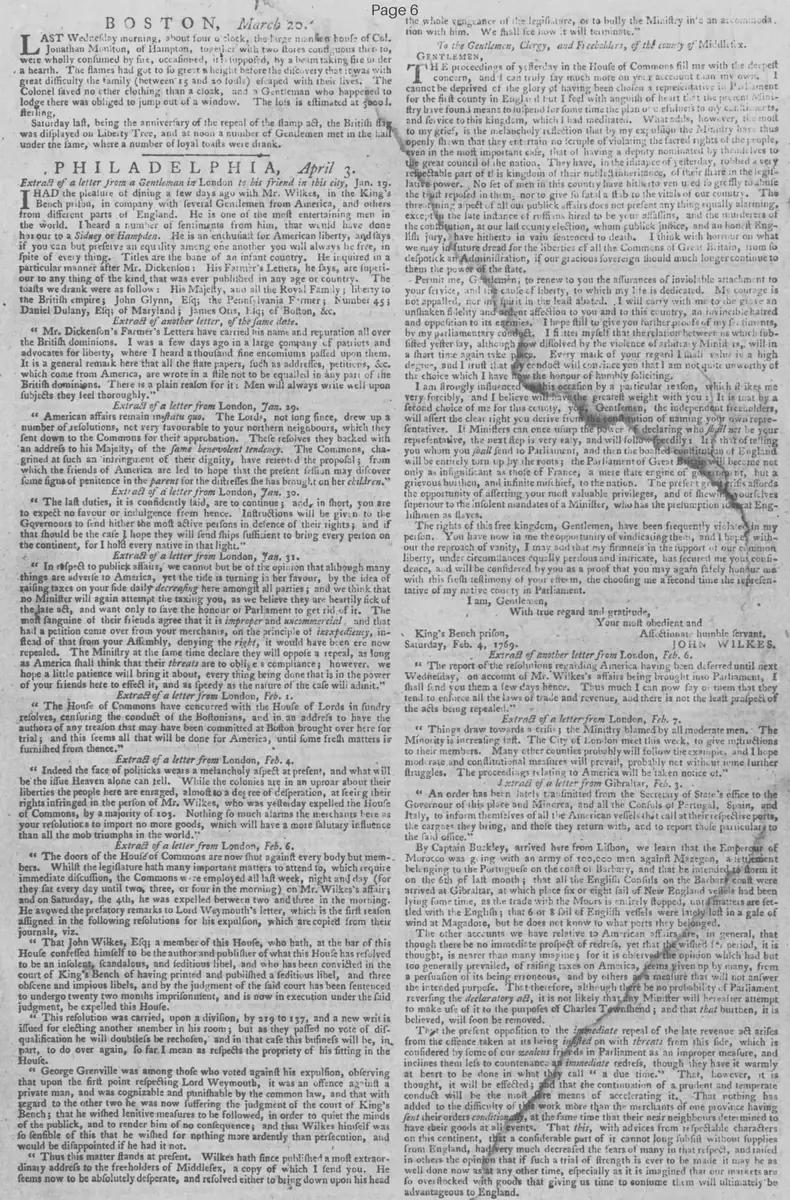
The doors of the House of Commons are now shut against every body but members. Whilst the legislature hath many important matters to attend to, which require immediate discussion, the Commons were employed all last week, night and day (for they sat every day until two, three, or four in the morning) on Mr. Wilkes's affair; and on Saturday, the 4th, he was expelled between two and three in the morning. He avowed the prefatory remarks to Lord Weymouth's letter, which is the first reason assigned in the following resolutions for his expulsion, which are copied from their journals, viz.
That John Wilkes, Esq; a member of this House, who hath, at the bar of this House confessed himself to be the author and publisher of what this House has resolved to be an insolent, scandalous, and seditious libel, and who has been convicted in the court of King's Bench of having printed and published a seditious libel, and three obscene and impious libels, and by the judgment of the said court has been sentenced to undergo twenty two months imprisonment, and is now in execution under the said judgment, be expelled this House.
This resolution was carried, upon a division, by 219 to 137, and a new writ is issued for electing another member in his room; but as they passed no vote of disqualification he will doubtless be rechosen, and in that case this business will be, in part, to do over again, so far I mean as respects the propriety of his sitting in the House.
George Grenville was among those who voted against his expulsion, observing that upon the first point respecting Lord Weymouth, it was an offence against a private man, and was cognizable and punishable by the common law, and that with regard to the other two he was now suffering the judgment of the court of King's Bench; that he wished lenitive measures to be followed, in order to quiet the minds of the publick, and to render him of no consequence; and that Wilkes himself was so sensible of this that he wished for nothing more ardently than persecution, and would be disappointed if he had it not.
Thus this matter stands at present. Wilkes hath since published a most extraordinary address to the freeholders of Middlesex, a copy of which I send you. He seems now to be absolutely desperate, and resolved either to bring down upon his head the whole vengeance of the legislature, or to bully the Ministry into an accommodation with him. We shall see how it will terminate.
What sub-type of article is it?
What keywords are associated?
What entities or persons were involved?
Where did it happen?
Foreign News Details
Primary Location
London
Event Date
Feb. 6
Key Persons
Outcome
expelled by vote of 219 to 137; new writ issued for middlesex election; no disqualification vote passed
Event Details
House of Commons debated and expelled John Wilkes for authoring and publishing libels, including prefatory remarks to Lord Weymouth's letter and convictions in King's Bench for seditious and obscene libels; he is imprisoned for 22 months. George Grenville voted against, advocating lenitive measures. Wilkes publishes address to Middlesex freeholders.