Thank you for visiting SNEWPapers!
Sign up free
Story
September 25, 1911
The New Haven Union
New Haven, New Haven County, Connecticut
What is this article about?
Article on rising sugar prices in the US from 5.5 to 8 cents per pound due to short crops and speculators, contrasting with 100 years ago at 38 cents wholesale. Discusses family consumption, shift from molasses and brown sugar to refined granulated and confectioners' sugar amid changing social habits.
Clipping
OCR Quality
98%
Excellent
Full Text
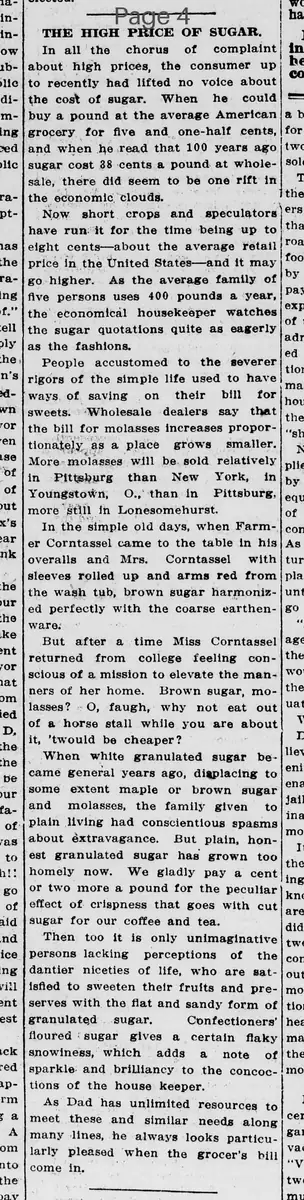
THE HIGH PRICE OF SUGAR.
In all the chorus of complaint about high prices, the consumer up to recently had lifted no voice about the cost of sugar. When he could buy a pound at the average American grocery for five and one-half cents, and when he read that 100 years ago sugar cost 38 cents a pound at wholesale, there did seem to be one rift in the economic clouds.
Now short crops and speculators have run it for the time being up to eight cents-about the average retail price in the United States-and it may go higher. As the average family of five persons uses 400 pounds a year, the economical housekeeper watches the sugar quotations quite as eagerly as the fashions.
People accustomed to the severer rigors of the simple life used to have ways of saving on their bill for sweets. Wholesale dealers say that the bill for molasses increases proportionately, as a place grows smaller. More molasses will be sold relatively in Pittsburgh than New York, in Youngstown, O., than in Pittsburgh more still in Lonesomehurst.
In the simple old days, when Farmer Corntassel came to the table in his overalls and Mrs. Corntassel with sleeves rolled up and arms red from the wash tub, brown sugar harmonized perfectly with the coarse earthenware:
But after a time Miss Corntassel returned from college feeling conscious of a mission to elevate the manners of her home. Brown sugar, molasses? O, faugh, why not eat out of a horse stall while you are about it, 'twould be cheaper?
When white granulated sugar became general years ago, displacing to some extent maple or brown sugar and molasses, the family given to plain living had conscientious spasms about extravagance. But plain, honest granulated sugar has grown too homely now. We gladly pay a cent or two more a pound for the peculiar effect of crispness that goes with cut sugar for our coffee and tea.
Then too it is only unimaginative persons lacking perceptions of the daintier niceties of life, who are satisfied to sweeten their fruits and preserves with the flat and sandy form of granulated sugar.
Confectioners' floured sugar gives a certain flaky snowiness which adds a note of sparkle and brilliancy to the concoctions of the housekeeper.
As Dad has unlimited resources to meet these and similar needs along many lines, he always looks particularly pleased when the grocer's bill comes in.
In all the chorus of complaint about high prices, the consumer up to recently had lifted no voice about the cost of sugar. When he could buy a pound at the average American grocery for five and one-half cents, and when he read that 100 years ago sugar cost 38 cents a pound at wholesale, there did seem to be one rift in the economic clouds.
Now short crops and speculators have run it for the time being up to eight cents-about the average retail price in the United States-and it may go higher. As the average family of five persons uses 400 pounds a year, the economical housekeeper watches the sugar quotations quite as eagerly as the fashions.
People accustomed to the severer rigors of the simple life used to have ways of saving on their bill for sweets. Wholesale dealers say that the bill for molasses increases proportionately, as a place grows smaller. More molasses will be sold relatively in Pittsburgh than New York, in Youngstown, O., than in Pittsburgh more still in Lonesomehurst.
In the simple old days, when Farmer Corntassel came to the table in his overalls and Mrs. Corntassel with sleeves rolled up and arms red from the wash tub, brown sugar harmonized perfectly with the coarse earthenware:
But after a time Miss Corntassel returned from college feeling conscious of a mission to elevate the manners of her home. Brown sugar, molasses? O, faugh, why not eat out of a horse stall while you are about it, 'twould be cheaper?
When white granulated sugar became general years ago, displacing to some extent maple or brown sugar and molasses, the family given to plain living had conscientious spasms about extravagance. But plain, honest granulated sugar has grown too homely now. We gladly pay a cent or two more a pound for the peculiar effect of crispness that goes with cut sugar for our coffee and tea.
Then too it is only unimaginative persons lacking perceptions of the daintier niceties of life, who are satisfied to sweeten their fruits and preserves with the flat and sandy form of granulated sugar.
Confectioners' floured sugar gives a certain flaky snowiness which adds a note of sparkle and brilliancy to the concoctions of the housekeeper.
As Dad has unlimited resources to meet these and similar needs along many lines, he always looks particularly pleased when the grocer's bill comes in.
What sub-type of article is it?
Curiosity
Historical Event
What themes does it cover?
Misfortune
Social Manners
What keywords are associated?
Sugar Prices
Historical Costs
Consumer Habits
Molasses Usage
Granulated Sugar
Social Elevation
What entities or persons were involved?
Farmer Corntassel
Mrs. Corntassel
Miss Corntassel
Dad
Where did it happen?
United States
Story Details
Key Persons
Farmer Corntassel
Mrs. Corntassel
Miss Corntassel
Dad
Location
United States
Event Date
100 Years Ago
Story Details
Rising sugar prices prompt reflection on historical costs and evolving consumer preferences from simple molasses and brown sugar to refined granulated and confectioners' sugar, illustrating social elevation in family habits.