Thank you for visiting SNEWPapers!
Sign up free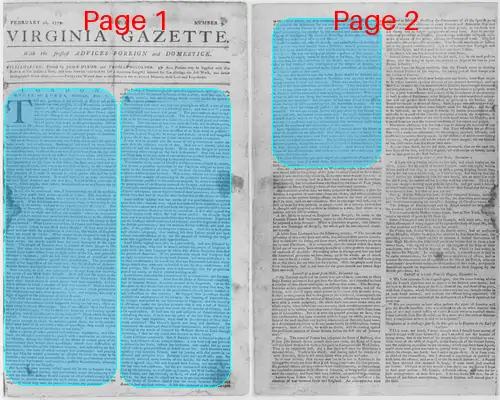
The Virginia Gazette
Richmond, Williamsburg, Richmond County, Virginia
What is this article about?
In the House of Lords on Monday, December, Marquis of Rockingham criticized a proclamation by British commissioners in New York for its cruel war policy against America, proposing a motion to disavow it. Debate ensued with speeches from bishops, lords, and dukes on humanity, strategy, and Franco-American alliance implications.
Merged-components note: This is a continuation of the House of Lords debate on the American proclamation, spanning across pages 1 and 2. The second component was mislabeled as 'story' but fits 'foreign_news' as it reports on international political events.
Clippings
1 of 2
OCR Quality
Full Text
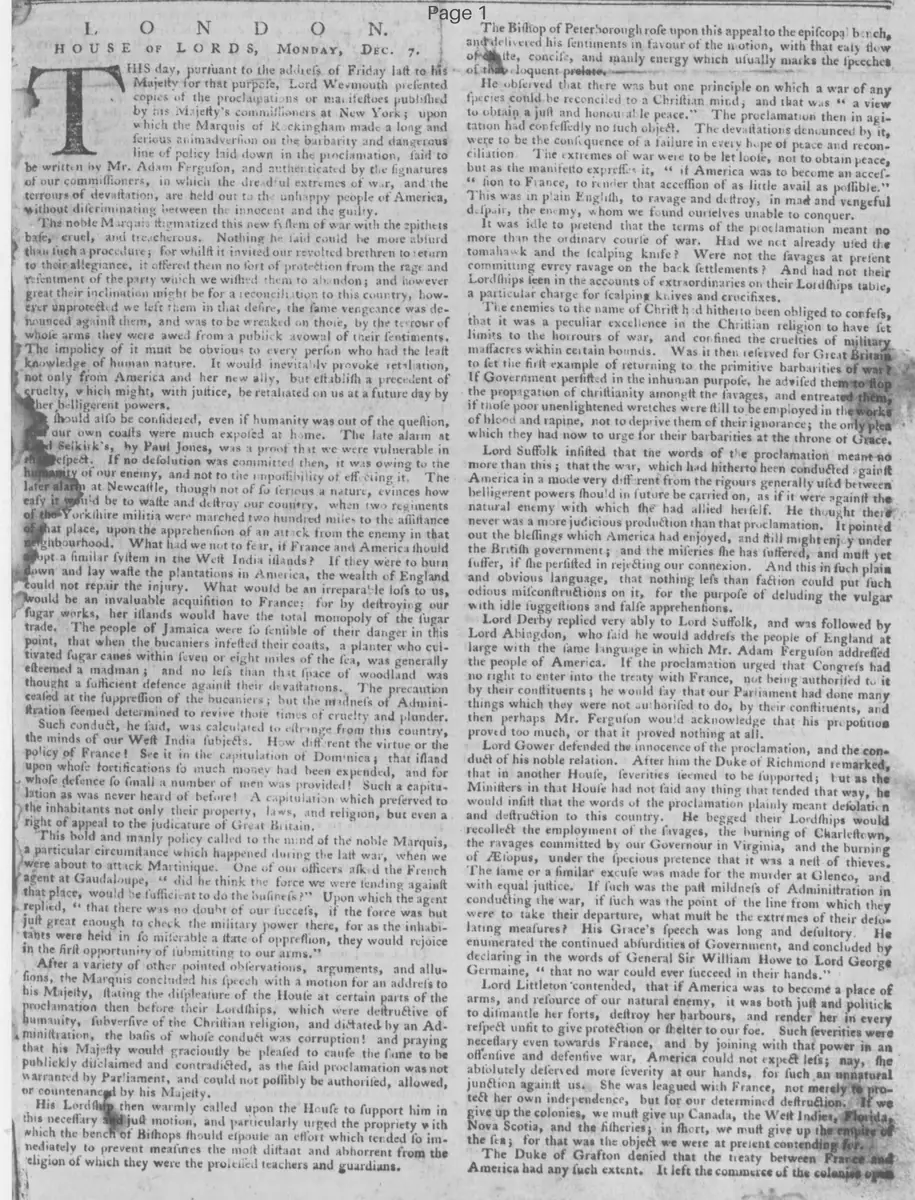
HOUSE OF LORDS, MONDAY, Dec.
This day, pursuant to the orders of Friday last to his Majesty for that purpose, Lord Weymouth presented copies of the proclamations or manifestoes published by his Majesty's commissioners at New York; upon which the Marquis of Rockingham made a long and serious animadversion on the barbarity and dangerous line of policy laid down in the proclamation, said to be written by Mr. Adam Ferguson, and authenticated by the signatures of our commissioners, in which the dreadful extremes of war, and the terrors of devastation, are held out to the unhappy people of America, without discriminating between the innocent and the guilty.
The noble Marquis stigmatized this new system of war with the epithets base, cruel, and treacherous. Nothing he said could be more absurd than such a procedure; for whilst it invited our revolted brethren to return to their allegiance, it offered them no sort of protection from the rage and resentment of the party which we wished them to abandon; and however great their inclination might be for a reconciliation to this country, however unprotected we left them in that desire, the same vengeance was denounced against them, and was to be wreaked on those, by the terror of whose arms they were awed from a public avowal of their sentiments.
The impolicy of it must be obvious to every person who had the least knowledge of human nature. It would inevitably provoke retaliation, not only from America and her new ally, but establish a precedent of cruelty, which might, with justice, be retaliated on us at a future day by her belligerent powers.
It should also be considered, even if humanity was out of the question, our own coasts were much exposed at home. The late alarm at St. Selkirk's, by Paul Jones, was a proof that we were vulnerable in that respect. If no devastation was committed then, it was owing to the humanity of our enemy, and not to the impossibility of effecting it. The latter alarm at Newcastle, though not of so serious a nature, evinces how easy it would be to waste and destroy our country, when two regiments of the Yorkshire militia were marched two hundred miles to the assistance of that place, upon the apprehension of an attack from the enemy in that neighbourhood. What had we not to fear, if France and America should adopt a similar system in the West India islands? If they were to burn down and lay waste the plantations in America, the wealth of England could not repair the injury. What would be an irreparable loss to us, would be an invaluable acquisition to France; for by destroying our sugar works, her islands would have the total monopoly of the sugar trade. The people of Jamaica were so sensible of their danger in this point, that when the buccaneers infested their coasts, a planter who cultivated sugar canes within seven or eight miles of the sea, was generally esteemed a madman; and no less than that space of woodland was thought a sufficient defence against their devastations. The precaution ceased at the suppression of the buccaneers; but the madness of Administration seemed determined to revive those times of cruelty and plunder.
Such conduct, he said, was calculated to estrange from this country, the minds of our West India subjects. How different the virtue or the policy of France! See it in the capitulation of Dominica; that island upon whose fortifications so much money had been expended, and for whose defence so small a number of men was provided! Such a capitulation as was never heard of before! A capitulation which preserved to the inhabitants not only their property, laws, and religion, but even a right of appeal to the judicature of Great Britain.
"This bold and manly policy called to the mind of the noble Marquis, a particular circumstance which happened during the last war, when we were about to attack Martinique. One of our officers asked the French agent at Guadeloupe, 'did he think the force we were sending against that place, would be sufficient to do the business?' Upon which the agent replied, 'that there was no doubt of our success, if the force was but just great enough to check the military power there, for as the inhabitants were held in so miserable a state of oppression, they would rejoice in the first opportunity of submitting to our arms.'"
After a variety of other pointed observations, arguments, and allusions, the Marquis concluded his speech with a motion for an address to his Majesty, stating the displeasure of the House at certain parts of the proclamation then before their Lordships, which were destructive of humanity, subversive of the Christian religion, and dictated by an Administration, the basis of whose conduct was corruption! and praying that his Majesty would graciously be pleased to cause the same to be publicly disclaimed and contradicted, as the said proclamation was not warranted by Parliament, and could not possibly be authorised, allowed, or countenanced by his Majesty.
His Lordship then warmly called upon the House to support him in this necessary and just motion, and particularly urged the propriety with which the bench of Bishops should espouse an effort which tended immediately to prevent measures the most distant and abhorrent from the religion of which they were the professed teachers and guardians.
The Bishop of Peterborough rose upon this appeal to the episcopal bench, and delivered his sentiments in favour of the motion, with that easy flow of elocution, concise, and manly energy which usually marks the speeches of that eloquent prelate.
He observed that there was but one principle on which a war of any species could be reconciled to a Christian mind, and that was "a view to obtain a just and honourable peace." The proclamation then in agitation had confessedly no such object. The devastations denounced by it, were to be the consequence of a failure in every hope of peace and reconciliation. The extremes of war were to be let loose, not to obtain peace, but as the manifesto expresses it, "if America was to become an accession to France, to render that accession of as little avail as possible."
This was in plain English, to ravage and destroy, in mad and vengeful despair, the enemy, whom we found ourselves unable to conquer.
It was idle to pretend that the terms of the proclamation meant no more than the ordinary course of war. Had we not already used the tomahawk and the scalping knife? Were not the savages at present committing every ravage on the back settlements? And had not their Lordships seen in the accounts of extraordinaries on their Lordships table, a particular charge for scalping knives and crucifixes.
The enemies to the name of Christ had hitherto been obliged to confess, that it was a peculiar excellence in the Christian religion to have set limits to the horrors of war, and confined the cruelties of military massacres within certain bounds. Was it then reserved for Great Britain to set the first example of returning to the primitive barbarities of war?
If Government persisted in the inhuman purpose, he advised them to oppose the propagation of Christianity amongst the savages, and entreated them, if those poor unenlightened wretches were still to be employed in the works of blood and rapine, not to deprive them of their ignorance; the only plea which they had now to urge for their barbarities at the throne of Grace.
Lord Suffolk insisted that the words of the proclamation meant no more than this; that the war, which had hitherto been conducted against America in a mode very different from the rigours generally used between belligerent powers should in future be carried on, as if it were against the natural enemy with which she had allied herself. He thought there never was a more judicious production than that proclamation. It pointed out the blessings which America had enjoyed, and still might enjoy under the British government; and the miseries she has suffered, and must yet suffer, if she persisted in rejecting our connexion. And this in such plain and obvious language, that nothing less than faction could put such odious misconstructions on it, for the purpose of deluding the vulgar with idle suggestions and false apprehensions.
Lord Derby replied very ably to Lord Suffolk, and was followed by Lord Abingdon, who said he would address the people of England at large with the same language in which Mr. Adam Ferguson addressed the people of America. If the proclamation urged that Congress had no right to enter into the treaty with France, not being authorised to it by their constituents; he would say that our Parliament had done many things which they were not authorised to do, by their constituents, and then perhaps Mr. Ferguson would acknowledge that his proposition proved too much, or that it proved nothing at all.
Lord Gower defended the innocence of the proclamation, and the conduct of his noble relation. After him the Duke of Richmond remarked, that in another House, severities seemed to be supported; but as the Ministers in that House had not said any thing that tended that way, he would insist that the words of the proclamation plainly meant desolation and destruction to this country. He begged their Lordships would recollect the employment of the savages, the burning of Charlestown, the ravages committed by our Governor in Virginia, and the burning of Esopus, under the precious pretence that it was a nest of thieves.
The same or a similar excuse was made for the murder at Glenco, and with equal justice. If such was the past mildness of Administration in conducting the war, if such was the point of the line from which they were to take their departure, what must be the extremes of their desolating measures? His Grace's speech was long and desultory.
He enumerated the continued absurdities of Government, and concluded by declaring in the words of General Sir William Howe to Lord George Germaine, "that no war could ever succeed in their hands."
Lord Lyttleton contended, that if America was to become a place of arms, and resource of our natural enemy, it was both just and politic to dismantle her forts, destroy her harbours, and render her in every respect unfit to give protection or shelter to our foe.
Such severities were necessary even towards France, and by joining with that power in an offensive and defensive war, America could not expect less; nay, she absolutely deserved more severity at our hands, for such an unnatural junction against us. She was leagued with France, not merely to protect her own independence, but for our determined destruction. If we give up the colonies, we must give up Canada, the West Indies, Florida, Nova Scotia, and the fisheries; in short, we must give up the empire of the sea; for that was the object we were at present contending for.
The Duke of Grafton denied that the treaty between France and America had any such extent. It left the commerce of the colonies open
to every other power, not even excepting Great Britain. He blamed the first Lord of the Admiralty for his tardiness in preparing a force sufficient to interrupt France in her naval preparations; and called upon Lord Stormont to say whether he had received and communicated intelligence of the signing the treaty of Versailles at the time that Ministry denied any knowledge of it in that House?
Lord Stormont rose after his Grace, and expressed much surprise that any person who had himself been a Minister, should propound such a question to an Ambassador, who was bound to secrecy by the nature of his office: He was not obliged to answer a question of that nature; but he thought he might, without prejudice to his duty, say this much on the occasion for the satisfaction of the House, and in justice to himself, that he had received early intelligence of the designs of France, and which, in his mind, amounted to the fullest conviction of the duplicity and hostile views of that court.
He was also surprised that the noble Duke should be seduced into a belief, that the treaty published at Versailles was the only or the true treaty between France and America. There was another, the object of which is the total destruction of Great Britain. They had even gone so far as to apportion out the parts of our possessions which were to belong to France, and the parts which were to belong to America. Was it then a time to talk of any thing but unanimity in our determinations, and vigour in our exertions? For his part, he had been absent from Parliament during all their proceedings on the American business: He was not there when the stamp Act passed: He was not there when it was repealed. He was not bound, he was not prejudiced by any former vote on the subject, for he had never given any. He might therefore flatter himself that he was in no degree biased in his present opinion, which was for the most firm and spirited measures that unanimity could adopt against the combined and mortal foes of this country.
Lord Shelburne took notice that all our Generals threw the blame of their ill success on the Ministry. Our Admirals were reduced to the same situation; and now a new story comes out, that our Ambassadors are not a jot better circumstanced. His Lordship then made a very long and desultory speech, traced the incapacity of the present Administration, step by step, through their whole official history. And having said in the course of his observations, that without a reunion with America, this country could not exist.
The Lord Chancellor got up to expose the imprudence of making such an observation, even if it were true; but absolutely denied the truth of such a proposition.
What sub-type of article is it?
What keywords are associated?
What entities or persons were involved?
Where did it happen?
Foreign News Details
Primary Location
New York
Event Date
Monday, Dec.
Key Persons
Outcome
motion proposed by marquis of rockingham for an address to the king to disavow parts of the proclamation; debate ongoing with supporters and defenders.
Event Details
Lord Weymouth presented copies of proclamations from commissioners at New York. Marquis of Rockingham criticized the proclamation's barbarity and proposed a motion to disavow it. Bishop of Peterborough supported the motion on Christian grounds. Various lords debated its policy, humanity, and implications for war with America and France, referencing past events like Paul Jones' raid, savages' use, and Franco-American treaty.