Thank you for visiting SNEWPapers!
Sign up free
Elizabeth Town Gazette
Elizabeth, Union County, New Jersey
What is this article about?
Charles Phillips, Irish orator, delivers a passionate speech at the Gloucestershire Missionary Society's fourth anniversary in Cheltenham, England, on October 7, extolling Christianity's origins and missionary successes in the South Sea Islands, India, and Africa, including abolition of infanticide and spread of education.
Clipping
OCR Quality
Full Text
The following is the substance of a speech delivered by Charles Phillips, Esq. the celebrated Irish Orator, at Cheltenham, (England,) on the 7th of October, at the Fourth Anniversary of the Gloucestershire Missionary Society.
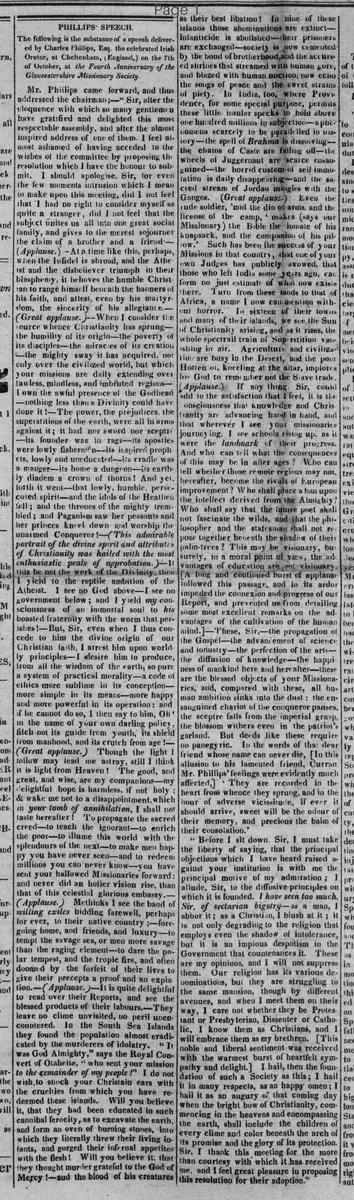
Mr. Phillips came forward, and thus addressed the chairman;— "Sir, after the eloquence with which so many gentlemen have gratified and delighted this most respectable assembly, and after the almost inspired address of one of them, I feel almost ashamed of having acceded to the wishes of the committee by proposing the resolution which I have the honour to submit. I should apologise, Sir, for even the few moments intrusion which I mean to make upon this meeting, did I not feel that I had no right to consider myself as quite a stranger, did I not feel that the subject unites us all into one great social family, and gives to the merest sojourner the claim of a brother and a friend— (Applause.) —At a time like this, perhaps, when the Infidel is abroad, and the Atheist and the disbeliever triumph in their blasphemy, it behoves the humble Christian to range himself beneath the banners of his faith, and attest, even by his martyrdom, the sincerity of his allegiance.— (Great applause.)—When I consider the source whence Christianity has sprung— the humility of its origin—the poverty of its disciples—the miracles of its creation —the mighty sway it has acquired, not only over the civilized world, but which your missions are daily extending over lawless, mindless, and imbruted regions— I own the awful presence of the Godhead —nothing less than a Divinity could have done it!—The power, the prejudices, the superstitions of the earth, were all in arms against it; it had no sword nor sceptre —its founder was in rags—its apostles were lowly fishermen—its inspired prophets, lowly and uneducated—its cradle was a manger—its home a dungeon—its earthly diadem a crown of thorns! And yet, forth it went—that lowly, humble, persecuted spirit—and the idols of the Heathen fell; and the thrones of the mighty trembled; and Paganism saw her peasants and her princes kneel down and worship the unaimed Conqueror!—(This admirable portrait of the divine spirit and attributes of Christianity was hailed with the most enthusiastic peals of approbation.)+If this be not the work of the Divinity, then I yield to the reptile ambition of the Atheist. I see no God above—I see no government below; and I yield my consciousness of an immortal soul to his boasted fraternity with the worm that perishes!—But, Sir, even when I thus concede to him the divine origin of our Christian faith, I arrest him upon worldly principles—I desire him to produce, from all the wisdom of the earth, so pure a system of practical morality—a code of ethics more sublime in its conception— more simple in its means—more happy and more powerful in its operation: and if he cannot do so, I then say to him, Oh in the name of your own darling policy, filch not its guide from youth, its shield from manhood, and its crutch from age! (Great applause.) Though the light I follow may lead me astray, still I think it is light from Heaven! The good, and great, and wise, are my companions—my delightful hope is harmless, if not holy & wake me not to a disappointment, which in your tomb of annihilation, I shall not taste hereafter! To propagate the sacred creed—to teach the ignorant—to enrich the poor—to illume this world with the splendours of the next—to make men happy you have never seen—and to redeem millions you can never know—you have sent your hallowed Missionaries forward; and never did an holier vision rise, than that of this celestial glorious embassy.— (Applause.) Methinks I see the band of willing exiles bidding farewell, perhaps for ever, to their native country;—foregoing home, and friends, and luxury—to tempt the savage sea, or men more savage than the raging element—to dare the polar tempest, and the tropic fire, and often doomed by the forfeit of their lives to give their precepts a proof and an explanation.—(Applause. —It is quite delightful to read over their Reports, and see the blessed products of their labours. They leave no clime unvisited, no peril unencountered. In the South Sea Islands they found the population almost eradicated by the murderers of idolatry. "It was God Almighty," says the Royal Convert of Otaheite, "who sent your mission to the remainder of my people!" I do not wish, to shock your Christian ears with the cruelties from which you have redeemed these islands. Will you believe it, that they had been educated in such cannibal ferocity, as to excavate the earth, and form an oven of burning stones, into which they literally threw their living infants, and gorged their infernal appetites with the flesh! Will you believe it; that they thought murder grateful to the God of Mercy!—and the blood of his creatures as their best libation! In nine of these islands those abominations are extinct— infanticide is abolished—their prisoners are exchanged—society is now cemented by the bond of brotherhood and the accursed shrines that streamed with human gore, and blazed with human unction, now echo the songs of peace and the sweet strains of piety. In India, too, where Providence, for some special purpose, permits these little insular specks to hold in subjection above one hundred millions—a phenomena scarcely to be paralleled in history—the spell of Brahma is dissolving— the chains of Caste are falling off—the wheels of Juggernaut are scarce ensanguined—the horrid custom of self immolation is daily disappearing—and the sacred stream of Jordan mingles with the Ganges. (Great applause.) Even the rude soldier, 'mid the din of arms, and the license of the camp, 'makes (says our Missionary) the Bible the inmate of his knapsack, and the companion of his pillow.' Such has been the success of your Missions in that country, that one of your own Judges has publicly avowed, that those who left India some years ago, can form no just estimate of what now exists there. Turn from these lands to that of Africa, a name I now can mention without horror. In sixteen of their towns and many of their islands, we see the Sun of Christianity arising, and as it rises, the whole spectral train of Superstition vanishing in air. Agriculture and civilization are busy in the Desert, and the poor Hottenot, kneeling at the altar, implores his God to remember not the Slave trade. (Applause.) If any thing, Sir, could add to the satisfaction that I feel, it is the consciousness that knowledge and Christianity are advancing hand in hand, and that wherever I see your missionaries journeying, I see schools rising up, as it were the landmark of their progress. And who can tell what the consequences of this may be in after ages? Who can tell whether those remote regions may not, hereafter, become the rivals of European improvement? Who shall place a ban upon the intellect derived from the Almighty? Who shall say that the future poet shall not fascinate the wilds, and that the philosopher and the statesman shall not repose together beneath the shadow of their palm-trees? This may be visionary, but surely, in a moral point of view, the advantages of education are not visionary. A long and continued burst of applause followed this passage, and in its ardor impeded the connexion and progress of our Report, and prevented us from detailing some most excellent remarks on the advantages of the cultivation of the human mind.] These, Sir,—the propagation of the Gospel—the advancement of science and industry—the perfection of the arts— the diffusion of knowledge—the happiness of mankind here and hereafter—these are the blessed objects of your Missionaries, and, compared with these, all human ambition sinks into the dust: the ensanguined chariot of the conqueror pauses, the sceptre falls from the imperial grasp, the blossom withers even in the patriot's garland. But deeds like these require no panegyric. In the words of that dear friend whose name can never die, [In this allusion to his lamented friend, Curran, Mr. Phillips' feelings were evidently much affected,] 'They are recorded in the heart from whence they sprung, and in the hour of adverse vicissitude, if ever it should arrive, sweet will be the odour of their memory, and precious the balm of their consolation.' "Before I sit down, Sir, I must take the liberty of saying, that the principal objections which I have heard raised against your institution is with me the principal motive of my admiration; I allude, Sir, to the diffusive principles on which it is founded. I have seen too much, Sir, of sectarian bigotry—as a man, I abhor it; as a Christian, I blush at it: it is not only degrading to the religion that employs even the shadow of intolerance but it is an impious despotism in the Government that countenances it. These are my opinions, and I will not suppress them. Our religion has its various denominations, but they are struggling to the same mansion, though by different avenues, and when I meet them on their way, I care not whether they be Protestant or Presbyterian, Dissenter or Catholic, I know them as Christians, and I will embrace them as my brethren. [This noble and liberal sentiment was received with the warmest burst of heartfelt sympathy and delight.] I hail, then the foundation of such a Society as this: I hail it in many respects, as a happy omen; I hail it as an augury of that coming day when the bright bow of Christianity, commencing in the heavens and encompassing the earth, shall include the children of every clime and color beneath the arch of its promise and the glory of its protection. Sir, I thank this meeting for the more than courtesy with which it has received me, and I feel great pleasure in proposing this resolution for their adoption."
What sub-type of article is it?
What keywords are associated?
What entities or persons were involved?
Where did it happen?
Foreign News Details
Primary Location
Cheltenham, England
Event Date
7th Of October
Key Persons
Outcome
missionary successes include abolition of infanticide in nine south sea islands, dissolving of caste in india, and spread of christianity in sixteen african towns with vanishing superstitions and advancing agriculture and education.
Event Details
Charles Phillips delivers a speech praising the divine origins and moral superiority of Christianity, defending it against atheism, and highlighting the Gloucestershire Missionary Society's efforts in propagating the gospel, educating the ignorant, and redeeming distant peoples through missions in the South Sea Islands (Otaheite), India, and Africa, where former cruelties like cannibalism and infanticide have been eradicated and societies improved.