Thank you for visiting SNEWPapers!
Sign up free
Norfolk Gazette And Publick Ledger
Norfolk, Virginia
What is this article about?
Trial of William Cobbett for seditious libel over an 1809 article criticizing the flogging of mutinous Cambridgeshire militia by German Legion troops, seen as satire on Lord Castlereagh's bill. Cobbett defends himself; jury finds him guilty at Westminster Hall.
Clipping
OCR Quality
Full Text
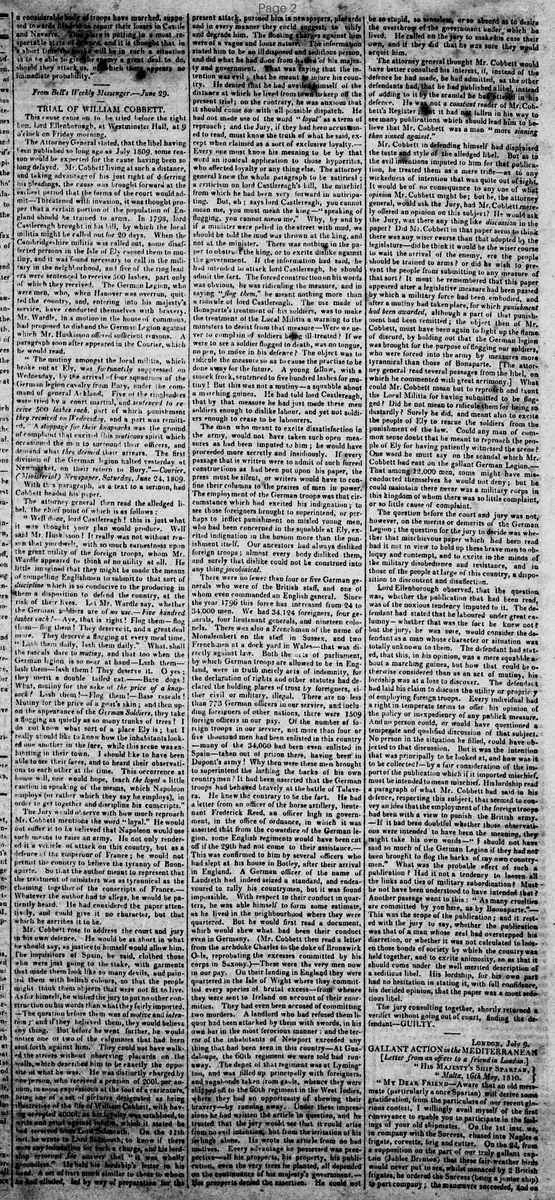
TRIAL OF WILLIAM COBBETT.
This cause came on to be tried before the right hon. lord Ellenborough, at Westminster Hall, at 9 o'clock on Friday morning.
The Attorney General stated, that the libel having been published so long ago as July 1809, some reason would be expected for the cause having been so long delayed. Mr. Cobbett living at such a distance, and taking advantage of his just right of deferring his pleadings, the cause was brought forward at the earliest period that the forms of the court would admit--Threatened with invasion, it was thought proper that a certain portion of the population of England should be trained to arms. In 1798, lord Castlereagh brought in his bill, by which the local militia might be called out for 20 days. When the Cambridgeshire militia was called out, some disaffected persons in the Isle of Ely caused them to mutiny, and it was found necessary to call in the military in the neighborhood, and five of the ring leaders were sentenced to receive 500 lashes, part only of which they received. The German Legion, who were men, who, when Hanover was overrun, quitted the country, and, entering into his majesty's service, have conducted themselves with bravery.
Mr. Wardle, in a motion in the house of commons, had proposed to disband the German Legion against which Mr. Huskisson offered sufficient reasons. A paragraph soon after appeared in the Courier, which he would read.
"The mutiny amongst the local militia, which broke out at Ely, was fortunately suppressed on Wednesday, by the arrival of four squadrons of the German legion cavalry from Bury, under the command of general Ackland. Five of the ringleaders were tried by a court martial, and sentenced to receive 500 lashes each, part of which punishment they received on Wednesday, and a part was remitted. A stoppage for their knapsacks was the ground of complaint that excited this mutinous spirit which occasioned the men to surround their officers, and demand what they deemed their arrears. The first division of the German legion halted yesterday at Newmarket, on their return to Bury."--Courier. (Ministerial) Newspaper, Saturday, June 24, 1809.
With this paragraph, as a text to a sermon, had Cobbett headed his paper.
The attorney-general then read the alleged libel, the chief point of which is as follows:
"Well done, lord Castlereagh! this is just what it was thought your plan would produce. Well said Mr. Huskisson! It really was not without reason that you dwelt, with so much earnestness upon the great utility of the foreign troops, whom Mr. Wardle appeared to think of no utility at all. He little imagined that they might be made the means of compelling Englishmen to submit to that sort of discipline which is so conducive to the producing in them a disposition to defend the country, at the risk of their lives. Let Mr. Wardle say, whether the German soldiers are of no use.--Five hundred lashes each!--Aye, that is right! Flog them-flog them--flog them! They deserve it, and a great deal more. They deserve a flogging at every meal time. "Lash them daily, lash them daily." What, shall the rascals dare to mutiny, and that too when the German legion is so near at hand-Lash them--lash them--lash them! They deserve it. O yes; they merit a double tailed cat.--Base dogs! What, mutiny for the sake of the price of a knapsack! Lash them!-Flog them!-Base rascals! Mutiny for the price of a goat's skin; and then upon the appearance of the German Soldiers, they take a flogging as quietly as so many trunks of trees! I do not know what sort of a place Ely is; but I really should like to know how the inhabitants looked one another in the face, while this scene was exhibiting in their town. I should like to have been able to see their faces, and to hear their observations to each other at the time. This occurrence at home will, one would hope, teach the loyal a little caution in speaking of the means, which Napoleon employs (or rather which they say he employs), in order to get together and discipline his conscripts."
The Jury would observe with how much reproach Mr. Cobbett mentions the word "loyal." He would not suffer it to be believed that Napoleon would use such means to raise an army. He not only rendered it a vehicle of attack on this country, but as a defence of the emperor of France; he would not permit the country to believe the tyranny of Buonaparte. So that the author meant to represent that the treatment of ministers was as tyrannical as the chaining together of the conscripts of France.--Whatever the author had to allege, he would be patiently heard. He had considered the paper attentively, and could give it no character, but that which he ascribes it to be.
Mr. Cobbett rose to address the court and jury in his own defence. He would be as short in what he should say, as justice to himself would allow. The inquisitors of Spain, he said, clothed those who were just going to the stake, with garments that made them look like so many devils, and painted them with hellish colours, so that the people might think them objects that were not fit to live. As for himself, he wished the jury to put no other construction on his words than what they fairly imported. The question before them was of motive and intention; and if they believed them, they would believe any thing. But before he went further, he would notice one or two of the calumnies that had been sent forth against him. They could not have walked the streets without observing placards on the walls, which described him to be exactly the opposite of what he was. He was distinctly charged by one person, who received a pension of 200l. per annum, in some expressions at the foot of a caricature, being one of a set of pictures designated as being illustrative of the life of William Cobbett, with having accepted donative, as his loyalty was established, to write and print against reform, which it stated he had received from Lord Sidmouth. On the 11th inst he wrote to Lord Sidmouth, to know if there were any foundation for such a charge and his lordship returned for answer that "it was wholly groundless he held his lordship letter in his hand. A set of liars much similar to those to whom he had alluded, led by way of preparation, for the present attack, pursued him in newspapers, placards and in every manner they could suggest; to vilify and degrade him. The floating charges against him were of a vague and loose nature The information stated him to be an ill-disposed and seditious person, and did what he had done from hatred of his majesty and government, That was saying that the intention was evil that he meant to injure his country. He denied that he had availed himself of the distance at which he lived from town to keep off the present trial; on the contrary, he was anxious that it should come on with all possible dispatch. He had not made use of the word "loyal" as a term of reproach; and the Jury, if they had been accustomed to read, must know the truth of what he said, except when claimed as a sort of exclusive loyalty.---Every one must know his meaning to be by that word an ironical application to those hypocrites, who affected loyalty or any thing else. The attorney general knew the whole paragraph to be satirical; a criticism on lord Castlereagh's bill, the mischief from which he had been very forward in anticipating. But, oh; says lord Castlereagh, you cannot mean me, you must mean the king-" speaking of flogging, you cannot mean me," Why, by and by if a minister were pelted in the street with mud, we should be told the mud was thrown at the king, and not at the minister. There was nothing in the paper to obstruct the king, or to excite dislike against the government. If the information had said, he had intended to attack lord Castlereagh, he should admit the fact. The forced construction on his words was obvious, he was ridiculing the measure, and in saying "flog them," he meant nothing more than a ridicule of lord Castlereagh. The use made of Bonaparte's treatment of his soldiers, was to make the treatment of the Local Militia a warning to the ministers to desist from that measure--Were we never to complain of soldiers being ill-treated ? If we were to see a soldier flogged to death, was no tongue, no pen, to move in his defence? The object was to ridicule the measure so as to cause the practise to be done away for the future. A young fellow, with a smock frock, sentenced to five hundred lashes for mutiny ! But this was not a mutiny -a squabble about a marching guinea. He had told lord Castlereagh, that by that measure he had just made these men soldiers enough to dislike labour, and yet not soldiers enough to cease to be labourers.
The man who meant to excite dissatisfaction in the army, would not have taken such open measures as had been imputed to him; he would have proceeded more secretly and insidiously. If every passage that is written were to admit of such forced constructions as had been put upon his paper, the press must be silent, or writers would have to confine their columns to the praises of men in power. The employment of the German troops was that circumstance which had excited his indignation; to see those foreigners brought to superintend, or perhaps to inflict punishment on misled young men, who had been concerned in the squabble at Ely, excited indignation in the bosom more than the punishment itself. Our ancestors had always disliked foreign troops; almost every body disliked them, and surely that dislike could not be construed into any thing jacobinical.
There were no fewer than four or five German generals who were of the British staff, and one of whom even commanded an English general. Since the year 1796 this force has increased from 24 to 34,000 men. We had 34,124 foreigners, four generals, four lieutenant generals, and nineteen colonels. There was also a Frenchman of the name of Montalembert on the staff in Sussex, and two Frenchmen at a dock yard in Wales-that was directly against law. Both the acts of parliament, by which German troops are allowed to be in England, were in truth merely acts of indemnity, for the declaration of rights and other statutes had declared the holding places of trust by foreigners, either civil or military, illegal. There are no less than 773 German officers in our service, and including foreigners of other nations, there were 1509 foreign officers in our pay. Of the number of foreign troops in our service, not more than four or five thousand men had been enlisted in this country --many of the 34,000 had been even enlisted in Spain--taken out of prison there, having been in Dupont's army! Why then were these men brought to superintend the lashing the backs of his own countrymen ? it had been asserted that the German troops had behaved bravely at the battle of Talavera. He knew the contrary to be the fact. He had a letter from an officer of the horse artillery, lieutenant Frederick Reed, an officer high in government, in the office of ordnance, in which it was asserted that from the cowardice of the German legion, some English regiments would have been cut off if the 29th had not come to their assistance.--This was confirmed to him by several officers who had slept at his house in Botley, after their arrival in England. A German officer of the name of Landreth had indeed seized a standard, and endeavoured to rally his countrymen, but it was found impossible. With respect to their conduct in quarters, he was able himself to form some estimate, as he lived in the neighbourhood where they were quartered. But he would first read a document, which would shew what had been their conduct even in Germany. (Mr. Cobbett then read a letter from the archduke Charles to the duke of Brunswick Oels, reprobating the excesses committed by his corps in Saxony.)--These were the very men now in our pay. On their landing in England they were quartered in the Isle of Wight where they committed every species of brutal excess--from whence they were sent to Ireland on account of their enormities. They had even been accused of committing two murders. A landlord who had refused them liquor had been attacked by them with swords, in his own bar in the most ferocious manner : and the terror of the inhabitants of Newport exceeded any thing that had been seen in this country--At Guadaloupe, the 60th regiment we were told had run away. The depot of that regiment was at Lymington, and was filled up principally with foreigners, and vagabonds taken from gaols, whence they were shipped off to the 60th regiment in the West Indies, where they had an opportunity of shewing their bravery by running away. Under these impressions he had written the article in question, and he trusted that the jury would see that it could arise from no evil intention, but from the irritation of his feelings alone. He wrote the article from no bad motives. Every advantage he possessed was prospective-all his prospects, his property, his publication, even the very trees he planted, all depended on the continuance of his majesty's government. His prospects denied the assertion. He could not be so stupid, so senseless, or so absurd as to desire the overthrow of the government under which he lived. He called on the jury to make his case their own and if they did that he was sure they would acquit him.
The attorney general thought Mr. Cobbett would have better consulted his interest, if, instead of the defence he had made, he had admitted, as the other defendants had, that he had published a libel, instead of adding to it by the scandal he had offered in his defence. He was not a constant reader of Mr. Cobbett's Register ; but it had not fallen in his way to see many publications which should lead him to believe that Mr. Cobbett was a man "more sinning than sinned against."
Mr. Cobbett in defending himself had dispraised the taste and style of the alleged libel. But as to the evil intentions imputed to him for that publication, he treated them as a mere trifle--as to any wickedness of intention that was quite out of sight. It would be of no consequence to any one of what opinion Mr.Cobbett might be; but he, the attorney general, would ask the Jury, had Mr. Cobbett merely offered an opinion on this subject? He would ask the Jury, was there any thing like discussion in the paper? Did Mr. Cobbett in that paper seem to think there was any wiser course than that adopted by the legislature-did he think it would be the wiser course to wait the arrival of the enemy, ere the people should be trained to arms? or did he wish to prevent the people from submitting to any measure of that sort? It must be remembered that this paper appeared after a legislative measure had been passed by which a military force had been embodied, and after a mutiny had taken place, for which punishment had been awarded, although a part of that punishment had been remitted; the object then of Mr. Cobbett, must have been again to light up the flame of discord, by holding out that the German-legion was brought for the purpose of flogging our soldiers, who were forced into the army by measures more tyrannical than those of Bonaparte. [The attorney general read several passages from the libel, on which he commented with great acrimony.] What could Mr. Cobbett mean but to reproach and taunt the Local Militia for having submitted to be flogged ? Did he not mean to ridicule them for being so dastardly? Surely he did, and meant also to excite the people of Ely to rescue the soldiers from the punishment of the law. Could any man of common sense doubt that he meant to reproach the people of Ely for having patiently witnessed the scene? One word he must say on the scandal which Mr. Cobbett had cast on the gallant German Legion. That among 12,000 men, some might have misconducted themselves he would not deny; but he could maintain there never was a military corps in this kingdom of whom there was so little complaint, or so little cause of complaint.
The question before the court and jury was not, however, on the merits or demerits of the German Legion ; the question for the jury to decide was whether that mischievous paper which had been read had it not in view to hold up these brave men to obloquy and contempt, and to excite in the minds of the military disobedience and resistance, and in those of the people at large of this country, a disposition to discontent and disaffection.
Lord Ellenborough observed, that the question was, whether the publication that had been read, was of the noxious tendency imputed to it. The defendant had stated that he laboured under great calumny-whether that was the fact he knew not? but the jury, he was sure, would consider the defendant as a man whose character or situation was totally unknown to them. The defendant had stated, that this, in his opinion, was a mere squabble about a marching guinea, but how that could be otherwise considered than as an act of mutiny, his lordship was at a loss to discover. The defendant had laid his claim to discuss the utility or propriety of employing foreign troops. Every individual had a right in temperate terms to offer his opinion of the policy or inexpediency of any public measure. And no person could, or would have questioned a temperate and qualified discussion of that subject. No person in the situation he filled, could have objected to that discussion. But it was the intention that was principally to be looked at, and how was it to be collected?-by a fair consideration of the import of the publication which if it imported mischief. must be intended to mean mischief. His lordship read a paragraph of what Mr. Cobbett had said in his defence, respecting this subject, that seemed to convey an idea that the employment of the foreign troops had been with a view to punish the British army. -If it had been doubtful whether those observations were intended to have been the meaning, they might take his own words-"I should not have said so much of the German Legion if they had not been brought to flog the backs of my own countrymen." What was the probable effect of such a publication ? Had it not a tendency to loosen all the links and ties of military subordination? Must he not have been understood to have intended that? Another passage went to this : "As many cruelties are committed by you here, as by Buonaparte."-This was the scope of the publication; and it rested with the jury to say, whether the publication was that of a man whose zeal had overstepped his discretion, or whether it was not calculated to loosen those bonds of society by which the country was held together, and to excite animosity, so as that it should come under the well merited description of a seditious libel. His lordship, or his own part had no hesitation in stating it, with full confidence, his decided opinion, that the paper was a most seditious libel.
The jury consulting together, shortly returned verdict without going out of court, finding the defendant-GUILTY.
What sub-type of article is it?
What themes does it cover?
What keywords are associated?
What entities or persons were involved?
Where did it happen?
Story Details
Key Persons
Location
Westminster Hall
Event Date
June 29
Story Details
William Cobbett is tried for seditious libel over a satirical article mocking the flogging of mutinous Cambridgeshire militia by German Legion troops under Lord Castlereagh's bill. He defends it as criticism of the measure and foreign troops' use. The Attorney General argues it incites disaffection; Lord Ellenborough deems it seditious. Jury finds him guilty.