Thank you for visiting SNEWPapers!
Sign up free
Literary
February 3, 1790
Gazette Of The United States
New York, New York County, New York
What is this article about?
An anonymous essay for The Tablet compares Christian theology with Manichaean and Norse mythology from the Edda, highlighting similarities in concepts like creation, deluge, hell, and the devil. It discusses etymologies of 'God' and 'Devil' and the role of language in comprehending religious ideas.
Clipping
OCR Quality
95%
Excellent
Full Text
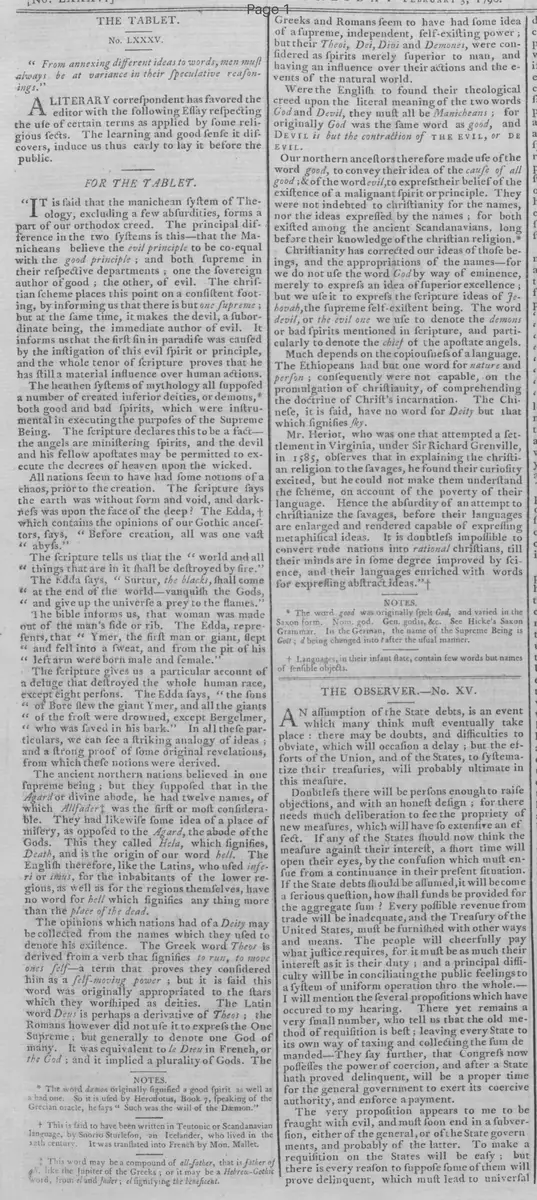
THE TABLET.
No. LXXXV.
"From annexing different ideas to words, men must always be at variance in their speculative reasonings."
A LITERARY correspondent has favored the editor with the following Essay respecting the use of certain terms as applied by some religious sects. The learning and good sense it discovers, induce us thus early to lay it before the public.
FOR THE TABLET.
"It is said that the Manichaean system of Theology, excluding a few absurdities, forms a part of our orthodox creed. The principal difference in the two systems is this—that the Manichaeans believe the evil principle to be co-equal with the good principle; and both supreme in their respective departments; one the sovereign author of good; the other, of evil. The Christian scheme places this point on a consistent footing, by informing us that there is but one supreme; but at the same time, it makes the devil, a subordinate being, the immediate author of evil. It informs us that the first sin in paradise was caused by the instigation of this evil spirit or principle, and the whole tenor of scripture proves that he has still a material influence over human actions.
The heathen systems of mythology all supposed a number of created inferior deities, or demons,*
both good and bad spirits, which were instrumental in executing the purposes of the Supreme Being. The scripture declares this to be a fact—the angels are ministering spirits, and the devil and his fellow apostates may be permitted to execute the decrees of heaven upon the wicked.
All nations seem to have had some notions of a chaos, prior to the creation. The scripture says the earth was without form and void, and darkness was upon the face of the deep? The Edda, t
a which contains the opinions of our Gothic ancestors, says, "Before creation, all was one vast
abyss."
The scripture tells us that the "world and all things that are in it shall be destroyed by fire."
The Edda says, "Surtur, the black smith, shall come at the end of the world—vanquish the Gods,
and give up the universe a prey to the flames."
The bible informs us, that woman was made out of the man's side or rib. The Edda, repre-
sents, that "Ymer, the first man or giant, slept and fell into a sweat, and from the pit of his
left arm were born male and female."
The scripture gives us a particular account of a deluge that destroyed the whole human race,
except eight persons. The Edda says, "the sons of Bore slew the giant Ymer, and all the giants
of the frost were drowned, except Bergelmer,
who was saved in his bark." In all these par-
ticulars, we can see a striking analogy of ideas;
and a strong proof of some original revelations,
from which these notions were derived.
The ancient northern nations believed in one supreme being; but they supposed that in the Asgard or divine abode, he had twelve names, of which Allfather was the first or most conside-
rable. They had likewise some idea of a place of misery, as opposed to the Asgard, the abode of the Gods. This they called Hela, which signifies, Death, and is the origin of our word hell. The English therefore, like the Latins, who used inferi or imus, for the inhabitants of the lower re-
gions, as well as for the regions themselves, have no word for hell which signifies any thing more than the place of the dead.
The opinions which nations had of a Deity may be collected from the names which they used to denote his existence. The Greek word Theos is derived from a verb that signifies to run, to move ones self—a term that proves they considered him as a self-moving power; but it is said this word was originally appropriated to the stars which they worshiped as deities. The Latin word Deus is perhaps a derivative of Theos; the Romans however did not use it to express the One Supreme; but generally to denote one God of many. It was equivalent to le Dieu in French, or the God; and it implied a plurality of Gods.
NOTES.
*The word daemon originally signified a good spirit as well as a bad one. So it is used by Herodotus, Book 7, speaking of the Grecian oracle, he says "Such was the will of the Daemon."
+ This is said to have been written in Teutonic or Scandinavian language, by Snorro Sturleson, an Icelander, who lived in the 12th century. It was translated into French by Mon. Mallet.
This word may be a compound of all-father, that is father of all, like the Jupiter of the Greeks; or it may be a Hebrew-Gothic word, from el and fader; el signifying the beneficent.
Greeks and Romans seem to have had some idea of a supreme, independent, self-existing power; but their Theoi, Dei, Divi and Demones, were con-
sidered as spirits merely superior to man, and having an influence over their actions and the e-
vents of the natural world.
Were the English to found their theological creed upon the literal meaning of the two words God and Devil, they must all be Manichaeans; for originally God was the same word as good, and Devil is but the contraction of THE EVIL, or DE EVIL.
Our northern ancestors therefore made use of the word good, to convey their idea of the cause of all good; & of the word evil, to express their belief of the existence of a malignant spirit or principle. They were not indebted to christianity for the names, nor the ideas expressed by the names; for both existed among the ancient Scandinavians, long before their knowledge of the christian religion.*
Christianity has corrected our ideas of those be-
ings, and the appropriations of the names—for we do not use the word God by way of eminence, merely to express an idea of superior excellence; but we use it to express the scripture ideas of Je-
hovah, the supreme self-existent being. The word devil, or the evil one we use to denote the demons or bad spirits mentioned in scripture, and parti-
cularly to denote the chief of the apostate angels.
Much depends on the copiousness of a language. The Ethiopians had but one word for nature and person; consequently were not capable, on the promulgation of christianity, of comprehending the doctrine of Christ's incarnation. The Chi-
nee, it is said, have no word for Deity but that which signifies sky.
Mr. Hariot, who was one that attempted a set-
tlement in Virginia, under Sir Richard Grenville, in 1585, observes that in explaining the christi-
an religion to the savages, he found their curiosity excited, but he could not make them understand the scheme, on account of the poverty of their language. Hence the absurdity of an attempt to christianize the savages, before their languages are enlarged and rendered capable of expressing metaphisical ideas. It is doubtless impossible to convert rude nations into rational christians, till their minds are in some degree improved by ci-
ence, and their languages enriched with words for expressing abstract ideas."†
NOTES.
* The word good was originally spelt God, and varied in the Saxon form. Nom. god. Gen. godis, &c. See Hickes's Saxon Grammar. In the German, the name of the Supreme Being is Gott; d being changed into t after the usual manner.
+ Languages, in their infant state, contain few words but names of sensible objects.
No. LXXXV.
"From annexing different ideas to words, men must always be at variance in their speculative reasonings."
A LITERARY correspondent has favored the editor with the following Essay respecting the use of certain terms as applied by some religious sects. The learning and good sense it discovers, induce us thus early to lay it before the public.
FOR THE TABLET.
"It is said that the Manichaean system of Theology, excluding a few absurdities, forms a part of our orthodox creed. The principal difference in the two systems is this—that the Manichaeans believe the evil principle to be co-equal with the good principle; and both supreme in their respective departments; one the sovereign author of good; the other, of evil. The Christian scheme places this point on a consistent footing, by informing us that there is but one supreme; but at the same time, it makes the devil, a subordinate being, the immediate author of evil. It informs us that the first sin in paradise was caused by the instigation of this evil spirit or principle, and the whole tenor of scripture proves that he has still a material influence over human actions.
The heathen systems of mythology all supposed a number of created inferior deities, or demons,*
both good and bad spirits, which were instrumental in executing the purposes of the Supreme Being. The scripture declares this to be a fact—the angels are ministering spirits, and the devil and his fellow apostates may be permitted to execute the decrees of heaven upon the wicked.
All nations seem to have had some notions of a chaos, prior to the creation. The scripture says the earth was without form and void, and darkness was upon the face of the deep? The Edda, t
a which contains the opinions of our Gothic ancestors, says, "Before creation, all was one vast
abyss."
The scripture tells us that the "world and all things that are in it shall be destroyed by fire."
The Edda says, "Surtur, the black smith, shall come at the end of the world—vanquish the Gods,
and give up the universe a prey to the flames."
The bible informs us, that woman was made out of the man's side or rib. The Edda, repre-
sents, that "Ymer, the first man or giant, slept and fell into a sweat, and from the pit of his
left arm were born male and female."
The scripture gives us a particular account of a deluge that destroyed the whole human race,
except eight persons. The Edda says, "the sons of Bore slew the giant Ymer, and all the giants
of the frost were drowned, except Bergelmer,
who was saved in his bark." In all these par-
ticulars, we can see a striking analogy of ideas;
and a strong proof of some original revelations,
from which these notions were derived.
The ancient northern nations believed in one supreme being; but they supposed that in the Asgard or divine abode, he had twelve names, of which Allfather was the first or most conside-
rable. They had likewise some idea of a place of misery, as opposed to the Asgard, the abode of the Gods. This they called Hela, which signifies, Death, and is the origin of our word hell. The English therefore, like the Latins, who used inferi or imus, for the inhabitants of the lower re-
gions, as well as for the regions themselves, have no word for hell which signifies any thing more than the place of the dead.
The opinions which nations had of a Deity may be collected from the names which they used to denote his existence. The Greek word Theos is derived from a verb that signifies to run, to move ones self—a term that proves they considered him as a self-moving power; but it is said this word was originally appropriated to the stars which they worshiped as deities. The Latin word Deus is perhaps a derivative of Theos; the Romans however did not use it to express the One Supreme; but generally to denote one God of many. It was equivalent to le Dieu in French, or the God; and it implied a plurality of Gods.
NOTES.
*The word daemon originally signified a good spirit as well as a bad one. So it is used by Herodotus, Book 7, speaking of the Grecian oracle, he says "Such was the will of the Daemon."
+ This is said to have been written in Teutonic or Scandinavian language, by Snorro Sturleson, an Icelander, who lived in the 12th century. It was translated into French by Mon. Mallet.
This word may be a compound of all-father, that is father of all, like the Jupiter of the Greeks; or it may be a Hebrew-Gothic word, from el and fader; el signifying the beneficent.
Greeks and Romans seem to have had some idea of a supreme, independent, self-existing power; but their Theoi, Dei, Divi and Demones, were con-
sidered as spirits merely superior to man, and having an influence over their actions and the e-
vents of the natural world.
Were the English to found their theological creed upon the literal meaning of the two words God and Devil, they must all be Manichaeans; for originally God was the same word as good, and Devil is but the contraction of THE EVIL, or DE EVIL.
Our northern ancestors therefore made use of the word good, to convey their idea of the cause of all good; & of the word evil, to express their belief of the existence of a malignant spirit or principle. They were not indebted to christianity for the names, nor the ideas expressed by the names; for both existed among the ancient Scandinavians, long before their knowledge of the christian religion.*
Christianity has corrected our ideas of those be-
ings, and the appropriations of the names—for we do not use the word God by way of eminence, merely to express an idea of superior excellence; but we use it to express the scripture ideas of Je-
hovah, the supreme self-existent being. The word devil, or the evil one we use to denote the demons or bad spirits mentioned in scripture, and parti-
cularly to denote the chief of the apostate angels.
Much depends on the copiousness of a language. The Ethiopians had but one word for nature and person; consequently were not capable, on the promulgation of christianity, of comprehending the doctrine of Christ's incarnation. The Chi-
nee, it is said, have no word for Deity but that which signifies sky.
Mr. Hariot, who was one that attempted a set-
tlement in Virginia, under Sir Richard Grenville, in 1585, observes that in explaining the christi-
an religion to the savages, he found their curiosity excited, but he could not make them understand the scheme, on account of the poverty of their language. Hence the absurdity of an attempt to christianize the savages, before their languages are enlarged and rendered capable of expressing metaphisical ideas. It is doubtless impossible to convert rude nations into rational christians, till their minds are in some degree improved by ci-
ence, and their languages enriched with words for expressing abstract ideas."†
NOTES.
* The word good was originally spelt God, and varied in the Saxon form. Nom. god. Gen. godis, &c. See Hickes's Saxon Grammar. In the German, the name of the Supreme Being is Gott; d being changed into t after the usual manner.
+ Languages, in their infant state, contain few words but names of sensible objects.
What sub-type of article is it?
Essay
What themes does it cover?
Religious
What keywords are associated?
Manichaean Theology
Norse Edda
Scripture Analogy
Hell Origin
Language Theology
What entities or persons were involved?
A Literary Correspondent
Literary Details
Author
A Literary Correspondent
Subject
Respecting The Use Of Certain Terms As Applied By Some Religious Sects
Form / Style
Prose Essay On Comparative Theology
Key Lines
"From Annexing Different Ideas To Words, Men Must Always Be At Variance In Their Speculative Reasonings."
It Is Said That The Manichaean System Of Theology, Excluding A Few Absurdities, Forms A Part Of Our Orthodox Creed.
Were The English To Found Their Theological Creed Upon The Literal Meaning Of The Two Words God And Devil, They Must All Be Manichaeans; For Originally God Was The Same Word As Good, And Devil Is But The Contraction Of The Evil, Or De Evil.