Thank you for visiting SNEWPapers!
Sign up free
Literary
November 27, 1857
Ellsworth American
Ellsworth, Hancock County, Maine
What is this article about?
Essay by H.B. Stowe meditating on the silence and separation of death, critiquing spiritualism as inadequate comfort, and promoting Christian communion with Christ as true solace for the bereaved.
Clipping
OCR Quality
88%
Good
Full Text
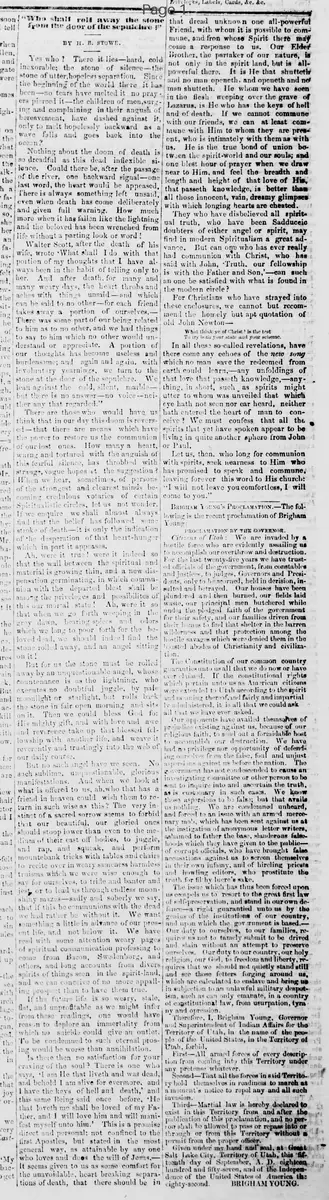
"Who shall roll away the stone from the door of the sepulchre?"
BY H. B. STOWE.
Yes, who? There it lies—hard, cold, inexorable: the stone of silence—the stone of utter, hopeless separation. Since the beginning of the world there it has been—no tears have melted it, no prayers pierced it—the children of men, surging and complaining in their anguish of bereavement, have dashed against it, only to melt hopelessly backward as a wave falls and goes back into the ocean?
Nothing about the doom of death is so dreadful as this dead, inflexible silence. Could there be, after the passage of the river, one backward signal—one last word, the heart would be appeased. There is always something left unsaid, even when death has come deliberately and given full warning. How much more when it has fallen like the lightning and the beloved has been wrenched from life without a parting look or word! Walter Scott, after the death of his wife, wrote: What shall I do with that portion of my thoughts that I have always been in the habit of telling only to her. And after death, for many and many weary days, the heart throbs and aches with things unsaid—and which can be said to no other—for each friend takes away a portion of ourselves. There was some part of our being related to him as to no other, and we had things to say to him which no other would understand or appreciate. A portion of our thoughts has become useless and burdensome; and again and again, with involuntary yearnings, we turn to the stone at the door of the sepulchre. We lean against the cold, silent, marble—but there is no answer—no voice—neither any that regarded.
There are those who would have us think that in our day this doom is reversed—that there are means which have the power to restore us the communion of our lost ones. How many a heart, worn and tortured with the anguish of this fearful silence, has throbbed with strange, vague hopes at the suggestion? When we hear, sometimes, of persons of the strongest and clearest minds becoming credulous votaries of certain Spiritualistic circles, let us not wonder. If we enquire we shall almost always find that the belief has followed some stroke of death—it is only the indication of the desperation of that heart-hunger which in part it appeases.
Ah, were it true! were it indeed so that the wall between the spiritual and material is growing thin, and a new dispensation germinating, in which communion with the departed blessed shall be among the privileges and possibilities of this our mortal state! Ah, were it so that when we go forth weeping in the grey dawn, bearing spices and odors which we long to pour forth for the beloved dead, we should indeed find the stone rolled away, and an angel sitting on it!
But for us the stone must be rolled away by an unquestionable angel, whose countenance is as the lightning, who executes no doubtful juggle, by pale moonlight or starlight, but rolls back the stone in fair open morning and sits on it. Then we could bless God for His mighty gift, and with love and awe and reverence take up that blessed fellowship with another life, and weave it reverently and trustingly into the web of our daily course.
But no such angel have we seen. No such sublime, unquestionable, glorious manifestations. And when we look at what is offered to us, ah, who that has a friend in heaven could wish them to return in such wise as this? The very instinct of a sacred sorrow seems to forbid that our beautiful, our glorified ones should stoop lower than even to the medium of their cast-off bodies, to juggle, and rap, and squeak, and perform mountebank tricks with tables and chairs to recite over in weary sameness harmless truisms which we were wise enough to say for ourselves, to trifle and banter and jest, or to lead us through endless moonshiny mazes—sadly and soberly we say, that if this be communion with the dead we had rather be without it. We want something a little in advance of our present life, and not below it. We have read with some attention weary pages of spiritual communication professing to come from Bacon, Swedenborg, and others, and long accounts from divers spirits of things seen in the spirit-land, and we can conceive of no more appalling prospect than to have them true. If the future life is so weary, stale, flat, and unprofitable as we might infer from these readings, one would have reason to deplore an immortality from which no suicide could give an outlet. To be condemned to such eternal prosing would be worse than annihilation.
Is there then no satisfaction for your craving of the soul? There is one who says, 'I am He that liveth and was dead, and behold I am alive for evermore, and I have the keys of hell and death,' and this same Being said once before, 'He that loveth me shall be loved of my Father, and I will love him and will manifest myself unto him.' This is a promise direct and personal; not confined to the first Apostles, but stated in the most general way, as attainable by any one who loves and does the will of Jesus.
It seems given to us as some comfort for the unavoidable, heart-breaking separations of death, that there should be in us who do not express notice to the... [continuation into subscription but semantically ends here; cleaned as essay]
that dread unknown one all-powerful Friend, with whom it is possible to commune, and from whose Spirit there may come a response to us. Our Elder Brother, the partaker of our nature, is not only in the spirit land, but is all-powerful there. It is He that shutteth and no man openeth, and openeth and no man shutteth. He whom we have seen in the flesh weeping over the grave of Lazarus, is He who has the keys of hell and of death. If we cannot commune with our friends, we can at least commune with Him to whom they are present, who is intimately with them as with us. He is the true bond of union between the spirit-world and our souls; and one blest hour of prayer when we draw near to Him, and feel the breadth and length and height of that love of His that passeth knowledge, is better than all those innocent, vain, dreamy glimpses with which longing hearts are cheated.
They who have disbelieved all spiritual truth, who have been Sadducean doubters of either angel or spirit, may find in modern Spiritualism a great advance. But can one who has ever really had communion with Christ, who has said with John, 'Truly, our fellowship is with the Father and Son,'—can such an one be satisfied with what is found in the modern circle?
For Christians who have strayed into these enclosures, we cannot but recommend the homely but apt quotation of old John Newton—
What think ye of Christ? is the test
To try both your state and your scheme.
In all these so-called revelations, have there come any echoes of the new song which no man save the redeemed from earth could learn,—any unfoldings of that love that passeth knowledge,—anything, in short, such as spirits might utter to whom was unveiled that which eye hath not seen nor ear heard, neither hath entered the heart of man to conceive? We must confess that all the spirits that yet have spoken appear to be living in quite another sphere from John or Paul.
Let us, then, who long for communion with spirits, seek nearness to Him who has promised to speak and commune, leaving forever this word to His church: "I will not leave you comfortless, I will come to you."
BY H. B. STOWE.
Yes, who? There it lies—hard, cold, inexorable: the stone of silence—the stone of utter, hopeless separation. Since the beginning of the world there it has been—no tears have melted it, no prayers pierced it—the children of men, surging and complaining in their anguish of bereavement, have dashed against it, only to melt hopelessly backward as a wave falls and goes back into the ocean?
Nothing about the doom of death is so dreadful as this dead, inflexible silence. Could there be, after the passage of the river, one backward signal—one last word, the heart would be appeased. There is always something left unsaid, even when death has come deliberately and given full warning. How much more when it has fallen like the lightning and the beloved has been wrenched from life without a parting look or word! Walter Scott, after the death of his wife, wrote: What shall I do with that portion of my thoughts that I have always been in the habit of telling only to her. And after death, for many and many weary days, the heart throbs and aches with things unsaid—and which can be said to no other—for each friend takes away a portion of ourselves. There was some part of our being related to him as to no other, and we had things to say to him which no other would understand or appreciate. A portion of our thoughts has become useless and burdensome; and again and again, with involuntary yearnings, we turn to the stone at the door of the sepulchre. We lean against the cold, silent, marble—but there is no answer—no voice—neither any that regarded.
There are those who would have us think that in our day this doom is reversed—that there are means which have the power to restore us the communion of our lost ones. How many a heart, worn and tortured with the anguish of this fearful silence, has throbbed with strange, vague hopes at the suggestion? When we hear, sometimes, of persons of the strongest and clearest minds becoming credulous votaries of certain Spiritualistic circles, let us not wonder. If we enquire we shall almost always find that the belief has followed some stroke of death—it is only the indication of the desperation of that heart-hunger which in part it appeases.
Ah, were it true! were it indeed so that the wall between the spiritual and material is growing thin, and a new dispensation germinating, in which communion with the departed blessed shall be among the privileges and possibilities of this our mortal state! Ah, were it so that when we go forth weeping in the grey dawn, bearing spices and odors which we long to pour forth for the beloved dead, we should indeed find the stone rolled away, and an angel sitting on it!
But for us the stone must be rolled away by an unquestionable angel, whose countenance is as the lightning, who executes no doubtful juggle, by pale moonlight or starlight, but rolls back the stone in fair open morning and sits on it. Then we could bless God for His mighty gift, and with love and awe and reverence take up that blessed fellowship with another life, and weave it reverently and trustingly into the web of our daily course.
But no such angel have we seen. No such sublime, unquestionable, glorious manifestations. And when we look at what is offered to us, ah, who that has a friend in heaven could wish them to return in such wise as this? The very instinct of a sacred sorrow seems to forbid that our beautiful, our glorified ones should stoop lower than even to the medium of their cast-off bodies, to juggle, and rap, and squeak, and perform mountebank tricks with tables and chairs to recite over in weary sameness harmless truisms which we were wise enough to say for ourselves, to trifle and banter and jest, or to lead us through endless moonshiny mazes—sadly and soberly we say, that if this be communion with the dead we had rather be without it. We want something a little in advance of our present life, and not below it. We have read with some attention weary pages of spiritual communication professing to come from Bacon, Swedenborg, and others, and long accounts from divers spirits of things seen in the spirit-land, and we can conceive of no more appalling prospect than to have them true. If the future life is so weary, stale, flat, and unprofitable as we might infer from these readings, one would have reason to deplore an immortality from which no suicide could give an outlet. To be condemned to such eternal prosing would be worse than annihilation.
Is there then no satisfaction for your craving of the soul? There is one who says, 'I am He that liveth and was dead, and behold I am alive for evermore, and I have the keys of hell and death,' and this same Being said once before, 'He that loveth me shall be loved of my Father, and I will love him and will manifest myself unto him.' This is a promise direct and personal; not confined to the first Apostles, but stated in the most general way, as attainable by any one who loves and does the will of Jesus.
It seems given to us as some comfort for the unavoidable, heart-breaking separations of death, that there should be in us who do not express notice to the... [continuation into subscription but semantically ends here; cleaned as essay]
that dread unknown one all-powerful Friend, with whom it is possible to commune, and from whose Spirit there may come a response to us. Our Elder Brother, the partaker of our nature, is not only in the spirit land, but is all-powerful there. It is He that shutteth and no man openeth, and openeth and no man shutteth. He whom we have seen in the flesh weeping over the grave of Lazarus, is He who has the keys of hell and of death. If we cannot commune with our friends, we can at least commune with Him to whom they are present, who is intimately with them as with us. He is the true bond of union between the spirit-world and our souls; and one blest hour of prayer when we draw near to Him, and feel the breadth and length and height of that love of His that passeth knowledge, is better than all those innocent, vain, dreamy glimpses with which longing hearts are cheated.
They who have disbelieved all spiritual truth, who have been Sadducean doubters of either angel or spirit, may find in modern Spiritualism a great advance. But can one who has ever really had communion with Christ, who has said with John, 'Truly, our fellowship is with the Father and Son,'—can such an one be satisfied with what is found in the modern circle?
For Christians who have strayed into these enclosures, we cannot but recommend the homely but apt quotation of old John Newton—
What think ye of Christ? is the test
To try both your state and your scheme.
In all these so-called revelations, have there come any echoes of the new song which no man save the redeemed from earth could learn,—any unfoldings of that love that passeth knowledge,—anything, in short, such as spirits might utter to whom was unveiled that which eye hath not seen nor ear heard, neither hath entered the heart of man to conceive? We must confess that all the spirits that yet have spoken appear to be living in quite another sphere from John or Paul.
Let us, then, who long for communion with spirits, seek nearness to Him who has promised to speak and commune, leaving forever this word to His church: "I will not leave you comfortless, I will come to you."
What sub-type of article is it?
Essay
What themes does it cover?
Death Mortality
Religious
What keywords are associated?
Death Silence
Spiritualism Critique
Christian Communion
Grief Solace
Biblical Promise
What entities or persons were involved?
By H. B. Stowe.
Literary Details
Author
By H. B. Stowe.
Key Lines
"Who Shall Roll Away The Stone From The Door Of The Sepulchre?"
What Shall I Do With That Portion Of My Thoughts That I Have Always Been In The Habit Of Telling Only To Her.
I Am He That Liveth And Was Dead, And Behold I Am Alive For Evermore, And I Have The Keys Of Hell And Death.
What Think Ye Of Christ? Is The Test
To Try Both Your State And Your Scheme.
I Will Not Leave You Comfortless, I Will Come To You.