Thank you for visiting SNEWPapers!
Sign up free
Kentucky Gazette
Lexington, Fayette County, Kentucky
What is this article about?
Committee on Education reports on common schools, proposing amendments for simpler taxation on land across districts and county-level adoption to promote universal education and stabilize republican government. Signed by A. Beatty et al.
Clipping
OCR Quality
Full Text
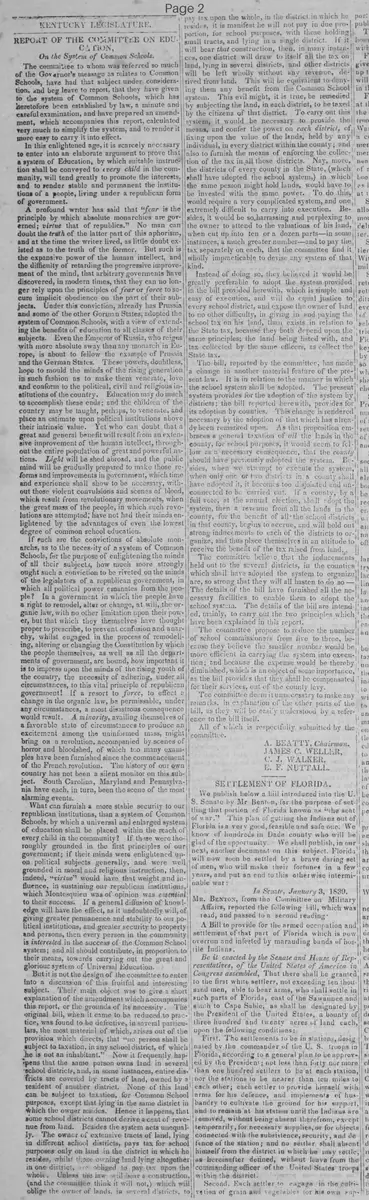
On the System of Common Schools.
The committee to whom was referred so much of the Governor's message as relates to Common Schools, have had that subject under consideration, and beg leave to report, that they have given to the system of Common Schools, which has heretofore been established by law, a minute and careful examination, and have prepared an amendment, which accompanies this report, calculated very much to simplify the system, and to render it more easy to carry it into effect.
In this enlightened age, it is scarcely necessary to enter into an elaborate argument to prove that a system of Education, by which suitable instruction shall be conveyed to every child in the community, will tend greatly to promote the interests, and to render stable and permanent the institutions of a people, living under a republican form of government.
A profound writer has said that "fear is the principle by which absolute monarchies are governed; virtue that of republics." No man can doubt the truth of the latter part of this aphorism, and at the time the writer lived, as little doubt existed as to the truth of the former. But such is the expansive power of the human intellect, and the difficulty of retarding the progressive improvement of the mind, that arbitrary governments have discovered, in modern times, that they can no longer rely upon the principles of fear or force to secure implicit obedience on the part of their subjects. Under this conviction, already has Prussia and some of the other German States, adopted the system of Common Schools, with a view of extending the benefits of education to all classes of their subjects. Even the Emperor of Russia, who reigns with more absolute sway than any monarch in Europe, is about to follow the example of Prussia and the German States. These powers, doubtless, hope to mould the minds of the rising generation in such fashion as to make them venerate, love and conform to the political, civil and religious institutions of the country. Education may do much to accomplish these ends: and the children of the country may be taught, perhaps, to venerate, and place an estimate upon political institutions above their intrinsic value. Yet who can doubt that a great and general benefit will result from an extensive improvement of the human intellect, throughout the entire population of great and powerful nations. Light will be shed abroad, and the public mind will be gradually prepared to make those reforms and improvements in government, which time and experience shall show to be necessary, without those violent convulsions and scenes of blood, which result from revolutionary movements, when the great mass of the people, in which such revolutions are attempted; have not had their minds enlightened by the advantages of even the lowest degree of common school education.
If such are the convictions of absolute monarchs, as to the necessity of a system of Common Schools, for the purpose of enlightening the minds of all their subjects, how much more strongly ought such a conviction to be riveted on the minds of the legislators of a republican government, in which all political power emanates from the people? In a government in which the people have a right to remodel, alter or change, at will, the organic law, with no other limitation upon their power, but that which they themselves have thought proper to prescribe, to prevent confusion and anarchy, whilst engaged in the process of remodelling, altering or changing the Constitution by which the people themselves, as well as all the departments of government, are bound, how important it is to impress upon the minds of the rising youth of the country, the necessity of adhering, under all circumstances, to this vital principle of republican government! If a resort to force, to effect a change in the organic law, be permissable, under any circumstances, a most disastrous consequence would result. A minority, availing themselves of a favorable state of circumstances to produce an excitement among the uninformed mass, might bring on a revolution, accompanied by scenes of horror and bloodshed, of which too many examples have been furnished since the commencement of the French revolution. The history of our own country has not been a silent monitor on this subject. South Carolina, Maryland and Pennsylvania have each, in turn, been the scene of the most alarming events.
What can furnish a more stable security to our republican institutions, than a system of Common Schools, by which a universal and enlarged system of education shall be placed within the reach of every child in the community? If these were thoroughly grounded in the first principles of our government; if their minds were enlightened upon political subjects generally, and were well grounded in moral and religious instruction, then, indeed, "virtue" would have that weight and influence, in sustaining our republican institutions, which Montesquieu was of opinion was essential to their success. If a general diffusion of knowledge will have the effect, as it undoubtedly will, of giving greater permanence and stability to our political institutions, and greater security to property and persons, then every person in the community is interested in the success of the Common School system; and all should contribute, in proportion to their means, towards carrying out the great and glorious system of Universal Education.
But it is not the design of the committee to enter into a discussion of this fruitful and interesting subject. Their main object was to give a short explanation of the amendment which accompanies this report, or the grounds of its necessity. The original bill, when it came to be reduced to practice, was found to be defective, in several particulars, the most material of which, arises out of the provision which directs, that "no person shall be subject to taxation, in any school district, of which he is not an inhabitant." Now it frequently happens that the same person owns land in several school districts, and, in some instances, entire districts are covered by tracts of land, owned by a resident of another district. None of this land can be subject to taxation, for Common School purposes, except that lying in the same district in which the owner resides. Hence it happens, that some school districts cannot derive a cent of revenue from land. Besides the system acts unequally. The owner of extensive tracts of land, lying in different school districts, pays tax for school purposes only on land in the district in which he resides, whilst those owning land lying altogether in one district, are obliged to pay tax upon the whole. Unless the law will bear a construction (and the committee think it will not,) which will oblige the owner of lands, in several districts, to pay tax upon the whole, in the district in which he resides, it is manifest he will not pay in due proportion, for school purposes, with those holding small tracts, and lying in a single district. If it will bear that construction, then, in many instances, one district will draw to itself all the tax on land, lying in several districts, and other districts will be left wholly without any revenue, derived from land. This will be equivalent to denying them any benefit from the Common School system. This evil might, it is true, be remedied by subjecting the land, in each district, to be taxed by the citizens of that district. To carry out this system, it would be necessary to provide the means, and confer the power on each district, of fixing upon the value of the lands, held by any individual, in every district within the county; and also to furnish the means of enforcing the collection of the tax in all those districts. Nay, more, the districts of every county in the State, (which shall have adopted the school system,) in which the same person might hold lands, would have to be invested with the same power. To do this, would require a very complicated system, and one extremely difficult to carry into execution. Besides, it would be so harrassing and perplexing to the owner to attend to the valuations of his land, when cut up into ten or a dozen parts-in some instances, a much greater number-and to pay the tax separately on each, that the committee find it wholly impracticable to devise any system of that kind.
Instead of doing so, they believed it would be greatly preferable to adopt the system provided in the bill provided herewith, which is simple and easy of execution, and will do equal justice to every school district, and expose the owner of land to no other difficulty, in giving in and paying the school tax on his land, than exists in relation to the State tax, because they both depend upon the same principles; the land being listed with, and tax collected by the same officers, as collect the State tax.
The bill, reported by the committee, has made a change in another material feature of the present law. It is in relation to the manner in which the school system shall be adopted. The present system provides for the adoption of the system by districts: the bill reported herewith, provides for its adoption by counties. This change is rendered necessary by the adoption of that which has already been remarked upon. As that proposition embraces a general taxation of all the lands in the county, for school purposes, it would seem to follow as a necessary consequence, that the county should have previously adopted the system. Besides, when we attempt to execute the system, when only one or two districts in a county shall have adopted it, it becomes too disjointed and unconnected to be carried out. If a county, by a full vote, at the annual election, shall adopt the system, then a revenue from all the lands in the county, for the benefit of all-the school districts in that county, begins to accrue, and will hold out strong inducements to each of the districts to organize, and thus place themselves in an attitude to receive the benefit of the tax raised from land. The committee believe that the inducements held out to the several districts, in the counties which shall have adopted the system to organize are, so strong that they will all hasten to do so. The details of the bill have furnished all the necessary facilities to enable them to adopt the school system. The details of the bill are intended, mainly, to carry out the two principles which have been explained in this report.
The committee propose to reduce the number of school commissioners from five to three, because they believe the smaller number would be more efficient in carrying the system into execution; and because the expense would be thereby diminished, which is an object of some importance, as the bill provides that they shall be compensated for their services, out of the county levy. The committee deem it unnecessary to make any remarks, in explanation of the other parts of the bill, as they will be easily understood by a reference to the bill itself.
All of which is respectfully submitted by the committee.
A. BEATTY, Chairman.
JAMES C. WELLER,
C. J. WALKER.
L. F. NUTTALL.
What sub-type of article is it?
What keywords are associated?
What entities or persons were involved?
Domestic News Details
Key Persons
Outcome
proposed amendments to simplify the common schools system, including county-wide adoption and taxation based on state tax principles, reducing commissioners from five to three.
Event Details
The Committee on Education examined the existing common schools system and prepared amendments to simplify it, particularly in taxation of land across districts and shifting adoption from districts to counties. The report argues for universal education to strengthen republican institutions, citing examples from monarchies and historical U.S. events.