Thank you for visiting SNEWPapers!
Sign up free
The National Intelligencer And Washington Advertiser
Washington, District Of Columbia
What is this article about?
Article from Cobbett's Political Register discusses ongoing diplomatic dispute between Britain and the United States over renewal of the 1794 Treaty of Amity, Commerce, and Navigation, focusing on trade restrictions with British West India Islands. Criticizes British ministers for delay, highlights American demands and threats, and anticipates severe commercial consequences if concessions are made.
Merged-components note: Continuation of the article from Cobbett's Political Register on the dispute between Britain and America; the second part picks up directly with 'true! and, therefore...' and maintains the foreign news topic on international relations and commerce.
Clippings
1 of 2
OCR Quality
Full Text
DISPUTE WITH AMERICA.
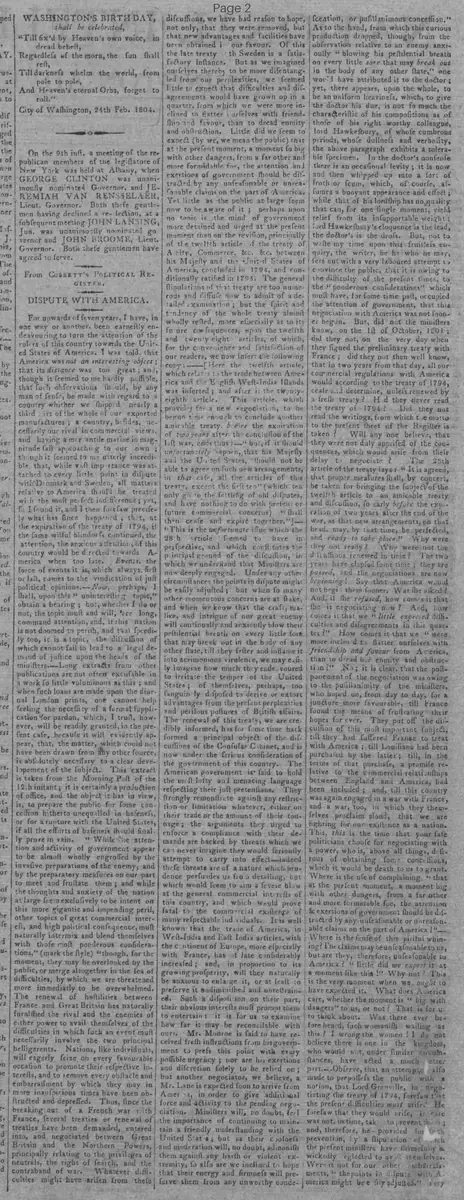
For upwards of seven years, I have, in one way or another, been earnestly endeavouring to turn the attention of the rulers of this country towards the United States of America. I was told, that America was not an interesting object; that its distance was too great; and, though it seemed to me hardly possible, that such observations should, by any man of sense, be made with regard to a country whither we shipped nearly a third part of the whole of our exported manufactures; a country, besides, necessarily our rival in commercial views, and having a mercantile marine in magnitude approaching to our own; though it seemed to me utterly incredible, that, while vast importance was attached to every little point in dispute with Denmark and Sweden, all matters relative to America should be treated with the most perfect indifference; yet, so I found it, and I then foresaw precisely what has since happened; that, at the expiration of the treaty of 1794, if the same wilful blindness continued, the attention, the anxious attention, of this country would be directed towards America when too late. Events, the force of events it is, which always, first or last, comes to the vindication of just political opinions.-- Now, perhaps, I shall, upon this "uninteresting topic," obtain a hearing; but, whether I do or not, the topic must and will, ere long, command attention, and, if this nation is not doomed to perish, and that speedily too, it is a topic, the discussion of which cannot fail to lead to a legal demand of justice upon the heads of the ministers.--Long extracts from other publications are not often excusable in a work so little voluminous as this; and when such loans are made upon the diurnal London prints, one cannot help feeling the necessity of a formal application for pardon, which, I trust, however, will be readily granted, in the present case, because it will evidently appear, that, the matter, which could not have been drawn from any other source, is absolutely necessary to a clear development of the subject. This extract is taken from the Morning Post of the 12th instant; it is certainly a production of office, and the object it has in view, is, to prepare the public for some concession hitherto unequalled in baseness, or for a rupture with the United States, if all the efforts of baseness should finally prove in vain. " While the attention and activity of government appear to be almost wholly engrossed by the invasive preparations of the enemy, and by the preparatory measures on our part to meet and frustrate them; and while the thoughts and anxiety of the nation at large seem exclusively to be intent on this more gigantic and impending peril, other topics of great commercial interest, and high political consequence, must naturally intermix and blend themselves with those most ponderous considerations," (mark the style) "though, for the moment, they may be overlooked by the public, or merge altogether in the sea of difficulties, by which we are threatened more immediately to be overwhelmed. The renewal of hostilities between France and Great Britain has naturally furnished the rival and the enemies of either power to avail themselves of the difficulties in which such an event must necessarily involve the two principal belligerents. Nations, like individuals, will eagerly seize on every favourable occasion to promote their respective interests, and to remove every obstacle and embarrassment by which they may in more inauspicious times have been obstructed and depressed. Thus, since the breaking out of a French war with France, several treaties or renewal of treaties have been demanded, entered into, and negotiated between Great Britain and the Northern Powers, principally relating to the privileges of neutrals, the right of search, and the Contraband of war. Whatever difficulties might have arisen from these discussions, we have had reason to hope, not only, that they were removed, but that new advantages and facilities have been obtained in our favour. Of this the late treaty with Sweden is a satisfactory instance. But as we imagined ourselves thereby to be more disentangled from our perplexities, we seemed little to expect that difficulties and disagreements would have grown up in a quarter, from which we were more inclined to flatter ourselves with friendship and favour, than to dread enmity and obstruction. Little did we seem to expect (by we, we mean the public) that at the present moment, a moment so big with other dangers, from a far other and more formidable foe, the attention and exertions of government should be distracted by any unreasonable or unreason-able claims on the part of America. Yet little as the public at large seem now to be aware of it; perhaps upon no topic is the mind of government more detained and urged at the present moment than on the revision, principally of the twelfth article of the treaty of Amity. Commerce. &c. &c. between his Majesty and the United States of America, concluded in 1794, and conditionally ratified in 1795. The general stipulations of that treaty are too numerous and diffuse now to admit of a detailed examination; but the spirit and tendency of the whole treaty almost wholly rested, more especially as to its future consequences, upon the twelfth and twenty eight articles, of which, for the convenience and satisfaction of our readers, we now insert the following copy:[Here the twelfth article, which relates to the trade between America and the English West-India Islands was inserted; and after it the twenty-eighth article. This article, which provides for a new negotiation, to be begun time enough to conclude another amicable treaty. before the expiration of two years after the conclusion of the last war, ends thus :-" but, if it should unfortunately happen, that his Majesty and the United States, should not be able to agree on such new arrangements, in that case, all the articles of this treaty. except the first ten"(which ten only go to the settling of old disputes, and have nothing to do with present. or future commercial concerns) "shall then cease and expire together."]- "This is the unfortunate issue which the 28th article seemed to have in perspective, and which constitutes the principal ground of the discussion, in which we understand that Ministers are now deeply engaged. Under any other circumstances the points in dispute might be easily adjusted; but when so many other momentous concerns are at stake, and when we know that the craft, malice, and intrigue of our great enemy will continually and anxiously blow their petilential breath on every little sore that may break out in the body of any other state, till they enter and inflame it into acrimonious virulence, we may easily imagine how much they endeavoured to irritate the temper of the United States; of themselves, perhaps, too sanguinely disposed to derive or extort advantages from the present perplexities and perilous postures of British affairs. The renewal of this treaty, we are credibly informed, has for some time back formed a principal object of the discussions of the Consular Cabinet, and is now under the serious consideration of the government of this country. The American government is said to hold the most lofty and menacing language respecting their just pretensions. They strongly remonstrate against any restriction or limitation whatever, either on their trade or the amount of their tonnage; the arguments they urged to enforce a compliance with their demands are backed by threats which we can never imagine they would seriously attempt to carry into effect indeed these threats are of a nature which prudence persuades us to a detailing, but which would seem to aim a severe blow at the general commercial interests of this country, and which would prove fatal to the commercial existence of many respectable individuals. It is well known that the trade of America, in West-India and East India articles, with the continent of Europe, more especially with France, has of late considerably increased; and, in proportion to its growing prosperity, will they naturally be anxious to enlarge it, or at least to preserve it undiminished and unrestrained. Such a disposition on their part, their obvious interests must prompt them to entertain: it is for us to examine how far it may be reconcilable with ours. Mr. Monroe is said to have received fresh instructions from his government to press this point with every possible urgency; nor are his exertions and discretion solely to be relied on; but another negotiator, we believe, a Mr. Pinkney is expected soon to arrive from America, in order to give 'additional force and activity to the pending negotiation. Ministers will, no doubt, feel the importance of continuing to maintain a friendly understanding with the United States; but as their coolness and moderation will, no doubt, admonish them against any harsh or violent extremity, so also are we inclined to hope that their energy and firmness will preserve them from any unworthy condescension, or pusillanimous concession."
As to the hand, from which this curious production dropped, though, from the observation relative to an enemy anxiously "blowing his petilential breath on every little sore that may break out in the body of any other state," one would have attributed it to the doctor: yet, there appears, upon the whole, to be an uniform heaviness, which, to give the doctor his due, is not so much the characteristic of his compositions as of those of his right worthy colleague, lord Hawkesbury, of whose cumbrous periods, whose dullness and verbosity, the above paragraph exhibits a tolerable specimen. In the doctor's nonsense there is an occasional levity; it is now and then whipped up into a sort of froth or cream, which, of course, assumes a buoyant appearance and effect; while that of his lordship has no quality that can, for one single moment, yield relief from its insupportable weight: lord Hawkesbury's eloquence is the lead, the doctor's is the dross. But, not to waste my time upon this fruitless enquiry, the writer, be who he may, sets out with a very laboured attempt to convince the public, that it is owing to the difficulty of the present times, to the "ponderous considerations" which must have, for some time past, occupied the attention of government, that this negotiation with America was not sooner begun. But, did not the ministers know, on the 1st of October, 1801: did they not, on the very day when they signed the preliminary treaty with France; did they not then well know, that in two years from that day, all our commercial regulations with America would according to the treaty of 1794, cease and determine, unless renewed by a fresh treaty? Had they never read the treaty of 1794? Did they not read the writings, from which the motto to the present sheet of the Register is taken? Will any one believe, that they were not duly apprised of the consequences, which would arise from their delay to negotiate? The 28th article of the treaty lays: " It is agreed, that proper measures shall, by concert, be taken for bringing the subject of the twelfth article to an amicable treaty and discussion, so early before the expiration of two years after the end of the war, as that new arrangements, on that head, may, by that time, be perfected, and ready to take place." Why were they not ready? Why were not the discussions renewed in time? The two years have elapsed some time; they are passed, and the negotiations are now beginning! Say that America would not begin them sooner. Was he asked? And, if he refused, how comes it that she is negotiating now? And, how comes it that we " little expected dif-ficulties and disagreements in this quar-ter?" How comes it that we " were more inclined to flatter ourselves with friend-ship and favour from America, than to dread her enmity and obstruc-tion?" No; it is clear, that the postponement of the negotiation was owing to the pusillanimity of the ministers, who hoped on, from day to day, for a juncture more favourable, till France found the means of frustrating their hopes for ever. They put off the dis-cussion of this most important subject, till they had suffered France to treat with America; till Louisiana had been purchased by the latter'; till, in the terms of that purchase, a promise re-lative to the commercial relationships between England and America, had been included; and, till this country was again engaged in a war with France, and a war, too, in which they them-selves proclaim aloud, that we are fighting for our existence as a nation. This, this is the time that your safe politicians choose for negotiating with a power, who is, above all things, de-sirous of obtaining some concessions, which it would be death to us to grant. Where is the use of complaining, " that at the present moment, a moment big with other dangers, from a far other and more formidable foe, the attention & exertions of government should be di-stracted by any unreasonable or unreason-able claims on the part of America?"-- Where is the sense of this pitiful whin-ing? The claims may be unreasonable to us, but are they, therefore, unreasonable to America? " little did we expect it at a moment like this!" Why not This is the very moment when we ought to have expected it. What does America care, whether the moment is " big with dangers" to us, or not? That is for us to think about. Was there ever be-fore heard, such womanish wailing as this? I wrong the women! I do not believe there is one in the kingdom, who would not, under similar circum-stances, have acted a much better part.--Observe, that an attempt is also made to possess the public with a notion, that Lord Grenville, in nego-tiating the treaty of 1794, foresaw that the present difficulties must arise. He foresaw that they would arise, if care was not, in time, taken to prevent them; and, therefore, he provided for such prevention, by a stipulation which the present ministers have shamefully & wickedly neglected to avail themselves. Were it not for our other embarrass-ments, " the points in dispute with A-merica might be easily adjusted."
true! and, therefore, we must agree. and we ought to beseech his Majesty to dismiss from his councils, the men who have brought us into those other embarrassments. This is "a little sore;" but, little as it is, it seems, that some apprehensions are entertained, as to its growing into a very dangerous ulcer; for, we are told, that the demands of the Americans are extremely unreasonable: that they are urged with lofty and menacing language; that the threats alluded to are "of a nature which prudence persuades the ministers from detailing, which seems to aim a severe blow at the general commercial interests of this country, and which would prove fatal to many respectable individuals." This, then, is not merely a "little sore." It is something that will require more skill to cure than Doctor Addington and his whole college possess. They are alarmed, and well they may be; for this, this is the blow, that will most assuredly finish either their power, or the power of England. There is the treaty of Lord Grenville; we were at war, when that treaty was made; it was concluded at a very disastrous period of the war; let the present ministers, therefore, answer with their lives any abandonment of its principles; for on its principles depend our existence as a maritime power. Mr. Fox censured the treaty of 1794. He said it was too favorable to America; and, in some points, it certainly was. What, then, shall be said, what shall be done, to the minister, who shall dare to enter into a compact more favorable to America? Lord Hawkesbury boasted of the clever trick of "placing the French upon the back of the Americans," and said it would be a sure means of binding the latter more closely to England. Well; now let us see, whether this deep trick has answered the end proposed; let us see whether he will obtain as good terms as those which were obtained by Lord Grenville before the French were placed upon the back of the Americans. The "haughtiness," of the Grenvilles has been, by the present ministers, made the subject of much mortifying complaint: let us see then, whether as much will be done by their conciliating disposition; let us see which is most advantageous to the country, the "haughtiness" of the Grenvilles, or the sycophancy of the Jenkinsons. We have, indeed, already had a tolerable good proof, in the Conventions with the Northern neutrals; but, it is in the result of the present dispute with America; this is the event, that will make the nation feel, though it may still be resolved to shut its eyes; this event will bring on it the punishment justly due to its baseness in tamely and silently submitting to the rule of ministers, whose measures it disapproves of, and whose talents and character it despises. It will be perceived, that I have been obliged to confine myself here merely to a few short remarks on this ministerial paragraph; and that, as to the subject of the dispute itself, I have not room enough even to enter on it. In the next sheet, however, I intend, 1st. to state the origin of this dispute; 2nd. to describe the objects which the American government has in view; 3rd. to show the fatal effects which, to the commerce, navigation, and maritime strength of Great Britain, must inevitably proceed from the accomplishment of those objects; and 4th. to trace the pretensions and demands of America, clearly and fairly to trace them, to their only source, to wit, the misconduct of ministers with regard to the peace of Amiens, and to Louisiana in particular; to the general imbecility of their councils, and to the utter contempt, in which their public character and talents are held, in the United States, amongst persons of all parties and descriptions. I cannot dismiss this subject without observing, that the statement, which has been given in the ministerial prints, respecting the satisfaction testified by the Americans at the conduct of our cruisers, is totally false, there being now, on the table before me, proof upon proof of their discontent as to the conduct of those cruisers, which proofs shall appear in my next. I beg not to be understood as abetting the complaints of the Americans. I know that many of them will prove futile: but, when such a statement is made here, and that, too, with the low and malicious intention of making the public believe, that "the complaints, which were but too justly urged by the Americans, during the last war, are now completely removed," in such a case, it is my duty to detail facts, which might otherwise have been suffered to pass unnoticed: and I shall not fail to prove, that the complaints of the Americans, as to the point in question, have already been more numerous than they were during any year of the last war.
What sub-type of article is it?
What keywords are associated?
What entities or persons were involved?
Where did it happen?
Foreign News Details
Primary Location
United States Of America
Event Date
As Of 12th Instant
Key Persons
Outcome
ongoing negotiations for renewal of 1794 treaty; potential concessions or rupture; american demands backed by threats to british commercial interests
Event Details
British government engaged in discussions to renew the 1794 Treaty of Amity, Commerce, and Navigation with the United States, focusing on the twelfth article regarding trade with English West-India Islands. Delay in negotiations criticized; Americans demand unrestricted trade and tonnage, using menacing language and threats. Mr. Monroe pressing claims, Mr. Pinkney expected to join. Fears of severe blow to British commerce if demands met.