Thank you for visiting SNEWPapers!
Sign up free
Story
December 14, 1954
Atlanta Daily World
Atlanta, Fulton County, Georgia
What is this article about?
U.S. Supreme Court allows discharged veteran Peter Brown to sue under Federal Tort Claims Act for permanent nerve damage from a defective tourniquet used in a 1951 VA hospital operation on his service-related knee injury, distinguishing from active duty cases.
Clipping
OCR Quality
98%
Excellent
Full Text
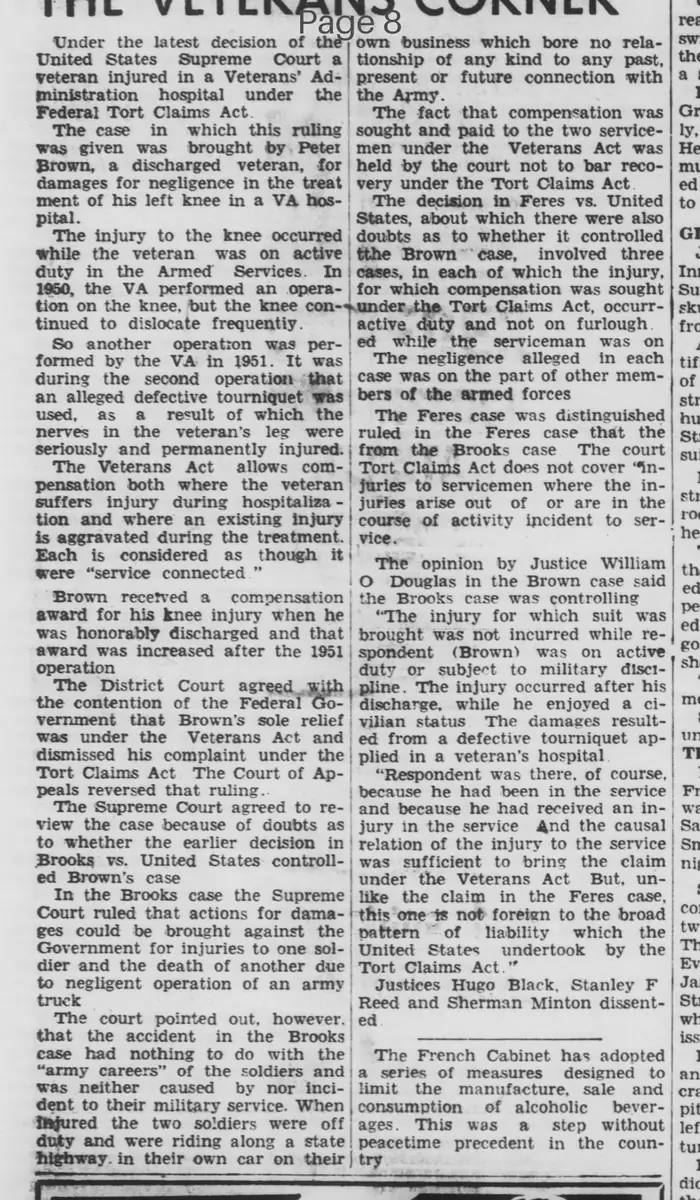
Under the latest decision of the United States Supreme Court a veteran injured in a Veterans' Administration hospital under the Federal Tort Claims Act.
The case in which this ruling was given was brought by Peter Brown, a discharged veteran, for damages for negligence in the treatment of his left knee in a VA hospital.
The injury to the knee occurred while the veteran was on active duty in the Armed Services. In 1950, the VA performed an operation on the knee, but the knee continued to dislocate frequently.
So another operation was performed by the VA in 1951. It was during the second operation that an alleged defective tourniquet was used, as a result of which the nerves in the veteran's leg were seriously and permanently injured.
The Veterans Act allows compensation both where the veteran suffers injury during hospitalization and where an existing injury is aggravated during the treatment. Each is considered as though it were "service connected".
Brown received a compensation award for his knee injury when he was honorably discharged and that award was increased after the 1951 operation.
The District Court agreed with the contention of the Federal Government that Brown's sole relief was under the Veterans Act and dismissed his complaint under the Tort Claims Act. The Court of Appeals reversed that ruling.
The Supreme Court agreed to review the case because of doubts as to whether the earlier decision in Brooks vs. United States controlled Brown's case.
In the Brooks case the Supreme Court ruled that actions for damages could be brought against the Government for injuries to one soldier and the death of another due to negligent operation of an army truck.
The court pointed out, however, that the accident in the Brooks case had nothing to do with the "army careers" of the soldiers and was neither caused by nor incident to their military service. When injured the two soldiers were off duty and were riding along a state highway in their own car on their own business which bore no relationship of any kind to any past, present or future connection with the Army.
The fact that compensation was sought and paid to the two servicemen under the Veterans Act was held by the court not to bar recovery under the Tort Claims Act.
The decision in Feres vs. United States, about which there were also doubts as to whether it controlled the Brown case, involved three cases, in each of which the injury, for which compensation was sought under the Tort Claims Act, occurred while the serviceman was on active duty and not on furlough.
The negligence alleged in each case was on the part of other members of the armed forces.
The Feres case was distinguished from the Brooks case. The court ruled in the Feres case that the Tort Claims Act does not cover injuries to servicemen where the injuries arise out of or are in the course of activity incident to service.
The opinion by Justice William O. Douglas in the Brown case said the Brooks case was controlling.
"The injury for which suit was brought was not incurred while respondent (Brown) was on active duty or subject to military discipline. The injury occurred after his discharge, while he enjoyed a civilian status. The damages resulted from a defective tourniquet applied in a veteran's hospital.
"Respondent was there, of course, because he had been in the service and because he had received an injury in the service. And the causal relation of the injury to the service was sufficient to bring the claim under the Veterans Act. But, unlike the claim in the Feres case, this one is not foreign to the broad pattern of liability which the United States undertook by the Tort Claims Act."
The case in which this ruling was given was brought by Peter Brown, a discharged veteran, for damages for negligence in the treatment of his left knee in a VA hospital.
The injury to the knee occurred while the veteran was on active duty in the Armed Services. In 1950, the VA performed an operation on the knee, but the knee continued to dislocate frequently.
So another operation was performed by the VA in 1951. It was during the second operation that an alleged defective tourniquet was used, as a result of which the nerves in the veteran's leg were seriously and permanently injured.
The Veterans Act allows compensation both where the veteran suffers injury during hospitalization and where an existing injury is aggravated during the treatment. Each is considered as though it were "service connected".
Brown received a compensation award for his knee injury when he was honorably discharged and that award was increased after the 1951 operation.
The District Court agreed with the contention of the Federal Government that Brown's sole relief was under the Veterans Act and dismissed his complaint under the Tort Claims Act. The Court of Appeals reversed that ruling.
The Supreme Court agreed to review the case because of doubts as to whether the earlier decision in Brooks vs. United States controlled Brown's case.
In the Brooks case the Supreme Court ruled that actions for damages could be brought against the Government for injuries to one soldier and the death of another due to negligent operation of an army truck.
The court pointed out, however, that the accident in the Brooks case had nothing to do with the "army careers" of the soldiers and was neither caused by nor incident to their military service. When injured the two soldiers were off duty and were riding along a state highway in their own car on their own business which bore no relationship of any kind to any past, present or future connection with the Army.
The fact that compensation was sought and paid to the two servicemen under the Veterans Act was held by the court not to bar recovery under the Tort Claims Act.
The decision in Feres vs. United States, about which there were also doubts as to whether it controlled the Brown case, involved three cases, in each of which the injury, for which compensation was sought under the Tort Claims Act, occurred while the serviceman was on active duty and not on furlough.
The negligence alleged in each case was on the part of other members of the armed forces.
The Feres case was distinguished from the Brooks case. The court ruled in the Feres case that the Tort Claims Act does not cover injuries to servicemen where the injuries arise out of or are in the course of activity incident to service.
The opinion by Justice William O. Douglas in the Brown case said the Brooks case was controlling.
"The injury for which suit was brought was not incurred while respondent (Brown) was on active duty or subject to military discipline. The injury occurred after his discharge, while he enjoyed a civilian status. The damages resulted from a defective tourniquet applied in a veteran's hospital.
"Respondent was there, of course, because he had been in the service and because he had received an injury in the service. And the causal relation of the injury to the service was sufficient to bring the claim under the Veterans Act. But, unlike the claim in the Feres case, this one is not foreign to the broad pattern of liability which the United States undertook by the Tort Claims Act."
What sub-type of article is it?
Historical Event
What themes does it cover?
Justice
What keywords are associated?
Supreme Court Ruling
Veteran Injury
Tort Claims Act
Va Hospital Negligence
Service Connected Injury
What entities or persons were involved?
Peter Brown
Justice William O. Douglas
Where did it happen?
Va Hospital
Story Details
Key Persons
Peter Brown
Justice William O. Douglas
Location
Va Hospital
Event Date
1950 1951
Story Details
The U.S. Supreme Court ruled that a discharged veteran, Peter Brown, could sue the government under the Federal Tort Claims Act for negligence during a 1951 VA hospital operation on his service-related knee injury, distinguishing it from cases where injuries occurred during active duty.