Thank you for visiting SNEWPapers!
Sign up free
The National Intelligencer And Washington Advertiser
Washington, District Of Columbia
What is this article about?
In a U.S. Senate proceeding, Mr. Harper defends Senator John Smith against expulsion for alleged ties to Aaron Burr's 1806 conspiracy. He argues the Senate lacks jurisdiction without prior indictment, demands face-to-face witness confrontation, and protests depositions as unconstitutional evidence.
Clipping
OCR Quality
Full Text
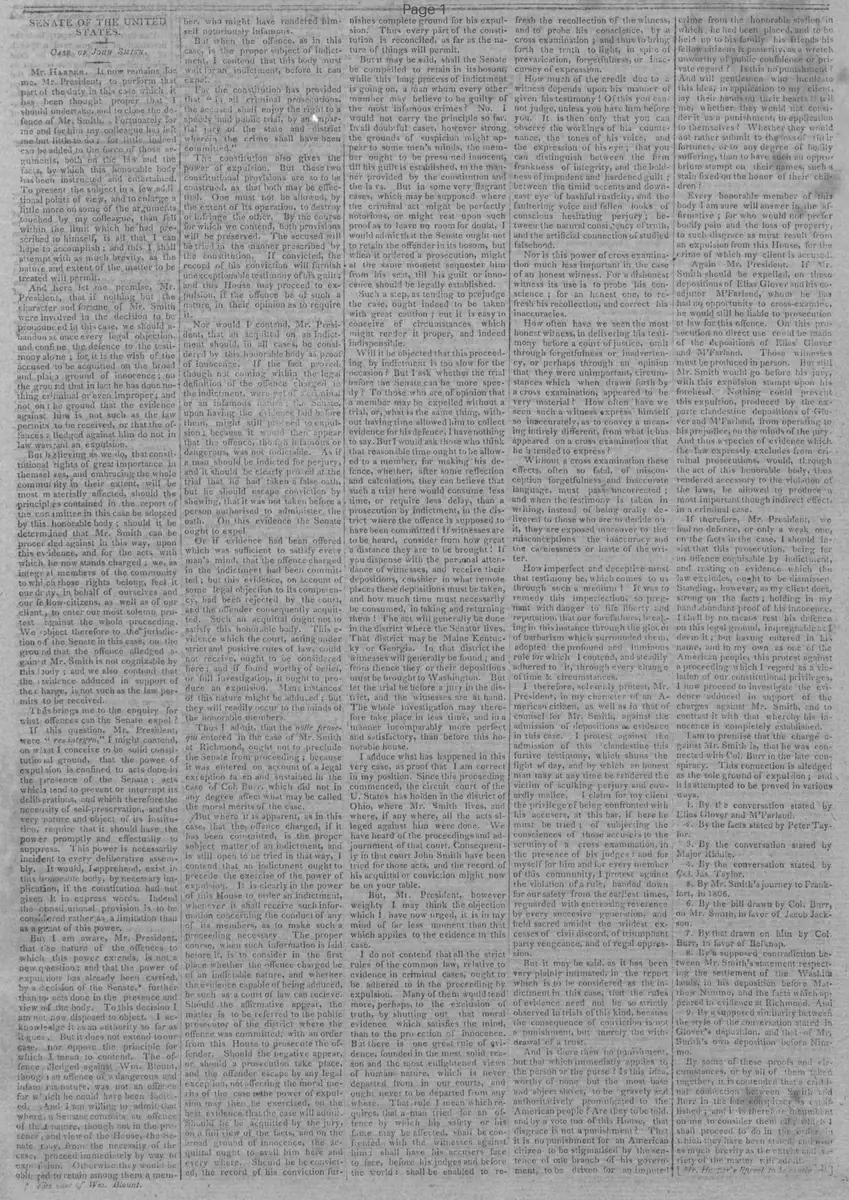
Mr. Harper. It now remains for me, Mr. President, to perform that part of the duty in this case which it has been thought proper that I should undertake, and to close the defense of Mr. Smith. Fortunately for me and for him my colleague has left me but little to do; for little indeed can be added to the force of those arguments, both on the law and the facts, by which this honorable body has been instructed and entertained. To present the subject in a few additional points of view, and to enlarge a little more on some of the arguments touched by my colleague, than fell within the limit which he had prescribed to himself, is all that I can hope to accomplish; and this I shall attempt with as much brevity, as the nature and extent of the matter to be treated will permit.
And here let me premise, Mr. President, that if nothing but the character and fortune of Mr. Smith were involved in the decision to be pronounced in this case, we should abandon at once every legal objection, and confine the defense to the testimony alone; for it is the wish of the accused to be acquitted on the broad and plain ground of innocence; on the ground that in fact he has done nothing criminal or even improper; and not on the ground that the evidence against him is not such as the law permits to be received, or that the offenses alleged against him do not in law warrant an expulsion.
But believing as we do, that constitutional rights of great importance in themselves, and embracing the whole community in their extent, will be most materially affected, should the principles contained in the report of the committee in this case be adopted by this honorable body; should it be determined that Mr. Smith can be proceeded against in this way, upon this evidence, and for the acts with which he now stands charged; we, as integral members of the community to which those rights belong, feel it our duty, in behalf of ourselves and our fellow-citizens, as well as our client, to enter our most solemn protest against the whole proceeding.
We object therefore to the jurisdiction of the Senate in this case, on the ground that the offence alleged against Mr. Smith is not cognizable by this body; and we also contend that the evidence adduced in support of the charge, is not such as the law permits to be received.
This brings me to the enquiry of what offences can the Senate expel? If this question, Mr. President, were res integra, I might contend, on what I conceive to be solid constitutional ground, that the power of expulsion is confined to acts done in the presence of the Senate; acts which tend to prevent or interrupt its deliberations, and which therefore the necessity of self-preservation, and the very nature and object of its institution, require that it should have the power promptly and effectually to suppress. This power is necessarily incident to every deliberative assembly. It would, I apprehend, exist in this honorable body, by necessary implication, if the constitution had not given it in express words. Indeed the constitutional provision is to be considered rather as a limitation than as a grant of this power.
But I am aware, Mr. President, that the nature of the offences to which this power extends, is not a new question; and that the power of expulsion has already been carried, by a decision of the Senate, further than to acts done in the presence and view of the body. To this decision I am not now disposed to object. I acknowledge it as an authority so far as it goes. But it does not extend to our case, nor oppose the principle for which I mean to contend. The offence alleged against Wm. Blount, though an offence of a dangerous and infamous nature, was not an offence for which he could have been indicted. And I am willing to admit that where a Senator commits an offence of that nature, though not in the presence and view of the House, the Senate may, from the necessity of the case, proceed immediately by way of expulsion. Otherwise they would be obliged to retain among them a member, who might have rendered himself notoriously infamous.
But when the offence, as in this case, is the proper subject of indictment, I contend that this body must wait for an indictment, before it can expel. For the constitution has provided that "in all criminal prosecutions, the accused shall enjoy the right to a speedy and public trial, by an impartial jury of the state and district wherein the crime shall have been committed."
The constitution also gives the power of expulsion. But these two constitutional provisions are so to be construed, as that both may be effectual. One must not be allowed, by the extent of its operation, to destroy or infringe the other. By the course for which we contend, both provisions will be preserved. The accused will be tried in the manner prescribed by the constitution. If convicted, the record of his conviction will furnish unexceptionable testimony of his guilt; and this House may proceed to expulsion, if the offence be of such a nature in their opinion as to require it.
Nor would I contend, Mr. President, that an acquittal on an indictment should, in all cases, be considered by this honorable body as proof of innocence. If the fact proved, though not coming within the legal definition of the offence charged in the indictment, were yet of a criminal or an infamous nature; the Senate, upon having the evidence laid before them, might still proceed to expulsion; because it would then appear that the offence, though infamous or dangerous, was not indictable. As if a man should be indicted for perjury, and it should be clearly proved at the trial that he had taken a false oath, but he should escape conviction by shewing, that it was not taken before a person authorised to administer the oath. On this evidence the Senate ought to expel.
Or if evidence had been offered which was sufficient to satisfy every man's mind, that the offence charged in the indictment had been committed; but this evidence, on account of some legal objection to its competency, had been rejected by the court, and the offender consequently acquitted. Such an acquittal ought not to satisfy this honorable body. This evidence which the court, acting under strict and positive rules of law, could not receive, ought to be considered here; and if found worthy of belief or full investigation, it ought to produce an expulsion. Many instances of this nature might be adduced; but they will readily occur to the minds of the honorable members.
Thus I admit, that the nolle prosequi entered in the case of Mr. Smith at Richmond, ought not to preclude the Senate from proceeding; because it was entered on account of a legal exception taken and sustained in the case of Col. Burr, which did not in any degree affect what may be called the moral merits of the case.
But where it is apparent, as in this case, that the offence charged, if it has been committed, is the proper subject matter of an indictment, and is still open to be tried in that way, I contend that an indictment ought to precede the exercise of the power of expulsion. It is clearly in the power of this House to order an indictment, whenever it shall receive such information concerning the conduct of any of its members, as to make such a proceeding necessary. The proper course, when such information is laid before it, is to consider in the first place whether the offence charged be of an indictable nature, and whether the evidence capable of being adduced, be such as a court of law can receive. Should the affirmative appear, the matter is to be referred to the public prosecutor of the district where the offence was committed, with an order from this House to prosecute the offender. Should the negative appear, or should a prosecution take place, and the offender escape by any legal exception, not affecting the moral merits of the case the power of expulsion may then be exercised, on the best evidence that the case will admit. Should he be acquitted by the jury, on a full view of the facts, and on the broad ground of innocence, the acquittal ought to avail him here and every where. Should he be convicted, the record of his conviction furnishes complete ground for his expulsion. Thus every part of the constitution is reconciled, as far as the nature of things will permit.
But it may be said, shall the Senate be compelled to retain in its bosom, while this long process of indictment is going on, a man whom every other member may believe to be guilty of the most infamous crimes? No. I would not carry the principle so far. In all doubtful cases, however strong the grounds of suspicion might appear to some men's minds, the member ought to be presumed innocent, till his guilt is established, in the manner provided by the constitution and the laws. But in some very flagrant cases, which may be supposed where the criminal act might be perfectly notorious, or might rest upon such proof as to leave no room for doubt, I would admit that the Senate ought not to retain the offender in its bosom, but when it ordered a prosecution, might at the same moment sequester him from his seat, till his guilt or innocence should be legally established. Such a step, as tending to prejudge the case, ought indeed to be taken with great caution; but it is easy to conceive of circumstances which might render it proper, and indeed indispensible.
Will it be objected that this proceeding by indictment is too slow for the occasion? But I ask whether the trial before the Senate can be more speedy? To those who are of opinion that a member may be expelled without a trial, or, what is the same thing, without having time allowed him to collect evidence for his defence, I have nothing to say. But I would ask those who think that reasonable time ought to be allowed to a member, for making his defence, whether, after some reflection and calculation, they can believe that such a trial here would consume less time, or require less delay, than a prosecution by indictment, in the district where the offence is supposed to have been committed? If witnesses are to be heard, consider from how great a distance they are to be brought! If you dispense with the personal attendance of witnesses, and receive their depositions, consider in what remote places these depositions must be taken, and how much time must necessarily be consumed, in taking and returning them! The act will generally be done in the district where the Senator lives. That district may be Maine, Kentucky or Georgia. In that district the witnesses will generally be found; and from thence they or their depositions must be brought to Washington. But let the trial be before a jury in the district, and the witnesses are at hand. The whole investigation may therefore take place in less time, and in a manner incomparably more perfect and satisfactory, than before this honorable house.
I adduce what has happened in this very case, as proof that I am correct in my position. Since this proceeding commenced, the circuit court of the U. States has holden in the district of Ohio, where Mr. Smith lives, and where, if any where, all the acts alleged against him were done. We have heard of the proceedings and adjournment of that court. Consequently in that court John Smith have been tried for those acts, and the record of his acquittal or conviction might now be on your table.
But, Mr. President, however weighty I may think the objection which I have now urged, it is in my mind of far less moment than that which applies to the evidence in this case.
I do not contend that all the strict rules of the common law, relative to evidence in criminal cases, ought to be adhered to in the proceeding by expulsion. Many of them would tend more, perhaps, to the exclusion of truth, by shutting out that moral evidence which satisfies the mind, than to the protection of innocence. But there is one great rule of evidence, founded in the most solid reason and the most enlightened views of human nature, which is never departed from in our courts, and ought never to be departed from any where. That rule I mean which requires, that a man tried for an offence by which his safety or his fame may be affected, shall be confronted with the witnesses against him: shall have his accusers face to face, before his judges and before the world: shall be enabled to refresh the recollection of the witness, and to probe his conscience, by a cross examination; and thus to bring forth the truth to light, in spite of prevarication, forgetfulness, or inaccuracy of expression.
How much of the credit due to a witness depends upon his manner of giving his testimony! Of this you cannot judge, unless you have him before you. It is then only that you can observe the workings of his countenance, the tones of his voice, and the expression of his eye; that you can distinguish between the firm frankness of integrity, and the boldness of impudent and hardened guilt; between the timid accents and downcast eye of bashful rusticity, and the faltering voice and fallen looks of conscious hesitating perjury; between the natural consistency of truth, and the artificial connection of studied falsehood.
Nor is this power of cross examination much less important in the case of an honest witness. For a dishonest witness its use is to probe his conscience; for an honest one, to refresh his recollection, and correct his inaccuracies.
How often have we seen the most honest witness, in delivering his testimony before a court of justice, omit through forgetfulness or inadvertency, or perhaps through an opinion that they were unimportant, circumstances which when drawn forth by a cross examination, appeared to be very material? How often have we seen such a witness express himself so inaccurately, as to convey a meaning entirely different, from what it has appeared on a cross examination that he intended to express?
Without a cross examination these effects, often so fatal, of misconception forgetfulness and inaccurate language, must pass uncorrected; and when the testimony is taken in writing, instead of being orally delivered to those who are to decide on it, they are exposed moreover to the misconceptions the inaccuracy and the carelessness or haste of the writer.
How imperfect and deceptive must that testimony be, which comes to us through such a medium! It was to remedy this imperfection, so pregnant with danger to life liberty and reputation, that our forefathers, breaking in this instance through the gloom of barbarism which surrounded them, adopted the profound and luminous rule for which I contend, and steadily adhered to it, through every change of time & circumstances.
I therefore, solemnly protest, Mr. President, in my character of an American citizen, as well as in that of counsel for Mr. Smith, against the admission of depositions as evidence in this case. I protest against the admission of this clandestine this furtive testimony, which shuns the light of day, and by which an honest man may at any time be rendered the victim of skulking perjury and cowardly malice. I claim for my client the privilege of being confronted with his accusers, at this bar, if here he must be tried; of subjecting the consciences of those accusers to the scrutiny of a cross examination, in the presence of his judges: and for myself for him and for every member of this community, I protest against the violation of a rule, handed down for our safety from the earliest times, regarded with increasing reverence by every successive generation, and held sacred amidst the wildest excesses of civil discord, of triumphant party vengeance, and of regal oppression.
But it may be said, as it has been very plainly intimated, in the report which is to be considered as the indictment in this case, that the rules of evidence need not be so strictly observed in trials of this kind, because the consequence of conviction is not a punishment, but merely the withdrawal of a trust.
And is there then no punishment but that which immediately applies to the person or the purse? Is this idea, worthy of none but the most base and abject slaves, to be gravely and authoritatively promulgated to the American people? Are they to be told, and by a vote too of this House, that disgrace is not a punishment? That it is no punishment to an American citizen to be stigmatised by the sentence of one branch of his government, to be driven on an imputed crime from the honorable station in which he had been placed, and to be held up to his family his friends his fellow citizens & posterity, as a wretch unworthy of public confidence or private regard? Is this no punishment?
And will gentlemen who inculcate this idea, in application to my client, lay their hands on their hearts: tell me, whether they would not consider it as a punishment, in application to themselves? Whether they would not rather submit to the loss of their fortunes, or to any degree of bodily suffering, than to have such an opprobrium stampt on their names, such a stain fixed on the honor of their children?
Every honorable member of this body I am sure will answer in the affirmative; for who would not prefer bodily pain and the loss of property to such disgrace as must result from an expulsion from this House, for the crime of which my client is accused.
Again Mr. President. If Mr. Smith should be expelled, on these depositions of Elias Glover and his co-adjutor M'Farland, whom he has had no opportunity to cross-examine, he would still be liable to prosecution at law for this offence. On this prosecution no direct use could be made of the depositions of Elias Glover and M'Farland. Those witnesses must be produced in person. But still Mr. Smith would go before his jury, with this expulsion stampt upon his forehead. Nothing could prevent this expulsion, produced by the ex parte clandestine depositions of Glover and M'Farland, from operating to his prejudice, on the minds of the jury. And thus a species of evidence which the law expressly excludes from criminal prosecutions, would, through the act of this honorable body, thus rendered accessory to the violation of the laws, be allowed to produce a most important though indirect effect. in a criminal case.
If therefore, Mr. President, we had no defence, or only a weak one, on the facts in the case, I should insist that this prosecution, being for an offence cognisable by indictment, and resting on evidence which the law excludes, ought to be dismissed. Standing, however, as my client does, strong on the facts; holding in my hand abundant proof of his innocence, I shall by no means rest his defence on this legal ground, impregnable as I deem it; but having entered in his name, and in my own as one of the American people, this protest against a proceeding which I regard as a violation of our constitutional privileges, I now proceed to investigate the evidence adduced in support of the charges against Mr. Smith, and to contrast it with that whereby his innocence is completely established.
I am to premise that the charge against Mr. Smith is, that he was connected with Col. Burr in the late conspiracy. This connection is alleged as the sole ground of expulsion; and it is attempted to be proved in various ways.
1. By the conversation stated by Elias Glover and M'Farland.
2. By the acts stated by Peter Taylor.
3. By the conversation stated by Major Riddle.
4. By the conversation stated by Col. Jas. Taylor.
5. By Mr. Smith's journey to Frankfort, in 1806.
6. By the bill drawn by Col. Burr, on Mr. Smith, in favor of Jacob Jackson.
7. By that drawn on him by Col. Burr, in favor of Belknap.
8. By a supposed contradiction between Mr. Smith's statement respecting the settlement of the Washita lands, in his deposition before Matthew Nimmo, and the facts which appeared in evidence at Richmond. And
9. By a supposed similarity between the style of the conversation stated in Glover's deposition, and that of Mr. Smith's own deposition before Nimmo.
By some of these proofs and circumstances, or by all of them taken together, it is contended that a criminal connection between Smith, and Burr in the late conspiracy is established; and it is therefore incumbent on me to consider them all: which I shall proceed to do in the order in which they have been stated, and with as much brevity as the extent and variety of the matter will admit.
Mr. Harper's Speech to be continued.
What sub-type of article is it?
What themes does it cover?
What keywords are associated?
What entities or persons were involved?
Where did it happen?
Story Details
Key Persons
Location
Senate Of The United States
Event Date
1806
Story Details
Mr. Harper delivers a defense speech for Senator John Smith against expulsion for alleged connection to Col. Burr's conspiracy, objecting to Senate jurisdiction without indictment, demanding confrontation of witnesses, and protesting use of depositions as evidence violating constitutional rights.