Thank you for visiting SNEWPapers!
Sign up free
Editorial
July 16, 1828
Literary Cadet And Rhode Island Statesman
Providence, Providence County, Rhode Island
What is this article about?
This editorial examines personal hostilities fueling political rivalries, defending Henry Clay against critics Hugh Nelson, Alexander Smyth, and Samuel Smith. It recounts Clay's early advocacy for recognizing South American independence in 1818-1820 and quotes his sarcastic remarks that wounded their pride, while criticizing Smith's deceptive election tactics.
Clipping
OCR Quality
95%
Excellent
Full Text
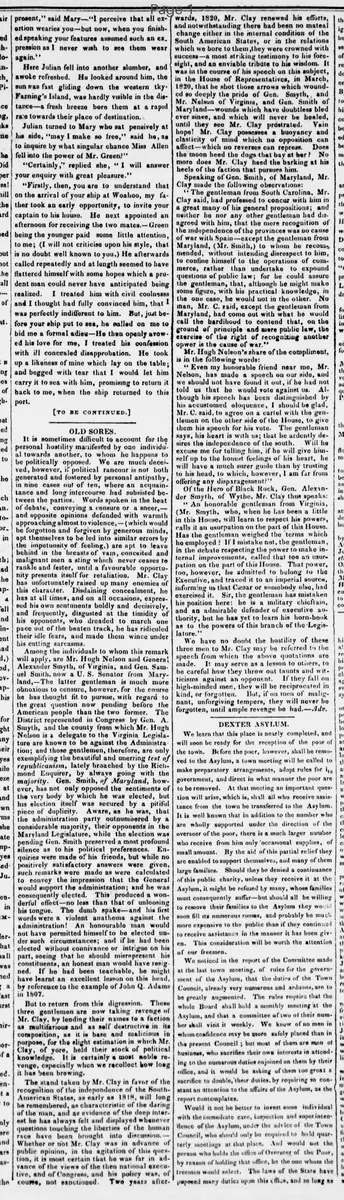
OLD SORES.
It is sometimes difficult to account for the personal hostility manifested by one individual towards another, to whom he happens to be politically opposed. We are much deceived, however, if political rancour is not both generated and fostered by personal antipathy, in nine cases out of ten, where an acquaintance and long intercourse had subsisted between the parties. Words spoken in the heat of debate, conveying a censure or a sneer,—and opposite opinions defended with warmth approaching almost to violence,—(which would be forgotten and forgiven by generous minds, apt themselves to be led into similar errors by the impetuosity of feeling,) are apt to leave behind in the breasts of vain, conceited and malignant men a sting which never ceases to rankle and fester, until a favourable opportunity presents itself for retaliation. Mr. Clay has unfortunately raised up many enemies of this character. Disdaining concealment, he has at all times, and on all occasions, expressed his own sentiments boldly and decisively, and frequently, disgusted at the timidity of his opponents, who dreaded to march one pace out of the beaten track, he has ridiculed their idle fears, and made them wince under his cutting sarcasms.
Among the individuals to whom this remark will apply, are Mr. Hugh Nelson and General Alexander Smyth, of Virginia, and Gen. Samuel Smith, now a U. S. Senator from Maryland.—The latter gentleman is much more obnoxious to censure, however, for the course he has thought fit to pursue, with regard to the great question now pending before the American people than the two former. The District represented in Congress by Gen. A. Smyth, and the county from which Mr. Hugh Nelson is a delegate to the Virginia Legislature are known to be against the Administration; and those gentlemen, therefore, are only exemplifying the beautiful and unerring test of republicanism, lately broached by the Richmond Enquirer, by always going with the majority. Gen. Smith, of Maryland, however, has not only opposed the sentiments of the very body by which he was elected, but his election itself was secured by a pitiful piece of duplicity. Aware, as he was, that the administration party outnumbered by a considerable majority, their opponents in the Maryland Legislature, while the election was pending Gen. Smith preserved a most profound silence as to his political preferences. Enquiries were made of his friends, but while no positively satisfactory answers were given, such remarks were made as were calculated to convey the impression that the General would support the administration; and he was consequently elected. This produced a wonderful effect—no less than that of unloosing his tongue. The dumb spake—and his first words were a violent anathema against the administration! An honourable man would not have permitted himself to be elected under such circumstances; and if he had been elected without connivance or intrigue on his part, seeing that he should misrepresent his constituents, an honest man would have resigned. If he had been teachable, he might have learnt an excellent lesson on this head. by reference to the example of John Q. Adams in 1807.
But to return from this digression. These three gentlemen are now taking revenge of Mr. Clay, by lending their names to a faction as multifarious and as self destructive in its composition, as it is base and malicious in purpose, for the slight estimation in which Mr. Clay, of yore, hold their stock of political knowledge. It is certainly most noble revenge, especially when we recollect how long it has been brewing.
The stand taken by Mr. Clay in favor of the recognition of the independence of the South-American States, as early as 1818, will long be remembered, as characteristic of the daring of the man. and as evidence of the deep interest he has always felt and displayed whenever questions touching the liberties of the human race have been brought into discussion.— Whether or not Mr. Clay was in advance of public opinion, in the agitation of this question, it is most certain that he was far in advance of the views of the then national executive, and of Congress, and his policy was, of course, not sanctioned. Two years afterwards, 1820. Mr. Clay renewed his efforts. and notwithstanding there had been no material change either in the internal condition of the South American States, or in the relations which we bore to them, they were crowned with success—a most striking testimony to his foresight, and an enviable tribute to his wisdom. It was in the course of his speech on this subject, in the House of Representatives, in March, 1820, that he shot those arrows which wounded so deeply the pride of Gen. Smyth, and Mr. Nelson of Virginia, and Gen. Smith of Maryland—wounds which have doubtless bled ever since, and which will never be healed, until they see Mr. Clay prostrated. Vain hope! Mr. Clay possesses a buoyancy and elasticity of mind which no opposition can affect—which no reverses can repress. Does the moon heed the dogs that bay at her? No more does Mr. Clay heed the barking at his heels of the faction that pursues him.
Speaking of Gen. Smith, of Maryland, Mr. Clay made the following observations:
The gentleman from South Carolina, Mr. Clay said, had professed to concur with him in a great many of his general propositions; and neither he nor any other gentleman had disagreed with him, that the mere recognition of the independence of the provinces was no cause of war with Spain—except the gentleman from Maryland, (Mr. Smith,) to whom he recommended, without intending disrespect to him, to confine himself to the operations of commerce, rather than undertake to expound questions of public law; for he could assure the gentleman, that, although he might make some figure, with his practical knowledge, in the one case, he would not in the other. No man, Mr. C. said, except the gentleman from Maryland, had come out with what he would call the hardihood to contend that, on the ground of principle and mere public law, the exercise of the right of recognizing another power is the cause of war.
Mr. Hugh Nelson's share of the compliment, is in the following words:
"Even my honorable friend near me, Mr Nelson, has made a speech on our side, and we should not have found it out, if he had not told us that he would vote against us. Although his speech has been distinguished by his accustomed eloquence, I should be glad, Mr. C. said, to agree on a cartel with the gentlemen on the other side of the House, to give them his speech for his vote. The gentleman says, his heart is with us; that he ardently desires the independence of the south. Will he excuse me for telling him, if he will give himself up to the honest feelings of his heart, he will have a much surer guide than by trusting to his head, to which, however, I am far from offering any disparagement?"
Of the Hero of Black Rock. Gen. Alexander Smyth, of Wythe. Mr. Clay thus speaks
"An honorable gentleman from Virginia, (Mr. Smyth, who, when he has been a little in this House, will learn to respect his powers, calls it an usurpation on the part of this House. Has the gentleman weighed the terms which he employed? If I mistake not, the gentleman, in the debate respecting the power to make internal improvements, called that too an usurpation on the part of this House. That power, too, however, he admitted to belong to the Executive, and traced it to an imperial source, informing us that Caesar or somebody else, had exercised it. Sir, the gentleman has mistaken his position here: he is a military chieftain, and an admirable defender of executive authority, but he has yet to learn his horn-book as to the powers of this branch of the Legislature.
We have no doubt the hostility of these three men to Mr. Clay may be referred to the speech from which the above quotations are made. It may serve as a lesson to others, to be careful how they throw out taunts and witticisms against an opponent. If they fall on high-minded men, they will be reciprocated in kind, or forgotten. But, if on men of malignant, unforgiving tempers, they will never be forgotten, until ample revenge be had.—Adv.
It is sometimes difficult to account for the personal hostility manifested by one individual towards another, to whom he happens to be politically opposed. We are much deceived, however, if political rancour is not both generated and fostered by personal antipathy, in nine cases out of ten, where an acquaintance and long intercourse had subsisted between the parties. Words spoken in the heat of debate, conveying a censure or a sneer,—and opposite opinions defended with warmth approaching almost to violence,—(which would be forgotten and forgiven by generous minds, apt themselves to be led into similar errors by the impetuosity of feeling,) are apt to leave behind in the breasts of vain, conceited and malignant men a sting which never ceases to rankle and fester, until a favourable opportunity presents itself for retaliation. Mr. Clay has unfortunately raised up many enemies of this character. Disdaining concealment, he has at all times, and on all occasions, expressed his own sentiments boldly and decisively, and frequently, disgusted at the timidity of his opponents, who dreaded to march one pace out of the beaten track, he has ridiculed their idle fears, and made them wince under his cutting sarcasms.
Among the individuals to whom this remark will apply, are Mr. Hugh Nelson and General Alexander Smyth, of Virginia, and Gen. Samuel Smith, now a U. S. Senator from Maryland.—The latter gentleman is much more obnoxious to censure, however, for the course he has thought fit to pursue, with regard to the great question now pending before the American people than the two former. The District represented in Congress by Gen. A. Smyth, and the county from which Mr. Hugh Nelson is a delegate to the Virginia Legislature are known to be against the Administration; and those gentlemen, therefore, are only exemplifying the beautiful and unerring test of republicanism, lately broached by the Richmond Enquirer, by always going with the majority. Gen. Smith, of Maryland, however, has not only opposed the sentiments of the very body by which he was elected, but his election itself was secured by a pitiful piece of duplicity. Aware, as he was, that the administration party outnumbered by a considerable majority, their opponents in the Maryland Legislature, while the election was pending Gen. Smith preserved a most profound silence as to his political preferences. Enquiries were made of his friends, but while no positively satisfactory answers were given, such remarks were made as were calculated to convey the impression that the General would support the administration; and he was consequently elected. This produced a wonderful effect—no less than that of unloosing his tongue. The dumb spake—and his first words were a violent anathema against the administration! An honourable man would not have permitted himself to be elected under such circumstances; and if he had been elected without connivance or intrigue on his part, seeing that he should misrepresent his constituents, an honest man would have resigned. If he had been teachable, he might have learnt an excellent lesson on this head. by reference to the example of John Q. Adams in 1807.
But to return from this digression. These three gentlemen are now taking revenge of Mr. Clay, by lending their names to a faction as multifarious and as self destructive in its composition, as it is base and malicious in purpose, for the slight estimation in which Mr. Clay, of yore, hold their stock of political knowledge. It is certainly most noble revenge, especially when we recollect how long it has been brewing.
The stand taken by Mr. Clay in favor of the recognition of the independence of the South-American States, as early as 1818, will long be remembered, as characteristic of the daring of the man. and as evidence of the deep interest he has always felt and displayed whenever questions touching the liberties of the human race have been brought into discussion.— Whether or not Mr. Clay was in advance of public opinion, in the agitation of this question, it is most certain that he was far in advance of the views of the then national executive, and of Congress, and his policy was, of course, not sanctioned. Two years afterwards, 1820. Mr. Clay renewed his efforts. and notwithstanding there had been no material change either in the internal condition of the South American States, or in the relations which we bore to them, they were crowned with success—a most striking testimony to his foresight, and an enviable tribute to his wisdom. It was in the course of his speech on this subject, in the House of Representatives, in March, 1820, that he shot those arrows which wounded so deeply the pride of Gen. Smyth, and Mr. Nelson of Virginia, and Gen. Smith of Maryland—wounds which have doubtless bled ever since, and which will never be healed, until they see Mr. Clay prostrated. Vain hope! Mr. Clay possesses a buoyancy and elasticity of mind which no opposition can affect—which no reverses can repress. Does the moon heed the dogs that bay at her? No more does Mr. Clay heed the barking at his heels of the faction that pursues him.
Speaking of Gen. Smith, of Maryland, Mr. Clay made the following observations:
The gentleman from South Carolina, Mr. Clay said, had professed to concur with him in a great many of his general propositions; and neither he nor any other gentleman had disagreed with him, that the mere recognition of the independence of the provinces was no cause of war with Spain—except the gentleman from Maryland, (Mr. Smith,) to whom he recommended, without intending disrespect to him, to confine himself to the operations of commerce, rather than undertake to expound questions of public law; for he could assure the gentleman, that, although he might make some figure, with his practical knowledge, in the one case, he would not in the other. No man, Mr. C. said, except the gentleman from Maryland, had come out with what he would call the hardihood to contend that, on the ground of principle and mere public law, the exercise of the right of recognizing another power is the cause of war.
Mr. Hugh Nelson's share of the compliment, is in the following words:
"Even my honorable friend near me, Mr Nelson, has made a speech on our side, and we should not have found it out, if he had not told us that he would vote against us. Although his speech has been distinguished by his accustomed eloquence, I should be glad, Mr. C. said, to agree on a cartel with the gentlemen on the other side of the House, to give them his speech for his vote. The gentleman says, his heart is with us; that he ardently desires the independence of the south. Will he excuse me for telling him, if he will give himself up to the honest feelings of his heart, he will have a much surer guide than by trusting to his head, to which, however, I am far from offering any disparagement?"
Of the Hero of Black Rock. Gen. Alexander Smyth, of Wythe. Mr. Clay thus speaks
"An honorable gentleman from Virginia, (Mr. Smyth, who, when he has been a little in this House, will learn to respect his powers, calls it an usurpation on the part of this House. Has the gentleman weighed the terms which he employed? If I mistake not, the gentleman, in the debate respecting the power to make internal improvements, called that too an usurpation on the part of this House. That power, too, however, he admitted to belong to the Executive, and traced it to an imperial source, informing us that Caesar or somebody else, had exercised it. Sir, the gentleman has mistaken his position here: he is a military chieftain, and an admirable defender of executive authority, but he has yet to learn his horn-book as to the powers of this branch of the Legislature.
We have no doubt the hostility of these three men to Mr. Clay may be referred to the speech from which the above quotations are made. It may serve as a lesson to others, to be careful how they throw out taunts and witticisms against an opponent. If they fall on high-minded men, they will be reciprocated in kind, or forgotten. But, if on men of malignant, unforgiving tempers, they will never be forgotten, until ample revenge be had.—Adv.
What sub-type of article is it?
Partisan Politics
Foreign Affairs
What keywords are associated?
Henry Clay
Political Rivalry
South American Independence
Samuel Smith
Hugh Nelson
Alexander Smyth
Personal Antipathy
Recognition Policy
What entities or persons were involved?
Mr. Clay
Mr. Hugh Nelson
General Alexander Smyth
Gen. Samuel Smith
John Q. Adams
Richmond Enquirer
Editorial Details
Primary Topic
Defense Of Henry Clay Against Political Rivals Stemming From Past Debates
Stance / Tone
Supportive Of Henry Clay, Critical Of Opponents Nelson, Smyth, And Smith
Key Figures
Mr. Clay
Mr. Hugh Nelson
General Alexander Smyth
Gen. Samuel Smith
John Q. Adams
Richmond Enquirer
Key Arguments
Political Rancor Often Arises From Personal Antipathies Rather Than Pure Policy Differences
Henry Clay's Bold Advocacy For South American Independence In 1818 Was Prescient And Successful By 1820
Gen. Samuel Smith's Election Involved Duplicity And Misrepresentation Of Constituents
Clay's Sarcastic Remarks In 1820 Speech Wounded The Pride Of Nelson, Smyth, And Smith
These Opponents Now Seek Revenge By Joining A Malicious Faction Against Clay